

National Security
Published in Association with Vivekananda International Foundation
Current Volume: 9 (2026 )
e-ISSN: 2581-9658
Periodicity: Quarterly
Month(s) of Publication: Mar, Jun, Sep & Dec
Subject: Political Science & International Affairs
DOI: 10.32381/NS
Online access is free for the Research Faculty of VIF
National Security is a policy-oriented quarterly journal of the Vivekananda International Foundation, New Delhi. It focuses on the principal issues and trends in India’s increasingly complex national and international security environment. The journal carries holistic analysis and informed debates on all aspects of security and has emerged as an important forum for top thinkers, policy experts, and academics from India and abroad. It also aims to meet the needs of an international readership that is increasingly interested in India’s security policies as its role in world affairs grows. Recent issues of the journal have covered a wide variety of vital themes: India’s two-front security challenge, the Indo-Pacific and Quad, developments in China and India-China relations, Pakistan, nuclear doctrine, BIMSTEC, the status of Tibet, defence policy, terrorism, the scientific revolution and security, and nationalism.
ProQuest
Ebsco
Indian Citation Index
Editor -in -chief Director Distinguished Fellow, Vivekananda International Foundation, Former Deputy National Security Advisor General Editor Center Head and Senior Fellow National Security and Strategic Vivekananda International Foundation Former Deputy Chief of Army Staff PVSM and AVSM Indian Foreign Service (Retd), Former Senior Fellow, Director General of the Russian International Affairs Council, Moscow Expert on Military Affairs and U.S. National Security, Vice President Former Foreign Secretary, Analyst, Member of the Advisory Council Vivekananda International Foundation, New Delhi Former Diplomat, Analyst, Member of the Advisory Council Vivekananda International Foundation, New Delhi Distinguished Fellow, Vivekananda International Foundation Professor Emeritus,
Arvind Gupta
Vivekananda International Foundation
He served as the Deputy National Security Advisor, Government of India
From 2014-2017 as is also former Director of the Institute of Defence Studies and Analyses, New Delhi
Editor
Sujit Dutta
Professor, Nelson Mandela Centre for Peace and Conflict Resolution (retd.)
and M K Gandhi Chair in Peace and Conflict Studies,
Jamia Milia Islamia, New Delhi
Former Senior Fellow,
Institute of Defence Studies and Analysis, New Delhi
Editorial Committee
Arvind Gupta
Postal Address : B-24, IFS Apartment
Mayur Vihar Phase-1
Delhi - 110091
Gautam Banerjee
Vivekananda International Foundation
Former Chief of Staff, Central Command
PVSM, AVSM, YSM, Editor
Ravi Sawhney
R. Rajagopalan
Ambassador of India to Guyana,
Cuba and Morocco
& Former Managing Editor,
Indian Foreign Affairs Journal
Sudhir Saxena
Vivekananda International Foundation
International Editorial Advisory Council
Andrey Kortunov
James Jay Carafano
Kathryn and Shelby Cullom Davis Institute for National Security and Foreign Policy, and the E.W. Richardson Fellow
The Heritage Foundation, Washington D.C.
Kanwal Sibal
Prabhat Shukla
Dilip K. Chakrabarti
South Asian Archaeology, University of Cambridge
Volume 9 Issue 2 , (Apr-2026 to Jun-2026)
Editor’s Note
Rethinking National Security amidst Global Flux
By: Arvind Gupta
Page No : i-iv
Read NowEssay
India’s Foreign Policy in a World of Turmoil
By: Anil Wadhwa
Page No : 163-177
Author
Amb. Anil Wadhwa is a Distinguished Fellow at the Vivekananda International Foundation (VIF). He is a former Indian diplomat and Secretary (East) in the Ministry of External Affairs. He has served in China, Geneva, Italy and the Hague, among others.
DOI : http://doi.org/10.32381/NS.2026.09.02.1
Read NowArticle
U.S. Withdrawal from Multilateral Institutions: Challenge to Viksit Bharat
By: Asoke Mukerji
Page No : 178-193
Abstract
The decision of the United States to withdraw from selected multilateral bodies has a direct impact on India’s reliance on a supportive multilateral framework for achieving its objective of becoming a developed country (Viksit Bharat) by 2047. By withdrawing from major international treaties and multilateral institutions involved in drawing up, and implementing, the sustainable development agenda, the U.S. effectively challenges India’s national priorities in leading through example on its sustainable development goals through international cooperation. This challenge includes repudiating special and differential multilateral legal provisions that anchor the “right to development”, which have enabled India to emerge as a major global economy. By undermining multilateral treaties and institutions, the U.S. seeks to coerce sovereign partner countries into accepting the extra-territorial application of U.S. domestic laws and priorities. Countering this challenge must be a priority for India as it transforms itself into a major power.
Author
Amb. Asoke Mukerji is a Distinguished Fellow at the Vivekananda International Foundation (VIF), New Delhi. He is a former Ambassador of India to the United Nations in New York.
DOI : http://doi.org/10.32381/NS.2026.09.02.2
Price: 101
Article
European Perspectives on Indo-EU Relations amidst Global Discord, Power Shift
By: Prem Mahadevan
Page No : 194-208
Abstract
The India-EU relationship has been gathering momentum lately, with high-profile visits to Delhi. These positive developments need to be seen against a backdrop where both sides need each other owing to unpredictability in their own respective relations with the United States. In order that India might be understood on its own terms by EU interlocutors, there is a need to move away from Anglo-American narrative frameworks which still influence how India is perceived internationally. India needs to strengthen its intellectual and policy engagement with continental European countries while remaining aware that political moods can shift swiftly against it, as happened in the past with China, whose rise was once welcomed by the West but later viewed with suspicion. To keep EU businesses invested in its prosperity, India needs to be seen as a place where foreign investment is profitable.
Author
Dr. Prem Mahadevan is a Visiting Fellow at the Vivekananda International Foundation (VIF). He has previously worked as a Senior Researcher with the Centre for Security Studies at the Swiss Federal Institute of Technology in Zurich, as a Senior Analyst with the Global Initiative Against Transnational Organized Crime in Geneva, and as a Senior Lecturer with the Department of International Relations and European Studies at Metropolitan University Prague.
DOI : http://doi.org/10.32381/NS.2026.09.02.3
Price: 101
Article
Self-Strengthening First: A Blueprint for Economic Engagement with China
By: Manoj Kewalramani , Amit Kumar
Page No : 209-226
Abstract
This article contends that the global order is undergoing an epochal transition, defined by a fundamental realignment of power and intensifying competition between the United States and China. As the boundaries between geopolitics, national security, and economic policy blur, Indian policymakers face an increasingly complex landscape in their pursuit of the goal of developmental transformation. Within this context, the article advocates for a strategic recalibration of India’s economic engagement with China. Proposing a framework of self-strengthening and de-risking, it outlines specific policy interventions across trade, investment, and global governance priorities. Ultimately, the article argues for a pragmatic synthesis, i.e., leveraging economic ties with China to catalyse domestic growth while systematically mitigating the attendant security risks.
Authors
Manoj Kewalramani is the chairperson of the Indo-Pacific Studies Programme at the Takshashila Institution. His research interests range from Chinese politics, foreign policy and great power competition to addressing questions of how India can work with like-minded partners to address the challenges presented by China’s rise.
Amit Kumar is a Staff Research Analyst with the Takshashila Institution’s Indo-Pacific Studies Programme. With a broader focus on China, he primarily studies issues at the intersection of economy, security and technology. He keenly tracks the geopolitical and geo-economic trends emerging from China.
DOI : http://doi.org/10.32381/NS.2026.09.02.4
Price: 101
By: Jaijit Bhattacharya , Anushka Verma , Dipanjan Ghosh
Page No : 227-244
Abstract
India’s digital transformation, anchored by BharatNet, nationwide 5G rollout, power-grid modernisation, and defence digitalisation, ultimately relies on a single foundational layer: optical fibre networks and active photonic components, including optical transceivers that enable high-speed signal transmission and reception. Despite rapid expansion, India’s critical infrastructure remains strategically vulnerable. More than 70 percent of optical fibre preforms and nearly all optical transceivers are imported, largely from China and other unverified supply sources, creating long-term dependence risks. Judicial interventions and customs classifications have further redefined active optical components as “parts” or “raw materials,” permitting duty-free imports and weakening incentives for domestic manufacturing capacity. At the same time, optical fibre, historically treated as a commodity input, faces emerging risks of engineered material defects that may surface only years after deployment. In an era defined by network-centric warfare and digital economies, dependence on unverified photonic inputs could undermine national security, economic resilience, and infrastructure integrity.
Authors
Dr. Jaijit Bhattacharya, President of the Centre for Digital Economy Policy Research (C-DEP), is a leading voice on India’s digital economy, technological sovereignty, and national security oriented policy reform.
Anushka Verma is a Policy Consultant at the Centre for Digital Economy Policy Research (C-DEP), specialises in digital economy and technology policy.
Dipanjan Ghosh, Senior Policy Analyst at the Centre for Digital Economy Policy Research (C-DEP), is an economist with consulting experience across ICT and public policy domains.
DOI : http://doi.org/10.32381/NS.2026.09.02.5
Price: 101
Article
Criminal Justice at a Crossroad: AI’s Impact on Law Enforcement and Legal Systems
By: Vikas Katheria
Page No : 245-262
Abstract
The rapid rise of Artificial Intelligence (AI), particularly agentic AI capable of autonomous decision-making, planning and adaptive action, is transforming crime, law enforcement and legal systems. Moving beyond passive tools, these systems can independently interact across digital environments, creating both opportunities and risks. Criminal enterprises increasingly weaponise AI for cyber intrusions, fraud, identity manipulation and automated attacks, while law enforcement adopts AI for predictive analytics, surveillance, evidence processing and intelligence-led policing.
However, traditional legal frameworks grounded in human intent struggle to address harms caused by autonomous systems, producing accountability gaps and challenges in assigning liability. Algorithmic opacity, emergent behaviour, bias in datasets and the growing judicial competency gap further complicate the use of AI-generated evidence. At the same time, cybercrime’s borderless nature exposes the limitations of traditional policing structures. The article argues that incremental reforms are insufficient and calls for new liability models, stronger transparency standards and networked, technology-driven enforcement to ensure
justice systems remain effective and legitimate in the AI era.
Author
Vikas Katheria is a distinguished senior officer of the Indian Police Service. He is presently working as Deputy Inspector General (Intelligence), in the Central Reserve Police Force (CRPF). He has worked in the triad of intelligence-Operations- Investigations during his significant stints in National Investigation Agency, Nagaland Police and CRPF where he worked in the most sensitive assignments. His scholarly works include books such as ‘The Art of Scientific Criminal Investigations’ and ‘The Terror Matrix: Decoding Terrorism’. He regularly contributes articles on major national security and police journals.
DOI : http://doi.org/10.32381/NS.2026.09.02.6
Price: 101
By: Sri Kishor S M , Sai Krishna
Page No : 263-280
Abstract
Cyberspace has emerged as a powerful tool for radicalising youth globally, particularly in India. It not only enables the transmission and spread of extremist narratives, but also facilitates recruitment and the execution of operations across targeted geographic boundaries. This study examines how online platforms like social media applications and encrypted online forums interact with socioeconomic grievances, identity politics and local networks to produce pathways toward violent and non-violent extremism among young people, with a focused case analysis of Tamil Nadu. Drawing on multidisciplinary theory, including social-movement theory, moral-panic frameworks, this research integrates (a) an empirical case material from India’s investigation agencies (b) government reports and policy documents from the Ministry of Home Affairs (MHA) and the Ministry of Electronics and Information Technology (MeitY) and (c) national and international scholarship on online radicalisation and youth vulnerability. Findings highlight three interacting mechanisms — algorithmic amplification, peer network formation and grievance activation — each shaping pathways to online radicalisation.
Authors
Sri Kishor S M, Assistant Professor, Department of Criminology, Nehru Arts and Science College, Coimbatore, Tamil Nadu.
Sai Krishna, Assistant Professor, Department of Criminology, Nehru Arts and Science College, Coimbatore, Tamil Nadu.
DOI : http://doi.org/10.32381/NS.2026.09.02.7
Price: 101
Article
Tech and Terror: Pakistan’s Use of Drones in Cross-border Terrorism
By: J. Jeganaathan
Page No : 281-303
Abstract
The proliferation of drone technology by Pakistan has altered the cross-border terrorism landscape in India, with the increasing use of Unmanned Aerial Vehicles (UAVs) for logistical support and direct attacks on military assets. This article examines the evolving use of drones by Pakistan, focusing on arms and narcotics smuggling, as well as surveillance. The use of arms, drugs and drones highlights a sophisticated nexus among criminal syndicates and terrorist organisations operating with the support of the Pakistani military establishment. This article explores how commercially available drones — primarily of Chinese origin — are being modified for payload delivery and intensified security application against Indian border troops. While the direct use of drones in terrorist attacks remains limited in the region as compared to their use in the Middle East, their strategic value in sustaining Pakistan’s “proxy war” against India can’t be denied. This study also discusses the broader implications of this technological shift and the need for India to come up with effective counter measures.
Author
Dr J. Jeganaathan is an Associate Professor at the Centre for European Studies, School of International Studies, Jawaharlal Nehru University, New Delhi. He has also worked as an Assistant Professor and Head of the Department of National Security Studies at Central University of Jammu from 2013-2023.
DOI : http://doi.org/10.32381/NS.2026.09.02.8
Price: 101
By: Abhishek Agarwal
Page No : 304-323
Abstract
Ports play a transformative role as economic multipliers in the global and Indian contexts. They have evolved from passive infrastructures to active catalysts for industrial development, trade integration and regional growth. This study analyses global port performance, specialisation patterns and the strategic importance of such infrastructure for economic and territorial security, with a particular focus on India’s position in the Indian Ocean region. It explores how port-centric development generates cascading effects across logistics networks and industrial ecosystems, drawing lessons from leading port economies such as China, Singapore, the United States and the European Union. The paper examines structural constraints in India’s port economy, While ports handle 95 percent of India’s trade volume, major ports operate at less than 50 percent capacity utilisation. Low containerisation (22 percent EXIM share), and significant hinterland connectivity gaps. It recommends development of multimodal corridors and the need for a hierarchical logistics network planning inspired by international best practices. Coordinated institutional reforms, capacity building and targeted infrastructure investments are essential for India to realise its potential as a central node in global trade networks.
Author
Abhishek Agarwal is a Non-Resident Fellow, Infrastructure and Governance at NITI Aayog and a Visiting Fellow, Foreign Policy and Security Studies at Centre for Social and Economic Progress. Presently researching on India-Middle East-Europe Economic Corridor (IMEC) and India’s connectivity with the globe, Opinions expressed in this article are personal and do not reflect the views of any organisation.
DOI : http://doi.org/10.32381/NS.2026.09.02.9
Price: 101
Book Review
Reimagining India’s Neighbourhood Policy
By: Arvind Gupta
Page No : 324-330
Author
Dr. Arvind Gupta is the Director of the Vivekananda International Foundation (VIF). He is a former diplomat and served as the Deputy National Security Advisor, Government of India (2014-17) and Director General of the Manohar Parrikar Institute for Defence Studies and Analyses (2012-2014), New Delhi.
Price: 101
Jan- to Mar-2026
Editor's Note
Civilisation, Identity and the Reawakening of India
By: Sujit Dutta
Page No : i-vii
Essay
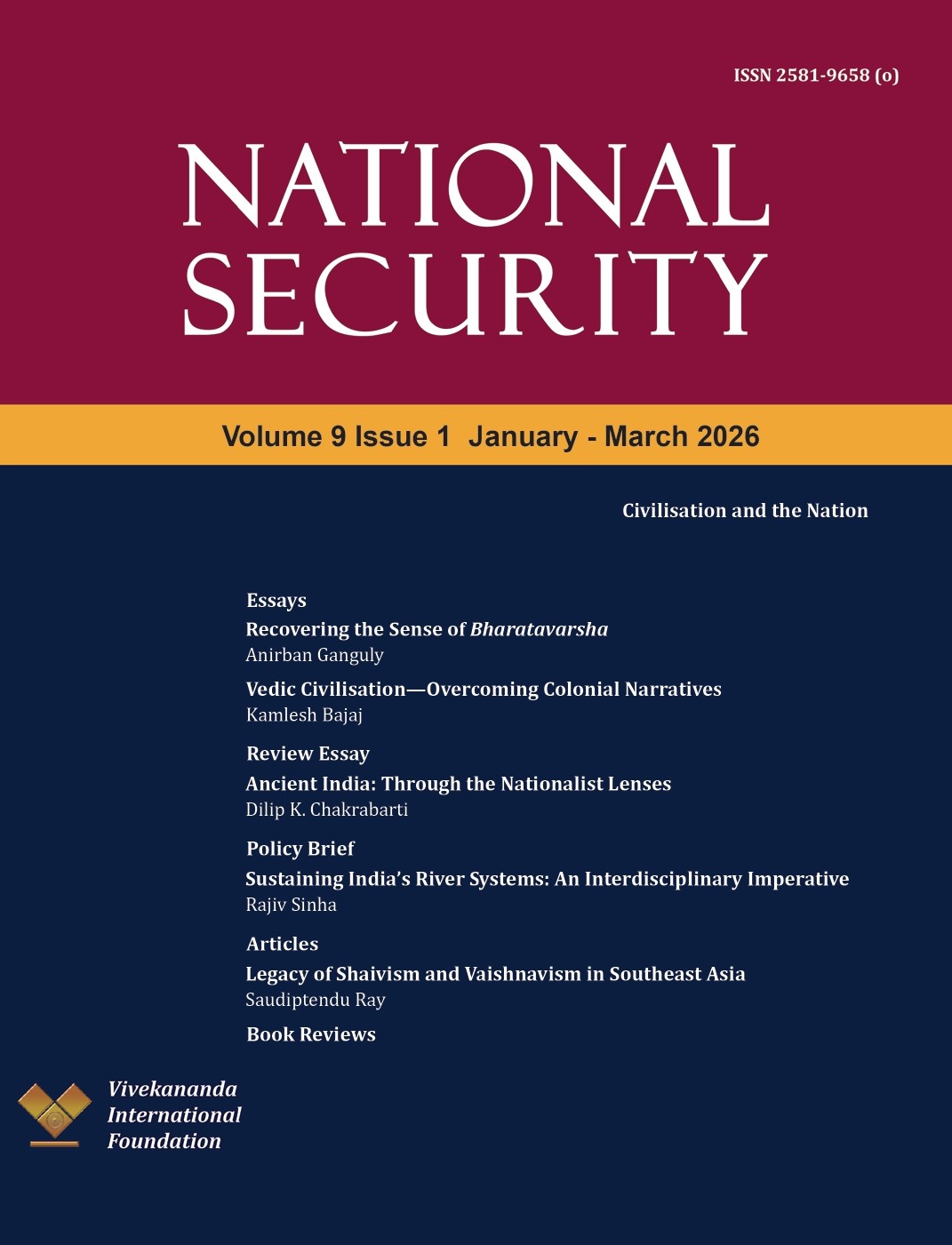
Recovering the Sense of Bharatavarsha
By: Anirban Ganguly
Page No : 1-14
Author
Dr. Anirban Ganguly is Chairman and Trustee of Dr. Syama Prasad Mookerjee Research Foundation (SPMRF), a New Delhi based think tank. Dr. Ganguly is a scholar of civilisation and history — especially, the history of India’s freedom movement and in it the early nationalist phase, of politics and culture. He has written extensively and continues to write on these subjects
DOI : http://doi.org/10.32381/NS.2026.09.01.1
Price: 101
Essay
Vedic Civilisation—Overcoming Colonial Narratives, Securing the Nation
By: Kamlesh Bajaj
Page No : 15-31
Author
Dr. Kamlesh Bajaj pioneered cyber security and data privacy in the government and industry for over two decades, both as the Founder Director, CERT-In, and Founder CEO, Data Security Council of India. His interest in ancient Indian history and Vedic heritage, and a critical reading of Nehru’s Discovery of India — a colonial narrative through the western lens, resulted in his book Discovering India through the Bharatiya Lens: Breaking the Colonial and Marxist Myth.
DOI : http://doi.org/10.32381/NS.2026.09.01.2
Price: 101
Essay
The Strait of Malacca: Through the Rise and Fall of Thalassocracies
By: Arunansh B. Goswami
Page No : 32-50
Abstract
The Malacca Strait has a long and intricate history of rivalry among maritime powers and continues to be of significant geopolitical and geoeconomic relevance. This strait serves as the most direct maritime route between the Middle East and East Asia, effectively minimising both transportation time and costs across this large geographical expanse. Approximately 60 percent of global maritime trade passes through this corridor. Both the United States and China have large trade, maritime and strategic interests around the Strait and have significant naval presence spanning the Indo-Pacific region. The Andaman and Nicobar Command (ANC), established in October 2001, with its headquarters in Port Blair, is India’s first integrated theatre command. It was formed to protect India’s strategic interests in Southeast Asia and the Strait of Malacca. This essay draws from the author’s research on Malacca and various regions of Malaysia, where he travelled and examined the historical context of the rivalry between rival major maritime powers in the region.
Author
Arunansh B. Goswami is a historian and lawyer residing in India. He is the head of the Scindia Research Centre, a think tank associated with the Scindia royal family of Gwalior, and also holds the position of Expert Fellow at the Orbeli Center, which is linked to the Government of Armenia. He has authored more than a hundred articles on law, history, and foreign policy.
DOI : http://doi.org/10.32381/NS.2026.09.01.3
Price: 101
Review Essay
Ancient India: Through the Nationalist Lenses
By: Dilip K. Chakrabarti
Page No : 51-65
Author
Dr. Dilip K. Chakrabarti is the Editor of VIF History Volumes. He is also the Emeritus Professor of South Asian Archaeology in the Department of Archaeology at Cambridge University. He is the first to hold a professorship in the field of ancient Indian history at that university.
DOI : http://doi.org/10.32381/NS.2026.09.01.4
Price: 101
Policy Brief
Sustaining India’s River Systems: An Interdisciplinary Imperative
By: Rajiv Sinha
Page No : 66-86
Author
Dr. Rajiv Sinha is a Professor at Department of Earth Sciences, Indian Institute of Technology Kanpur, India.
DOI : http://doi.org/10.32381/NS.2026.09.01.5
Price: 101
Article
India’s Prehistory and National Culture Policy
By: Ajay Pratap
Page No : 87-113
Abstract
This article provides a concise overview of key dimensions of prehistoric India and assesses their relevance to contemporary national cultural policy. Despite forming the deepest and most extensive phase of the subcontinent’s past, prehistory remains marginal in academic curricula and public heritage discourse. Indian prehistory spans the Pleistocene to the early Holocene and reflects exceptional ecological and cultural diversity shaped by repeated Quaternary climatic oscillations. Although fossil evidence is limited, this period witnessed the transition from Homo erectus to Homo sapiens and the dispersal of anatomically modern humans before and around 50,000 years ago. Archaeological evidence from regions such as the Narmada–Sone basins, the Thar Desert margins, the Hindukush, and western coastal India documents Acheulean, Middle, and Upper Palaeolithic occupations, including distinctive symbolic expressions. Holocene climatic shifts fostered dense Mesolithic settlements and gradual transitions to agriculture, sedentism, and technological innovation. Recognising this long-term cultural continuity is essential for informed heritage policy and public engagement.
Author
Ajay Pratap is a Professor (Retd.) at the Department of History, Faculty of Social Sciences, Banaras Hindu University, Varanasi.
DOI : http://doi.org/10.32381/NS.2026.09.01.6
Price: 101
Article
Legacy of Shaivism and Vaishnavism in Southeast Asia
By: Saudiptendu Ray
Page No : 114-140
Abstract
This article examines the deep and enduring influence of Shaivism and Vaishnavism across Southeast Asia from the early centuries of the Common Era to the medieval period. Drawing on archaeological, epigraphic, and literary evidence, it traces the transmission of Indic religious ideas through maritime trade networks across the Bay of Bengal. The article highlights a gradual assimilation in which Southeast Asian polities integrated elements of Indian religious traditions into existing animist and royal cults. The study emphasises the construction of monumental temples, localisation of Sanskrit epics, and development of syncretic forms such as the Harihara and Devaraja cults, while focusing on Myanmar, Thailand, Cambodia, Laos, Vietnam, and Indonesia. Architectural complexes such as Angkor Wat, Mỹ Sơn, Prambanan, Vat Phou, and Nathlaung Kyaung demonstrate how Shaiva Vaishnava cosmology shaped political ideology and sacred landscapes, forging a civilisational continuum between India and Southeast Asia.
Author
Saudiptendu Ray is a Research Associate at the Vivekananda International Foundation (VIF). His research focuses on India’s culture and civilisation. He has a master’s degree in Modern Indian History from the Faculty of Social Sciences at the University of Delhi and a master’s in Museology from the National Museum Institute, New Delhi.
DOI : http://doi.org/10.32381/NS.2026.09.01.7
Price: 101
Book Review
Indus Water Treaty—Interrupted
By: Arvind Gupta
Page No : 141-146
Author
Dr. Arvind Gupta is the Director of the Vivekananda International Foundation (VIF). He is a former diplomat and served as the Deputy National Security Advisor, Government of India (2014-17) and Director General of the Manohar Parrikar Institute for Defence Studies and Analyses (2012-2014), New Delhi
Price: 101
Book Review
Archaeologists of Independent India
By: Manjil Hazarika
Page No : 147-153
Author
Dr. Manjil Hazarika is an Assistant Professor at the Department of Archaeology, Cotton University, Guwahati.
Price: 101
Book Review
Understanding Indian Philosophical Traditions
By: Laxmikanta Padhi
Page No : 154-162
Author
Laxmikanta Padhi is Professor and former Head of the Department of Philosophy at the University of North Bengal in Siliguri. His teaching focuses on Applied Ethics, Bhāratiya Darṡana, Philosophy of Religion, Western Epistemology and Virtue Ethics. Currently, he is engaged in research on Itihāsa and Dharmaśāstra.
Price: 101
Jan- to Mar-2025
By: Arvind Gupta
Page No : i-iii
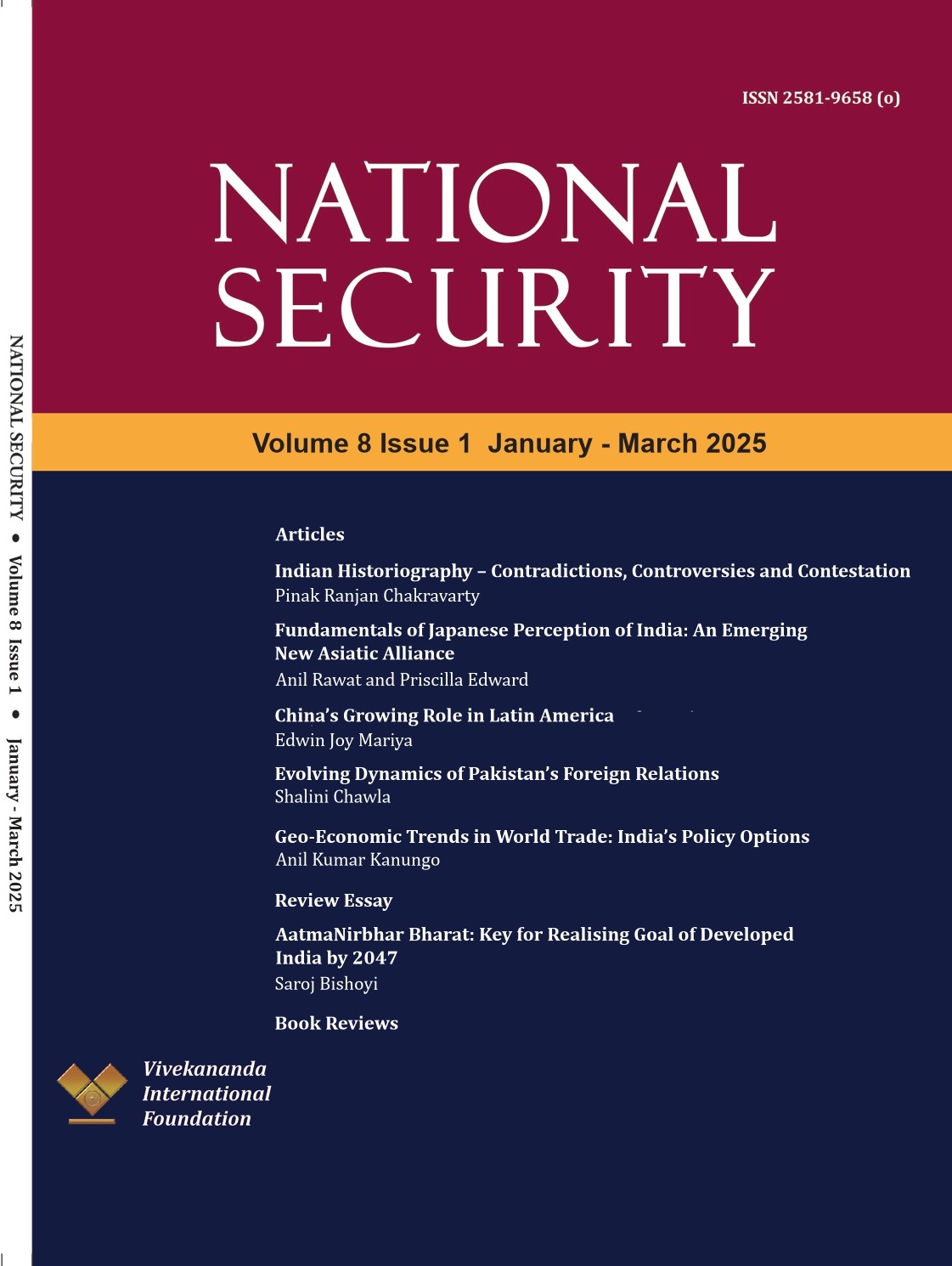
Indian Historiography – Contradictions, Controversies and Contestation
By: Pinak Ranjan Chakravarty
Page No : 1-13
Abstract
When history is written it inevitably has to deal with authenticity of sources, interpretation and ideological factors. Archaeological remains are the most authentic factual sources of history. India’s long history is a contested arena because of its ancient sources that are both a mix of facts and mythology. Muslim kings have left behind contemporary accounts by their court historians who also mixed up facts with eulogy, overlaid by religious zeal to subjugate a conquered people. The British brought their own brand of writing history from the European tradition, underpinned by their colonial mentality, prejudices and the imperative to dominate. Post-independent India witnessed a new debate on the new school textbooks which had ideological foundations. This led to a contest that continues to pit historians belonging to the Leftist-Marxist camp and those who are labelle Right-Wing. The debate, per se, is not unwelcome because it generates a better understanding of India’s history. In this article, these aspects of contestations have been discussed with this objective in mind.
Author :
Pinak Ranjan Chakravarty is a former diplomat who served as a Secretary in the Ministry of External Affairs. He was High Commissioner to Bangladesh and Ambassador to Thailand. He is a Visiting Fellow at the Observer Research Foundation and a founding Director of DeepStrat, a think tank.
DOI : http://doi.org/10.32381/NS.2025.08.01.1
An Overview of Indian Warfare: The Shaping of Indian History
By: Ajay Singh
Page No : 14-26
Abstract
The article covers an overview of Indian warfare and its most significant battles - including the battles of Kurukshetra, Tarain, the Three Battles of Panipat, Palash and others. The post-independence wars too have been covered in significant detail, especially the wars of 1962, 1965, 1971 and the Kargil war. The author aims to bring out the battles in the correct perspective — without embellishments— so that we can derive the right lessons from them and get a clear concept of the evolution of Indian warfare down the ages.
Author :
Col. Ajay Singh, a former Armoured Corps officer, is an international award-winning author who has written seven books and over 200 articles. He is a recipient of the Rabindranath Tagore International Award for Art and Literature.
DOI : http://doi.org/10.32381/NS.2025.08.01.2
Price: 101
Fundamentals of Japanese Perception of India: An Emerging New Asiatic Alliance
By: Anil Rawat , Priscilla Edward
Page No : 27-53
Abstract
Buddhism is considered to be the principal factor in the development of the India-Japan relationship. However, in our research, we have found that the Japanese perception of India has been more deeply influenced by the pre-Buddhist-Vedic civilisational value system since the Classical Period. A unique theoretical framework has been developed to explain this civilisational expansion and content of India-Japan relations, which eventually evolved into the “Tenjiku Conception” of India. “Tenjiku” was a cultural cognitive construct, comprising of those civilisational values that people imbibed in the early years of Japanese civilisation. The Japanese began to develop civilisational characteristics from the Yayoi Period and imbibed Indian Vedic values during their interactions with China. The kind of Buddhism adopted by the Japanese was enmeshed deeply within Vedic philosophical thought. Therefore, it may be more appropriate to describe it as “Brahmanical-Buddhism.” Furthermore, the Japanese found Indian spiritualism and attitudes towards nature very encouraging. The Vedic value system is attributed for the intimate relationship it nurtured among the Japanese people and their speedier expansion throughout Japan’s main islands. The core values of spiritualism and their analysis of nature provided decisive underpinnings of the “Tenjiku” Conception, which became the abiding basis of Japan’s perception of India.
Authors :
Dr. Anil Rawat is an academician, an institution builder and an edupreneur who has spent several years in Japan at the University of Tokyo and subsequently as Senior Fellow on Japan Foundation Fellowship at the Yokohama National University.
Priscilla Edward has double Masters - an Executive MBA and followed by a full time Post-Graduate Diploma in Business Management (MBA). Career wise she combines a very good experience of industry and academia. Being in academics also enabled her to pursue her passion for research. Along with her administrative work she also works as Associate Researcher.
DOI : http://doi.org/10.32381/NS.2025.08.01.3
Price: 101
China’s Growing Role in Latin America
By: Edwin Joy Mariya
Page No : 54-80
Abstract
There have been 220 foreign visits by Union Ministers between January 2020 and November 2023, but only six to Latin America and Caribbean (LAC) countries. Foreign visits by government delegations are one of the most visible manifestations of diplomacy that helped India to enhance its standing across the globe. That is why India should focus on enhancing its ties with LAC nations. Though India and LAC countries are similar in many ways and have great affinity, the former’s presence, apart from diaspora, is limited when compared to the Chinese presence in the region. In 2023, India’s trade with the LAC countries accounted for around USD 50 billion, whereas Chinese trade was USD 489 billion. So, how has the People’s Republic of China (PRC) become so influential in the LAC? Why is China so keen to enhance its grip in the Atlantic? What are the factors that have helped the PRC to develop its ties with the LAC countries?
That is why it has become essential to assess Chinese foreign policy. This article also analyses the economic and military presence of China in the LAC region vis-à-vis land, sea, air and space. In an emerging multipolar world, the LAC countries do not want to be squeezed in between the West and China. It is, therefore, important for their national interests to diversify their relations with other major powers. That is where India, the “Voice for the Global South”, can offer much.
Author :
Edwin Joy Mariya is an independent researcher. He has an MA in Political Science from Central University of Punjab, Bathinda, India (2019-2021) and another MA in International Relations from Newcastle University, Tyne and Wear,United Kingdom (2021-2022). His research interests include Realpolitik, International Relations, Balance of Power, BRICS, SCO, Indian Foreign Policy, Indo-Pacific, West Asia and National Security.
DOI : http://doi.org/10.32381/NS.2025.08.01.4
Price: 101
Evolving Dynamics of Pakistan’s Foreign Relations
By: Shalini Chawla
Page No : 81-94
Abstract
For decades, Pakistan has leveraged its geographic location and benefitted in the bargain with major powers and Muslim nations. Its association with the United States and China have helped its military to get modern military equipment and assistance, and achieve nuclear weapons capability. One of the most critical challenges for the newly elected regime of Prime Minister Shehbaz Sharif is to revive and strengthen Pakistan’s foreign relations, which suffered a blow during former Prime Minister Imran Khan’s tenure. There has been a decline in Pakistan’s strategic relevance owing to the US exit from Kabul in August 2021, and continued instability within Pakistan on varied fronts. Since Khan’s exit, Pakistan’s military and civilian leadership has been focused on strengthening its bilateral relations to support economic growth, attract investments, revive its strategic relevance and to continue to modernise its military. Pakistan seeks to derive both strategic and economic dividends by maintaining a delicate balance between Washington and Beijing.
Author :
Dr. Shalini Chawla is a Distinguished Fellow at the Centre for Air Power Studies (CAPS), New Delhi. She heads the Neighbourhood Studies Vertical at CAPS and has authored/edited seven books.
DOI : http://doi.org/10.32381/NS.2025.08.01.5
Price: 101
Geo-Economic Trends in World Trade: India’s Policy Options
By: Anil Kumar Kanungo
Page No : 95-119
Abstract
Since the onset of the Sino-US trade war, global economic integration has faced challenges increasingly. Disillusionment over uneven benefits of free trade, the fragility of highly specialised global supply chains following exposure to the COVID-19 pandemic and geo-political frictions heightening the advent of the war between Russia and Ukraine, have all contributed to an insecure and volatile world order. The global economy has been beset by multidimensional crises such as trade fragmentation, unilateral industrial policies, a reversal of multilateralism and threats to green transition. The world economy is witnessing new partnerships and alliances. Geo-economic trends are increasingly inward looking and not based on principles of multilateralism, or free and fair trade. The share of world trade has not significantly declined but if current trends continue, lesser economies risk being more marginalised. For India, stronger multilateralism remains its best bet, though it needs fresh policy options to cope with emerging challenges.
Author :
Anil Kumar Kanungo is a former Professor at the Indian Institute of Foreign Trade (IIFT), New Delhi, India.
DOI : http://doi.org/10.32381/NS.2025.08.01.6
Price: 101
Review Essay
AatmaNirbhar Bharat: Key for Realising Goal of Developed India by 2047
By: Saroj Bishoyi
Page No : 120-139
Abstract
India was once a pioneering contributor of ideas, products and services to the world, which were lost with the onset of colonial rule, and then, through the wrong policy decisions introduced and applied in India post-independence. Faced with several challenges arising out of the post-Covid era, that was a combination of health, economic and national security crisis, the AatmaNirbhar Bharat, a visionary initiative, was announced. It is an attempt to rediscover India’s intrinsic strengths and capabilities, and rekindle the lost pride of what India was once. In this setting, this review essay provides the context, definition and origin of the concept AatmaNirbhar Bharat. It analyses the significance of making India AatmaNirbhar in critical sectors amid the evolving geopolitical landscape and shifts in the global distribution of power, influence and resources. Highlighting major challenges and policy recommendations, the author argues that AatmaNirbhar Bharat is key for achieving the goal of developed India by 2047.
Author :
Dr. Saroj Bishoyi is a Research Fellow with the Centre for Technology and Scientific Studies, Vivekananda International Foundation (VIF), New Delhi. His research at VIF focuses on India’s capabilities and capacities in technology and international technology cooperation. His areas of research also focus on USA, India-US Strategic Partnership and Indo-Pacific.
Price: 101
Book Review
How India can Assist Africa?
By: Dammu Ravi
Page No : 140-144
Author
Dammu Ravi is a serving Indian Foreign Service officer.
Price: 101
Book Review
India's New Economic Diplomacy
By: Purnima M. Gupta
Page No : 145-148
Author
Purnima M. Gupta is a Former Economic Adviser, Central Electricity Authority, Ministry of Power, Government of India.
Price: 101
Apr- to Jun-2025
By: Arvind Gupta
Page No : i-iii
Essay
Opportunities and Challenges in India-US Relations Under Trump 2.0
By: Arun K. Singh
Page No : 149-154
Author:
Arun K. Singh is a former Ambassador to US, France and Israel. He is also a former member of India’s National Security Advisory Board. Currently he is a Visiting Faculty at Ashoka University and a Distinguished Fellow at the Vivekananda International Foundation (VIF).
DOI : http://doi.org/10.32381/NS.2025.08.02.1
Essay
Russia-US Relations Under Trump 2.0
By: Arvind Gupta
Page No : 155-164
Author:
Dr. Arvind Gupta is the Director of the Vivekananda International Foundation (VIF). He is a former diplomat and served as the Deputy National Security Advisor, Government of India (2014-17) and Director General of the Manohar Parrikar Institute for Defence Studies and Analyses (2012-2014), New Delhi.
DOI : http://doi.org/10.32381/NS.2025.08.02.2
Price: 101
Essay
US-India Technology and Industrial Collaboration: Possibilities Under Trump 2.0
By: Mukesh Aghi
Page No : 165-170
Author:
Dr. Mukesh Aghi is the President and CEO of the US-India Strategic Partnership Forum (USISPF), and is based out of Washington, DC.
DOI : http://doi.org/10.32381/NS.2025.08.02.3
Price: 101
Essay
Structuring India-US Economic Cooperation for a Technological Era
By: Sanjay Chadha
Page No : 171-180
Author:
Sanjay Chadha is a former Additional Secretary at the Ministry of Commerce and Industry, Government of India. He has also served as Chairman and CEO of MMTC Limited.
DOI : http://doi.org/10.32381/NS.2025.08.02.4
Price: 101
By: Anil Trigunayat
Page No : 181-189
Author:
Ambassador Anil Trigunayat is a Distinguished Fellow at the Vivekananda International Foundation (VIF), New Delhi. He is a former Ambassador of India to Jordan and Libya, and former High Commissioner to Malta. He is affiliated with several esteemed diplomatic and academic institutions such as Honorary Member of the International Trade Council, Brussels.
DOI : http://doi.org/10.32381/NS.2025.08.02.5
Price: 101
Article
India’s Approach to the Ukraine Conflict
By: Asoke Mukerji
Page No : 190-205
Abstract
India’s response to the Ukraine conflict, asserting the primary role of diplomacy and dialogue to ensure that this is “not an era of war”, is directly related to India’s goal of becoming a developed country by 2047 (Viksit Bharat). In systemic terms, the Ukraine conflict has illustrated the ineffectiveness of existing regional and multilateral treaty bodies, such as the OSCE and UNSC, in ensuring peace and security through diplomacy. Such conflicts have encouraged a process of international fragmentation driven by the unilateral use of military and economic measures. The effective resolution of ongoing conflicts requires proactive diplomatic initiatives by India for a major review of multilateralism. The three Voice of the Global South Summits convened by India since 2023 have endorsed the call for “reformed multilateralism”, prioritising a “human-centric” approach. This must be the focus of convening a UN General Conference marking the 80th anniversary of the UN in 2025.
Author
Asoke Mukerji is a Distinguished Fellow of the Vivekananda International Foundation (VIF), New Delhi. He is a former Ambassador of India to the United Nations in New York.
DOI : http://doi.org/10.32381/NS.2025.08.02.6
Price: 101
Article
Adaptation or Resistance? China-United States Relations Under Trump 2.0
By: Srikanth Kondapalli
Page No : 206-228
Abstract
The inauguration of Donald Trump as the 47th President of the United States on January 20, 2025 has major implications for bilateral relations with China, besides other countries. Both are the world’s largest economies, UN Security Council members, nuclear powers and have heft in regional and global orders. Four decades of “engagement cooperation” policies since President Richard Nixon’s visit in 1972 led to a consensus on the rise of China, stability in Taiwan Straits and nullifying Soviet challenge. While the US wants to retain its primacy, China announced in 2017 that it wants to occupy the “centre stage” leading to the “Thucydides Trap” – and acknowledged by both sides. It permeates bilateral relations, given the perception that China is “catching up” and “surpassing” the US’ comprehensive national power.
Trump’s first term witnessed tariff frictions on a major scale for the first time in bilateral relations, in addition to continuing tensions in the Taiwan Straits, the South China Sea, Indo-Pacific, the Global Commons and other areas. Trump rechristened the Asia-Pacific as Indo-Pacific in November 2017, triggering the revival of the QUAD. President Biden’s responses included “decoupling”, “small yard, high fence”, sanctions on Chinese companies and banning semi-conductor sales as well as continuing with levelling of tariffs. Trump 2.0 is expected to upend relations with China, barring the latter’s investments in the US and other tactical adjustments. It is argued in this article that while several similarities exist in mutual responses for the past decade, Trump 2.0 is poised to restructure bilateral relations further between the US and China with high stakes involved for both parties. By reflecting on issues such as diplomacy, trade and tariffs, Taiwan, technology, nuclear, Indo-Pacific and other issues, we argue that China is likely to resist the US on several of these issues.
Author:
Srikanth Kondapalli is a Professor in Chinese Studies at the Jawaharlal Nehru University (JNU), New Delhi. He was former Dean of School of International Studies, JNU from 2022-24. He was the Chairman of the Centre for East Asian Studies, SIS, JNU from 2008-10, 2012-14, 2016-18, 2018-20 and in 2022. He is Chair Professor under the Chair of Excellence of Ministry of Defence since August 2022. He learnt Chinese language at Beijing Language & Culture University and was a post-Doctoral Visiting Fellow at People’s University, Beijing from 1996-98.
DOI : http://doi.org/10.32381/NS.2025.08.02.7
Price: 101
Article
Tracing the Trajectory of Transatlantic Ties: Dealing with Trump 2.0
By: Shreya Sinha
Page No : 229-246
Abstract
Trump 2.0 is seen as Europe’s biggest challenge with a potential to cause an upheaval across the Atlantic, while radically revisiting the transatlantic stance on support for Ukraine and engagement with NATO, European economy and trade issues, the China factor and diplomatic engagement. This paper attempts to trace the trajectory of transatlantic relations while critically assessing Trump’s hyperbolic nationalism and its implications for Europe. The first part of this paper examines its impact on the European security architecture while discussing the ramifications on Ukrainian security in light of the Russia-Ukraine war, Trump’s potential withdrawal from NATO and the weakening of transatlantic security cooperation. The second part of the paper maps Europe’s economic apocalypse in light of Trump’s tariffs and the great power competition between the United States and China. The third part of the paper critically analyses Trump’s global diplomacy and the European Union’s need for strengthening its strategic autonomy.
Author:
Dr. Shreya Sinha is an Associate Fellow at Vivekananda International Foundation, New Delhi. She holds a PhD from the Centre for European Studies, SIS, JNU. She was previously a guest lecturer at the Department of Political Science, St. Stephen's College and a DAAD Scholar at the Otto-Suhr-Institut für Politikwissenschaft, Freie Universität Berlin, Germany.
DOI : http://doi.org/10.32381/NS.2025.08.02.8
Price: 101
Article
US-Japan Relations Under Trump 2.0
By: Prerna Gandhi
Page No : 247-258
Abstract
The US-Japan alliance has evolved beyond its traditional bilateral security framework to encompass regional and global strategic cooperation. Since the 2015 revision of defense guidelines, Japan has assumed a more proactive security role, deepening trilateral partnerships with South Korea and the Philippines while engaging in AUKUS-related defense initiatives. Under a second Trump administration, Japan faces increased pressure to expand its defense contributions, enhance counterstrike capabilities, and assume greater financial responsibility for the alliance. However, Trump's transactional approach and protectionist economic policies could strain economic ties, particularly in trade and technology cooperation. Meanwhile, Japan must navigate growing tensions with China, balancing deterrence with economic interdependence. The shifting US approach to alliances, NATO, and multilateral economic frameworks under Trump may compel Japan to diversify its partnerships with Europe and the Indo-Pacific.
Author:
Prerna Gandhi is an Associate Fellow at the Vivekananda International Foundation (VIF), New Delhi. She holds an M.Phil in Japanese Studies and an MA in East Asian studies. Her research focuses on East Asian Affairs, particularly Japan's strategic and security policies.
DOI : http://doi.org/10.32381/NS.2025.08.02.9
Price: 101
Article
Assessing Modi-Trump Summit in Washington
By: Chintamani Mahapatra
Page No : 259-270
Abstract
Prime Minister Narendra Modi visited Washington, D.C., in February 2025, weeks after the inauguration of President Donald Trump as the 47th President of the United States, to hold a summit level meeting with him. It was for the first time that any Indian leader could be the official guest in the White House within weeks of the beginning of a new administration. Two issues that prominently surfaced to affect Indo-US relations after Donald Trump’s election victory were India’s tariff rates and illegal immigrants from India. Prime Minister Modi went to Washington with a message that India had already reduced tariff rates on a host of goods exported by the US. During the summit, he also stated that India would receive all verified Indian immigrants who had been illegally staying in the United States. Nonetheless, the mercurial American President appeared provocative on occasions, while Modi deftly dealt with the issues.
Author:
Chintamani Mahapatra is the Founder Chairperson of Kalinga Institute of Indo-Pacific Studies and Editor, India Quarterly. He is also a former Professor at the Jawaharlal Nehru University (JNU), New Delhi.
DOI : http://doi.org/10.32381/NS.2025.08.02.10
Price: 101
Jul- to Sep-2025
Editor’s Note
India-US Ties: Trust Eroded, Uncertainty Ahead
By: Sujit Dutta
Page No : i-vi
By: Raghvendra Singh
Page No : 271-283
Author
Raghvendra Singh is a Senior Fellow at the Vivekananda International Foundation (VIF). He is a leading historian on the Partition and the British policies on Jammu and Kashmir, Baluchistan, and Pakistan. He is a former Secretary in the Ministry of Culture with extensive work on restoration and designing of museums and archives.
DOI : http://doi.org/10.32381/NS.2025.08.03.1
Essay
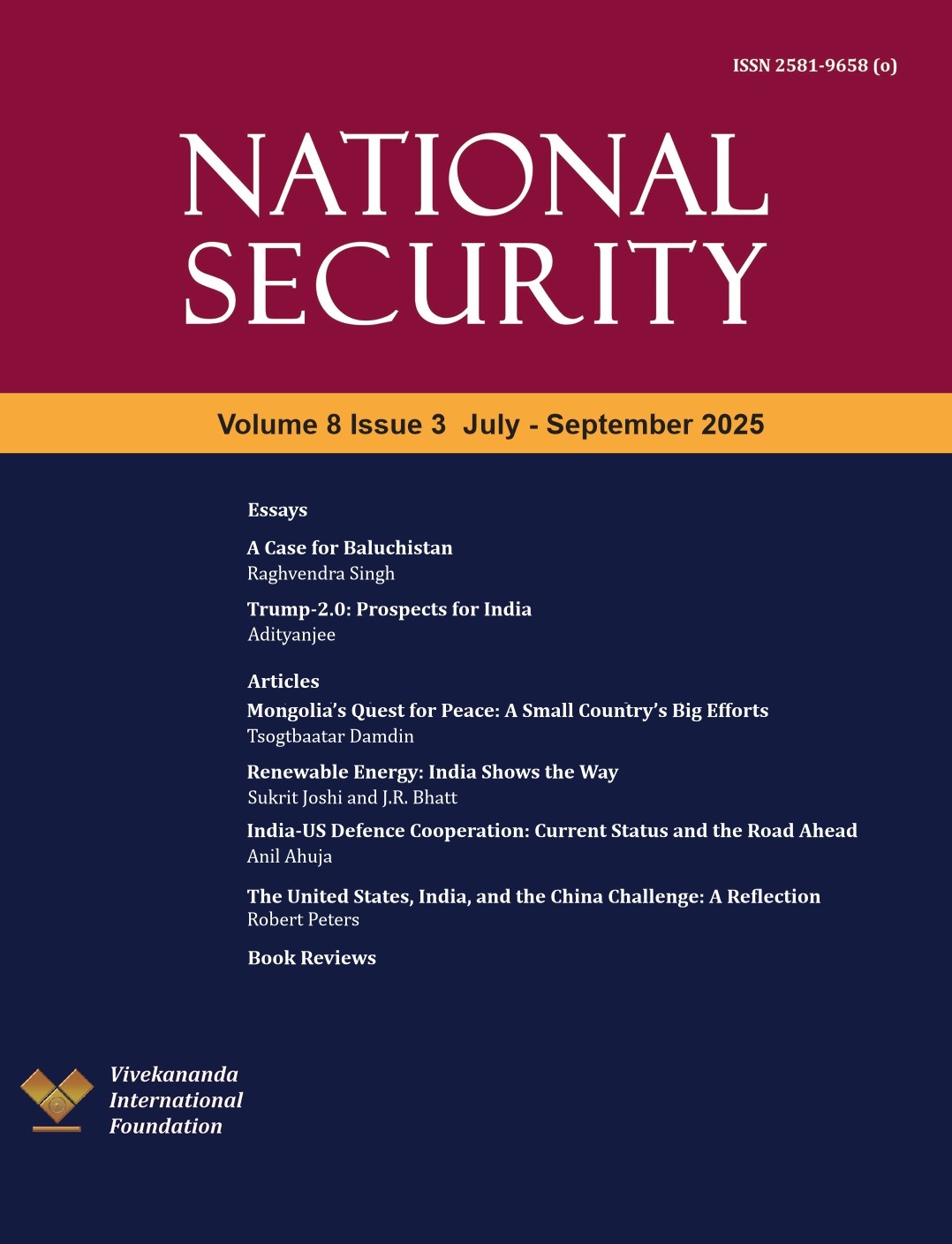
Trump-2.0: Prospects for India
By: Adityanjee
Page No : 284-300
Author
Dr. Adityanjee is the President of the Council for Strategic Affairs, a think tank based in Washington D.C., United States.
DOI : http://doi.org/10.32381/NS.2025.08.03.2
Price: 101
Essay
Rebuilding the European Order
By: Almut Möller
Page No : 301-308
Author
Almut Möller is the Director for European Union and Global Affairs at the European Policy Centre (EPC), Brussels.
DOI : http://doi.org/10.32381/NS.2025.08.03.3
Price: 101
Article
Mongolia’s Quest for Peace: A Small Country’s Big Efforts
By: Tsogtbaatar Damdin
Page No : 309-337
Abstract
This article brings a new perspective on the historical events that overwhelmed Mongolia in the early 20th century, and the eventual re-emergence of the nation. By analysing the intra-national and historical developments vis-à-vis the international processes, it argues that what has been identified up to these days as the ‘people’s revolution’ in the country should be accurately called a ‘national liberation movement’. Such a changed approach has far-reaching ramifications even today. The author explores the role of a small nation in the larger political games of global powers and emphasises that both bigger and smaller actors should be aware of their roles in the formation of a world order. This is especially relevant for peace-building today. The paper highlights Mongolian peace efforts and their impact on the broader region. Finally, the article elaborates the power of faith in propagating peace. Buddhism, as the foundation of Mongolian culture, has never fully lost its influence in the country. Even under communist rule Buddhist values stayed and exercised their subliminal influence. This was discernible in the Mongolian pro-peace and disarmament initiatives at that time. With the collapse of communism the survived religion not only began to flourish but also started feeding the Buddhist urge for global peace and harmony. The paper underlines the power of compassion deeply embedded in the philosophies of all major religions, which makes them vital for realising the growing global aspirations for peace.
Author
Mr. Tsogtbaatar Damdin, Ambassador Extraordinary and Plenipotentiary, is a Member of the Mongolian Parliament. A seasoned diplomat and politician, he has held key ministerial portfolios including Minister for the Nature, Environment and Tourism (2012) and Minister for Construction and Urban Development (2014-2015) and Minister for Foreign Affairs (2017-2020).
DOI : http://doi.org/10.32381/NS.2025.08.03.4
Article
Renewable Energy: India Shows the Way
By: Sukrit Joshi , J.R. Bhatt
Page No : 338-358
Abstract
The article discusses India’s national strategy for energy security by examining the extent of its dependence on a reliable and stable fossil fuel basket. India clearly needs a steady, equitable and a just transition to renewable energy sources. As the global community grapples with climate change impacts and an imminent need to transition to low carbon economy pathway, India is pursuing all possible combinations of a balanced energy mix that is reliable, affordable and sustainable for its 1.4 billion people. The article also discusses the nuances associated with global just transition concepts, models of regional cooperation for sharing electricity and the envisioned revision of India’s Nationally Determined Contributions. The article concludes by suggesting that India has pulled far more than its fair share in mitigation centric efforts and adaptation must now be its priority and concern.
Authors
Sukrit Joshi is a former Research Assistant at Research and Information System for Developing Countries – RIS, New Delhi.
J. R. Bhatt is the Distinguished Fellow in an honorary capacity at Vivekananda International Foundation, Research and Information System for Developing Countries, New Delhi and National Institute of Advanced Studies, Bangalore; formerly Scientist at the Ministry of Environment, Forest and Climate Change, Government of India.
DOI : http://doi.org/10.32381/NS.2025.08.03.5
Price: 101
Article
India-US Defence Cooperation: Current Status and the Road Ahead
By: Anil Ahuja
Page No : 359-375
Abstract
This paper reviews the trajectory of India-US defence cooperation under the strategic partnership forged over the last two decades. Efforts to deepen defence engagement during the last stages of the Obama 2.0 Presidency were sustained and, intensified during Trump 1.0. The Biden administration maintained the positive trend by shifting focus from a Pentagon-led engagement to one steered by the US State Department, placing emphasis on defence industrial cooperation and emerging technologies. Concerns, however, continue to prevail over the lack of substantial technology collaboration yet. Early indications suggest that the Trump Administration is highly transactional and unpredictable. The course of foreign policy towards China is yet to emerge clearly. This uncertainty suggests the need for India to “manage” this long-nurtured relationship, particularly in the field of defence, while reinvigorating efforts towards building its own capabilities and maintaining multiple issue-based relationships. Key drivers of the collaboration with the US include the mutual goal of countering Chinese belligerence against India and in the Indo-Pacific, complementing India's capability development efforts and bilateral efforts to maintain a technological edge. For the US, securing favourable access to Indian markets, including in defence, seems a key driver currently. Keeping defence and security relations insulated from other areas of dissonance (and turbulence) and maintaining a partnership of “trust” is crucial.
Author
Lt. Gen. Anil Ahuja (Retd.) is a Distinguished Fellow at the Vivekananda International Foundation (VIF). He is a former Corps Commander and Deputy Chief of Integrated Defence Staff for Policy Planning and Force Development. He has been the Co-Chair of India – US Inter Agency Task Force on Defence Technology and Trade Initiative (DTTI). He has also served as India’s Defence Attaché to Vietnam, Cambodia and Laos.
DOI : http://doi.org/10.32381/NS.2025.08.03.6
Price: 101
Article
Indo-US Defence Technology Cooperation: The Road Travelled and the Possible Future
By: Vikas Khitha
Page No : 376-387
Author
Vikas Khitha serves as Vice President and Head at the Precision Engineering & Systems business of Larsen & Toubro Limited, where he is responsible for the activities of the Corporate Office at New Delhi and International Relations. He is a B.Tech in Mechanical Engineering with over 37 years of work experience in India and abroad, in the domains of high technology manufacturing, power sector and infrastructure development projects. The views in this article are his personal views and do not reflect Government or organisational policy.
DOI : http://doi.org/10.32381/NS.2025.08.03.7
Price: 101
Article
The United States, India, and the China Challenge: A Reflection
By: Robert Peters
Page No : 388-399
Abstract
The United States and India share a common threat from China. Building upon the February 2025 visit to Washington by Prime Minister Modi, there are a number of avenues the United States and India can take in both broadening and deepening their defense relationship. This includes: loosening foreign military sales restrictions; improving licensing and co-production arrangements; and exercises. Specifically this article examines how both nations can 1) meet the China challenge in multiple domains; 2) develop areas for co-production and foreign military sales to benefit both nations’ militaries and defence industrial bases; and 3) develop a road-map for long-term cooperation between both nations that will better enable Delhi and Washington to counter the threats posed by Beijing.
Author
Robert Peters is the Senior Research Fellow for Strategic Deterrence at the Heritage Foundation. He served for 17 years in the Department of Defense and has written widely on various defense topics.
DOI : http://doi.org/10.32381/NS.2025.08.03.8
Price: 101
Book Review
Navigating Diplomatic Crosswinds: India’s Role in Cold War Geopolitics
By: Joseph N. Sanate
Page No : 400-405
Author
Dr. Joseph N. Sanate is a Research Associate at the Vivekananda International Foundation (VIF). He received his doctoral degree from the Center for Canadian, US & Latin American Studies, Jawaharlal Nehru University, New Delhi. The subjects he mainly focuses on are US domestic politics, the impact of race and ethnicity in America’s domestic and foreign affairs, US foreign policy, and India-US relations.
Price: 101
Book Review
State building and Peripherisation: Insights on India from Latin America
By: Aprajita Kashyap
Page No : 406-412
Author
Dr. Aprajita Kashyap is an Assistant Professor in the Latin American Studies Programme at the Centre for Canadian, US & Latin American Studies, School of International Studies (SIS), Jawaharlal Nehru University (JNU), New Delhi.
Price: 101
Oct- to Dec-2025
Editorial Note
The UN at 80: Mixed Legacy, Future Uncertain
By: Sujit Dutta
Page No : i-vii
Price: 251
Essay
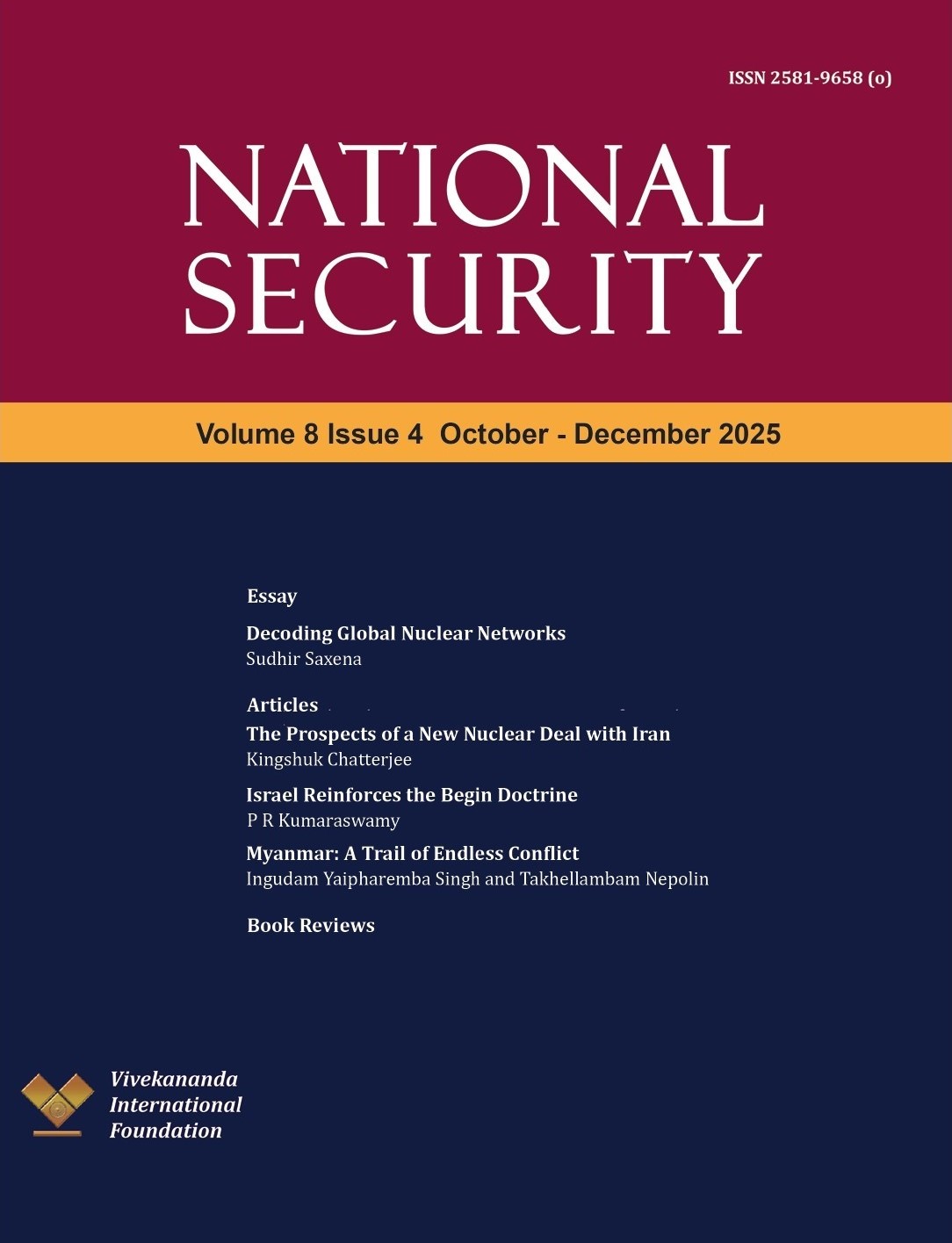
Decoding Global Nuclear Networks
By: Sudhir Saxena
Page No : 413-429
Author:
Prof. Sudhir Saxena is a Senior Fellow at the Vivekananda International Foundation (VIF) and a Visiting Faculty at the Indian Institute of Technology (IIT) Kanpur. He has served in National Security institutions, including the Institute for Defence Studies and Analysis, New Delhi. He specialises in Data/Signals Fusion and Analysis.
DOI : http://doi.org/10.32381/NS.2025.08.04.1
Price: 251
Article
The Prospects of a New Nuclear Deal with Iran
By: Kingshuk Chatterjee
Page No : 430-450
Abstract
Few phases in the Islamic Republic of Iran’s relationship with the United States has resembled a roller-coaster more than the six months since Donald Trump returned to the White House for his second term. Moving from talks on Iran’s nuclear programme, through air-strikes against Iranian nuclear installations, to offers for resumption of nuclear talks, including proposals for nuclear collaboration and American investment in the Iranian economy, the pace was dizzying. Having played hard-ball in his first term,Trump had surprised many by offering direct talks with the Iranians soon after assuming office. Tehran responded with alacrity, going through five rounds of talks and was poised on the sixth when Israel carried out military strikes on Iran on June 13. Until then the optimists were hoping the talks would not only result in a deal with Iran but would also bring about a reset of US-Iran relations. The sceptics did not believe there would even be a deal and considered themselves vindicated by the Twelve Day War between Israel and Iran, which culminated in US attacks on Fordow, Arak and Esfahan, and a measured and well-choreographed retaliation by Tehran on al-Udeid air base in Doha. The article looks at the trajectory of US-Iran relations, with closer attention to the Iranian nuclear programme. The article then looks at how joint Israeli and US attacks on Iran may have impacted on the prospective nuclear deal and the prospects of a reset that Trump appeared to have been keen on.
Author:
Dr. Kingshuk Chatterjee is a Professor in the Department of History, University of Calcutta. He specialises in the study of political developments in Iran.
DOI : http://doi.org/10.32381/NS.2025.08.04.2
Price: 251
Article
Israel Reinforces the Begin Doctrine
By: P. R. Kumaraswamy
Page No : 451-465
Abstract:
The 12-day Israel-Iran conflict underscored and reiterated Israel’s traditional position vis-à-vis the proliferation activities of its adversaries. Overwhelmed by conventional asymmetry, Israel has evolved a dual strategic approach. While maintaining an opaque nuclear posture, it has been assertive in destroying, preventing or delaying the nuclear activities of its adversaries. Formally ushered by Prime Minister Menachem Begin against Iraq in 1981, Israel had adopted a proactive preventive strategy—commonly known as the Begin Doctrine—vis à-vis Syria and later on the Islamic Republic of Iran. The June conflict was also part of Israeli efforts to target Iran over its support for various proxies in the region, including Hamas, Hezbollah and Houthis, which were undermining Israel’s regional interests. Sharing strategic interests with the US and Arab powers resulted in them adopting a dual approach towards the Israel-Iran conflict; public disapproval accompanied by private understanding and support.
Authors:
P R Kumaraswamy teaches contemporary Middle East at Jawaharlal Nehru University, New Delhi.
DOI : http://doi.org/10.32381/NS.2025.08.04.3
Price: 251
Article
Myanmar: A Trail of Endless Conflict
By: Ingudam Yaipharemba Singh , Takhellambam Nepolin
Page No : 466-487
Abstract:
A brutal civil war has raged in Myanmar for over four years since the military overthrew the elected government. Thousands of young Myanmarese joined an armed rebellion against the junta. Urban guerrillas and Generation Z, composed primarily of city youth, staged a ferocious form of resistance. During the revolution, young people took up arms to fight as a People’s Defence Force. Ethnic insurgents, having decades of combat experience, even trained and guided some of the newly formed youth battalions. However, the reality of war can be devastating; it destroys the future of many. This study explores Myanmar’s complex struggle in the context of changing geopolitics. While the junta has called for elections in the country on December 28 this year, given the bitter legacy of coups, repression, many deaths and continuous fighting, Myanmar’s return to democracy will be both challenging and complex. In a deeply fractured country, violence and conflict are likely to persist, especially in ethnic strongholds, where a bid will be made to capture power, and the minds of the people. It is difficult to envision the possibility of the military relinquishing its hold on political power any time soon.
Authors:
Dr. Ingudam Yaipharemba Singh is an Assistant Professor and Head at the Department of National Security Studies, Manipur University.
Takhellambam Nepolin is a Research Scholar, Department of National Security Studies, Manipur University
DOI : http://doi.org/10.32381/NS.2025.08.04.4
Price: 251
Book Review
Transforming India’s Military
By: Arvind Gupta
Page No : 488-492
Author:
Dr. Arvind Gupta is the Director of the Vivekananda International Foundation (VIF). He is a former diplomat and served as the Deputy National Security Advisor, Government of India (2014-17) and Director General of the Manohar Parrikar Institute for Defence Studies and Analyses (2012-2014), New Delhi.
Price: 251
Book Review
Understanding the Jaish-e-Mohammed
By: Anurag Sharma
Page No : 493-497
Author:
Anurag Sharma is an Associate Fellow for Counter-Terrorism and Cyber Security Studies at the Vivekananda International Foundation (VIF). His research focuses on terrorism, cybersecurity, organised crime and violent extremism.
Price: 251
Book Review
Arcs of Ambition: Redefining India’s New Era Choices
By: Saroj Bishoyi
Page No : 498-505
Author:
Dr. Saroj Bishoyi is a Senior Fellow at the Vivekananda International Foundation (VIF), New Delhi. His research focuses on India’s technological capabilities and international technology cooperation.
Price: 251
Book Review :
Digital Surveillance in China and Its Citizens
By: Prerna Gandhi
Page No : 506-512
Author:
Prerna Gandhi is an Associate Fellow at the Vivekananda International Foundation (VIF), New Delhi. She holds an M.Phil in Japanese Studies and an MA in East Asian studies. Her research focuses on East Asian Affairs.
Price: 251
Jan- to Mar-2024
Editor's Note
A Turbulent Global Transition and India’s Strategic Options
By: Sujit Dutta
Page No : i-v
Six Global Transitions and an Opportunity for India
By: Rajiv Kumar , Ishan Joshi
Page No : 1-11
Authors :
Rajiv Kumar : Rajiv Kumar is Chairman of the Pahle India Foundation, New Delhi, and former Vice Chairman, NITI Aayog.
Ishan Joshi : Ishan Joshi is Senior Fellow at the Pahle India Foundation, New Delhi.
Price: 101
The Role of the United States in a World in Crisis
By: Arun K. Singh
Page No : 12-20
Author : Ambassador Arun K. Singh is a Distinguished Fellow at the Vivekananda International Foundation (VIF), New Delhi. He is also a Distinguished Non-Resident Senior Fellow at the Asia Program of the German Marshall Fund of the United States, Washington DC; Senior Fellow at Carnegie India and a Visiting Professor at Ashoka University. He was India’s Ambassador to the United States in 2015-16, France in 2013-15 and Israel in 2005-08.
Price: 101
Addressing the Crisis in Global Governance
By: Asoke Mukerji
Page No : 21-31
Author : Ambassador Asoke Mukerji is a Distinguished Fellow with the Vivekananda International Foundation (VIF), New Delhi. He was India’s Permanent Representative to the United Nations in New York from 2013-2015.
Price: 101
Navigating the Turbulent World as a Civilisational State
By: Arvind Gupta
Page No : 32-39
Author : Dr. Arvind Gupta is the Director of the Vivekananda International Foundation (VIF). He served as the Deputy National Security Advisor, Government of India from 2014 to 2017 and is also former Director of the Manohar Parrikar Institute for Defence Studies and Analyses, New Delhi.
Price: 101
Towards a Grand Strategy for India in an Era of Global Instability
By: D. B. Venkatesh Varma
Page No : 40-51
Author : Ambassador D. B. Venkatesh Varma is a Distinguished Fellow with the Vivekananda International Foundation (VIF). He is a former Ambassador to Russia, Spain, and the Conference on Disarmament.
Military Aspects of the Emerging World Order
By: Gautam Banerjee
Page No : 52-66
Author : Lieutenant General (Retd.) Gautam Banerjee, PVSM, AVSM, YSM, is Senior Fellow and Editor with the Vivekananda International Foundation (VIF). During his career in the Indian Army, he was Chief of Staff, Central Command and Commandant of the Officers’ Training Academy, Chennai.
Price: 101
Managing the Sun to Manage Global Warming?
By: J. R. Bhatt
Page No : 67-72
Author : Dr. J. R. Bhatt is Distinguished Fellow at the Vivekananda International Foundation (VIF) and at the Research and Information System for Developing Countries (RIS), New Delhi. He is an internationally known expert on Climate Change.
Price: 101
Book Review
Governing Energy and Environment for India’s National Security
By: Purnima M. Gupta
Page No : 73-77
Author : Purnima M. Gupta is a Former Economic Adviser, Central Electricity Authority, Ministry of Power, Government of India.
Price: 101
Apr- to Jun-2024
Editor's Note
India’s Precarious Periphery
By: Sujit Dutta
Page No : i-vii
Caught in a Bind: Iran in the Wake of the Gaza Conflict
By: Kingshuk Chatterjee
Page No : 79-97
Abstract
Tehran’s influence in the Middle East has continued to rise with the outbreak of Israel’s war on Gaza. However, even as Tehran advances, it appears to be caught in a bind. While its biggest regional adversary is veritably tied down by the limits of its ethnocratic state system, the Islamic Republic of Iran too appears to have reached the limits of asymmetric warfare with the increasing danger that it may be sucked into a bigger regional conflict. This article argues that the overt manifestation of the shadow warfare which Tehran and Tel Aviv had been waging for the last several years has potentially made the neighbourhood far more dangerous than before. The Gaza conflict has pushed Iran, as much as Israel, into a bind. Iran risks being drawn into a regional war, neutralising all the advantages gained so far, and one that might even endanger its regime security. The article also assesses where India fits in this tense stand-off between its two partners in a period of instability and conflict.
Author:
Kingshuk Chatterjee : Dr. Kingshuk Chatterjee is a Professor in the Department of History, University of Calcutta. He specialises in the study of political developments in Iran.
DOI : http://doi.org/10.32381/NS.2024.07.02.1
Price: 101
Domestic Politics and Foreign Policy of the Maldives: Implications for India
By: Gulbin Sultana
Page No : 98-116
Abstract
The introduction of multi-party democracy in Maldives in 2008 has provided its citizens the much-awaited political freedom, and voice to freely express their views on matters of domestic as well as foreign affairs. A multi-party system has also emerged with differing ideological postures. Consequently, one can observe a rise in partisan approach to various foreign policy issues in the post-2008 Maldives. The impact of this change has been felt in the India-Maldives bilateral relations. Friendly relations between the two countries received a setback with the anti-India sentiment and the “India Out” campaign, which can be attributed more to internal political dynamics than genuine ideological differences or hostilities with India. Deterioration of the special relations, enjoyed by the two countries, can have far-reaching implications, particularly for the Maldives. The article, therefore, argues that India should acknowledge and feel confident about its own strength, and address concerns in the bilateral relations through dialogue and engagement with all the stakeholders in Maldives rather than adopting reactive measures.
Author
Gulbin Sultana : Dr. Gulbin Sultana is an Associate Fellow with the South Asia Centre in the Manohar Parrikar Institute for Defence Studies and Analyses (MP-IDSA), New Delhi.
DOI : http://doi.org/10.32381/NS.2024.07.02.2
Price: 101
Enduring Political Unrest in Pakistan: Implications for India
By: Ashish Shukla
Page No : 117-131
Abstract
Barring brief periods of relative calm and stability, Pakistan remains in a perpetual crisis. One can attribute the situation to a number of factors, including a fragile society sticking to a faulty social contract, existence of a hybrid polity, a governing system dominated by an omnipotent security establishment, and a compliant judiciary often ready to fall in line during a crisis. As a result, Pakistan finds itself in the midst of an enduring political crisis. Instead of putting an end to the political deadlock, the recently concluded election has actually made the situation more complicated. The Shehbaz Sharif government is too weak to deal with the multifaceted crisis in the country. If the situation persists, there can be adverse consequences for peace and stability in the region.
Author
Ashish Shukla : Dr. Ashish Shukla is Associate Fellow in the South Asia Centre at the Manohar Parrikar Institute for Defence Studies and Analyses (MP-IDSA), New Delhi.
DOI : http://doi.org/10.32381/NS.2024.07.02.3
Price: 101
Book Reviews
Rebonding India and Nepal
By: Arvind Gupta
Page No : 132-137
Author
Arvind Gupta : Dr. Arvind Gupta is the Director of the Vivekananda International Foundation (VIF). He is a former diplomat and served as the Deputy National Security Advisor, Government of India (2014-17) and Director General of the Manohar Parrikar Institute for Defence Studies and Analyses (2012-2014), New Delhi.
Price: 101
A Diplomat’s Insight into Evolving India-Bangladesh Relations
By: Anchita Borthakur
Page No : 138-143
Author
Anchita Borthakur : Dr. Anchita Borthakur is a Research Associate at Vivekananda International Foundation (VIF). She has received her PhD from Jawaharlal Nehru University (JNU), New Delhi.
Price: 101
The Uneasy Gateway: India, Myanmar, and the Challenges of a Shifting Landscape
By: Cchavi Vasisht
Page No : 144-151
Author
Cchavi Vasisht : Dr. Cchavi Vasisht has been a Research Associate at Vivekananda International Foundation (VIF). She has a PhD from the Centre for South Asian Studies, School of International Studies, Jawaharlal Nehru University (JNU), New Delhi.
Price: 101
Jul- to Sep-2024
Editor’s Note
Coping with a Fragmenting World Order
By: Sujit Dutta
Page No : i-v
Essay
Bharat@100: The Way Ahead
By: Ishan Joshi , Rajiv Kumar
Page No : 153-166
Author
Ishan Joshi : Ishan Joshi is Director (Programs) and Senior Fellow, Pahle India Foundation, New Delhi.
Rajiv Kumar : Rajiv Kumar is an eminent Economist and Chairman, Pahle India Foundation.
Price: 101
Essay
Prioritising Trade Negotiations for Transforming India
By: J.S. Deepak
Page No : 167-179
Author
J.S. Deepak : J.S. Deepak is Former Secretary, Telecom & IT, Government of India, and Former Ambassador of India to the World Trade Organization (WTO).
Price: 101
Essay
Strategic Maritime Trade: Lessons not Learnt from History
By: Anil L. Devli
Page No : 180-192
Abstract
Container shipping is essential for global commerce, accounting for over 80 percent of merchandise by volume. It has revolutionised trade, enabling efficient logistics and rapid globalisation. India's economic growth and its aspiration to become a global manufacturing hub hinge on its ability to efficiently ship goods worldwide. Container shipping supports India's import-export activities,generates employment, and drives investment in infrastructure, which is crucial for maintaining domestic supply chains and fostering regional economic integration. The article emphasises the historical and strategic dimensions of maritime trade. It traces the evolution of maritime warfare and illustrates how maritime strategies have been used to disrupt enemy economies without direct military engagement. India's container shipping capacities grew substantially with investment and policy support until 2017. However, a policy change in 2018 diluted licensing requirements for foreign ships, leading to a decline in Indian container fleet investment and increased dependency on foreign shipping companies. The document highlights the significant profits of major container shipping companies, their minimal tax contributions, and their successful tax planning strategies, which exempt them from the global minimum tax. There is an urgent need for India to develop its container shipping capacities, reduce dependency on foreign companies, ensure competitive export-import logistics,and enhance its strategic and economic security.
Author
Anil L. Devli : Anil L. Devli is the Chief Executive Officer of the Indian National Shipowners’ Association (INSA).
Essay
Geo-Economics of Titanium and India’s Industrial Future
By: Arun B. Kumar
Page No : 193-200
Author
Arun B. Kumar : Arun B. Kumar is an accomplished marketing leader with over 22 years of experience in Marketing Strategy and Business Development. He is currently the Deputy General Manager at the Kerala Minerals and Metals Ltd.
Price: 101
Article
India and the Geo-Economics of Critical Minerals
By: PK Khup Hangzo
Page No : 201-211
Abstract
Critical minerals such as copper, lithium, nickel, cobalt, and rare earth elements are vital for high-technology and high-growth sectors. They include, among others, consumer electronics (smart phones, laptops, tablets etc.), clean energy (wind turbines, solar panels, electric vehicles etc.), and defence (jet engines, sonar, radar, surveillance systems etc.). However, critical minerals face the risk of disruption of their supply chains due to growing contestation among the world’s major powers. Any supply disruption could have adverse security impact. It is imperative that India undertake concerted effort to build more diverse and resilient supply chains by developing domestic critical mineral resources, acquiring overseas mining assets, enhancing multilateral co-operation, and exploring new frontiers. Such a multifaceted approach offers the surest way to ensure India’s economic and energy security.
Author
PK Khup Hangzo : PK Khup Hangzo is Associate Fellow at the Vivekananda International Foundation (VIF). His area of research is environment, climate change and national security. Prior to joining VIF, he was a Research Analyst and then an Associate Research Fellow at the Centre for Non-Traditional Security (NTS) Studies, S. Rajaratnam School of International Studies (RSIS), Nanyang Technological University (NTU), Singapore.
DOI : http://doi.org/10.32381/NS.2024.07.03.1
Price: 101
Article
US Elections 2024: Polarisation, Key Issues and Impact on the World
By: K. P. Vijayalakshmi
Page No : 213-236
Abstract
The 2024 US Presidential Election is a pivotal political event that will shape the country's future direction. The election of the Republican candidate Donald Trump could have wide implications for both US domestic politics and foreign policy, especially its alliances. The deep politico-ideological rift between the Democrats and the Republicans, the “Reagan Republicans” and the traditional conservatives, and between the leftwing ‘progressives’ and mainstream Democrats has polarised the country with voters divided over political, economic, social, cultural and foreign policy issues. The exit of President Biden from the election and the swift consolidation of the Democrats behind the new nominee, Vice President Kamala Harris, revitalised the campaign against former President Trump and sharpened the deep-rooted differences between the two on most issues, including foreign policy. While Harris seemed inclined to continue the major policies of the Biden Administration, both domestic and foreign, Trump emphasised higher protectionism to ‘Make America Great Again’, ending illegal immigration, ending the Russia-Ukraine conflict, strong support for Israel, and robustly dealing with the China threat. It is expected that the bipartisan focus on strengthening US-India relations will continue. Trump’s victory is likely to reshape US engagement with its allies and adversaries alike.
Author
K. P. Vijayalakshmi : K. P. Vijayalakshmi is Professor and Head, Department of Geopolitics and International Relations, Manipal Academy of Higher Education (MAHE) Karnataka.
DOI : http://doi.org/10.32381/NS.2024.07.03.2
Price: 101
Oct- to Dec-2024
Editor’s Note
Whither Bangladesh?
By: Arvind Gupta
Page No : i-ii
Essay
The Geo-Strategics of Regime Change in Bangladesh
By: Veena Sikri
Page No : 237-250
Author
Veena Sikri is a former High Commissioner of India to Bangladesh. She is also the Convener of South Asia Women's Network (SWAN), New Delhi.
DOI : http://doi.org/10.32381/NS.2024.07.04.1
Essay
Bangladesh: Violent Regime Change and Power Shift
By: Pinak Ranjan Chakravarty
Page No : 251-272
Author
Pinak Ranjan Chakravarty is a former diplomat. He served as Secretary in the Ministry of External Affairs, earlier as the Deputy High Commissioner and later as High Commissioner to Bangladesh.
DOI : http://doi.org/10.32381/NS.2024.07.04.2
Price: 101
Essay
The Bangladesh Upheaval and an Uncertain Future
By: Sujit Dutta
Page No : 273-287
Author
Sujit Dutta is the Editor of National Security journal and a Distinguished Fellow of the Vivekananda International Foundation (VIF). He was Professor of Peace and Conflict Studies at the Jamia Millia Islamia, Central University, New Delhi, and held the M K Gandhi Chair in peace studies. He was earlier a Senior Fellow at the Institute of Defence Studies and Analyses, New Delhi.
DOI : http://doi.org/10.32381/NS.2024.07.04.3
Price: 101
Essay
An Unsettling Feeling of Déjà Vu: Nehru-Liaquat Pact and Shyama Prasad Mukherjee
By: Raghvendra Singh
Page No : 288-298
Author
Raghvendra Singh is a Senior Fellow with the Vivekananda International Foundation (VIF). A member of the Indian Administrative Service, he has headed the National Archives, the Nehru Memorial Museum and Library and the National Library. He was Secretary Culture and Textiles in the Government of India and has worked extensively in the sector of Museology.
DOI : http://doi.org/10.32381/NS.2024.07.04.4
Price: 101
Essay
Deconstructing Islamist Influence in Bangladeshi Politics and Society
By: Shantanu Mukharji
Page No : 299-315
Author
Shantanu Mukharji is a former senior Indian Police Service (IPS) officer. He is currently a Security Analyst and Adviser with NatStrat, New Delhi. NatStrat is an independent centre for research on strategic and security issues.
DOI : http://doi.org/10.32381/NS.2024.07.04.5
Price: 101
By: Saudiptendu Ray
Page No : 316-341
Abstract
The events in Bangladesh between June and August 2024 exposed vulnerabilities in its democratic institutions. A student-led protest against an outdated quota system turned into a violent movement once it was hijacked by radical Islamists who were backed by external forces. This resulted in the ouster of Sheikh Hasina and further destabilised Bangladesh. The crisis revealed the strategic interventionism of the United States, employing economic power, diplomatic pressure, media manipulation, and covert operations to influence regime change. This interference, driven by broader geopolitical priorities like countering China and monitoring India, prioritised the United States interests over Bangladesh’s sovereignty. The rise of Muhammad Yunus as Chief Adviser, supported by the United States elites, underscored external manipulation. Tragically, communal violence, particularly against Hindus, who are a minority in Bangladesh, worsened with time due to inadequate global response. The crisis underscores the dangerous interplay of domestic instability and foreign intervention.
Author
Saudiptendu Ray is a Research Associate at the Vivekananda International Foundation (VIF). His research focuses on India’s culture and civilisation. He has a master’s degree in Modern Indian History from the Faculty of Social Sciences at the University of Delhi and a master’s in Museology from the National Museum Institute, New Delhi.
DOI : http://doi.org/10.32381/NS.2024.07.04.6
Price: 101
Speech
Persecution of Hindus in Bangladesh
By: Satish Chandra
Page No : 342-347
Author
Satish Chandra, is the Vice Chairman of the board of trustees of the Vivekananda International Foundation and a former Deputy National Security Advisor.
DOI : http://doi.org/10.32381/NS.2024.07.04.7
Price: 101
Book Review
Designing Policies for Vikasit Bharat
By: V. Srinivas
Page No : 348-350
Author
V. Srinivas serves as Secretary to Government of India, Department of Administrative Reforms and Public Grievances, Department of Pension and Pensioners Welfare. He is also the Director General of National Centre for Good Governance, Government of India.
Price: 101
Biography
Rise, Fall and Re-rise of Dr. Muhammad Yunus
By: Anchita Borthakur
Page No : 351-363
Abstract
Dr. Muhammad Yunus is a Bangladeshi economist, entrepreneur, politician, and civil society leader, who has been serving as the Chief Adviser of the Interim Government of Bangladesh since August 8, 2024. Yunus is widely recognised for his pioneering work in microfinance and for founding the Grameen Bank in Bangladesh. He gained fame for his efforts to combat poverty and empower marginalised communities, particularly women, by offering access to small loans. However, his political journey in Bangladesh has been marked by a series of notable rises, setbacks, and comebacks. His political involvement has sparked intense debate, controversy, and public attention, highlighting his lasting influence and the complex relationship he has had with Bangladesh’s previous political establishment. Therefore, this biography explores the trajectory of Muhammad Yunus’s involvement in Bangladeshi politics, from his early rise as an economic and social reformer to his entry into active politics, followed by his decline and eventual resurgence as a political figure.
Author
Dr. Anchita Borthakur is a Research Associate at the Vivekananda International Foundation (VIF). She has completed her PhD from Jawaharlal Nehru University (JNU), New Delhi.
Price: 101
Jan- to Mar-2023
Editor's Note
Engaging a Troubled Neighbourhood
By: Sujit Dutta
Page No : i-viii
Essay
Xi's Foreign Policy Options and Evolving Strategy
By: Pankaj Saran
Page No : 1-12
Author :
Ambassador Pankaj Saran is a former Deputy National Security Advisor and Convenor at the NatStrat—a Delhi-based think-tank.
Organisational Restructuring for Defence Planning and Capability Acquisition
By: Amit Cowshish
Page No : 13-24
Abstract
The enduring asymmetry between India’s military capabilities vis-à-vis its adversaries is a matter of concern. The widely held view that it is largely because of the politico-bureaucratic apathy, which manifests itself in the continuing absence of a National Security Strategy (NSS) as the basis for defence planning and inadequate budgetary allocations, needs revaluation. The situation has not changed despite the government having set up a high-level Defence Planning Committee (DPC) in 2018 to inter alia draft the NSS. The budgetary allocations also continue to fall short of the requirement projected by the armed forces. This paper broadly explores these two issues and argues that there is a need to consider the desirability of setting up a 24x7 Defence Planning Board for financially viable defence planning and a bespoke Defence Capability Acquisition Organisation, both of which have been recommended in the past by committees constituted by the Ministry of Defence itself.
Author : Amit Cowshish was an officer of the Indian Defence Accounts Services and a former Financial Advisor (Acquisition). He is currently a Distinguished Fellow at the Vivekananda International Foundation (VIF).
DOI : http://doi.org/10.32381/NS.2023.06.01.1
Price: 101
Regional Cooperation to Preserve the Himalayan System
By: Shailesh Nayak
Page No : 25-45
Abstract
The Himalaya is a unique ecological system and millions of people depend on its rivers for water, food and energy. It has distinctive biodiversity with a variety of high altitude vascular plants, grasslands, birds, etc. The Himalaya is under stress due to natural hazards such as earthquakes, landslides, floods, glacial lake outburst floods, climate change impacts such as the retreat of glaciers, and changes in precipitation patterns. Besides, anthropogenic activities related to infrastructure development, urbanisation, tourism, etc., also affect the Himalayan system. Defencerelated activities by China, Pakistan and India have placed additional pressure on the Himalayan ecology. The geological, cryospheric, hydrological and atmospheric processes and their interaction need to be modeled for the preservation of the Himalayan ecosystem. The formation of the Himalayan Science Council (HSC) is a positive step but it needs to set up monitoring systems for observing/measuring geological, hydrological, cryospheric, atmospheric and biological phenomena. Collaboration between research institutes of the Himalayan nations is a critical necessity.
Author :
Dr. Shailesh Nayak is the Director of National Institute of Advanced Studies (NIAS), Bengaluru, Karnataka.
DOI : http://doi.org/10.32381/NS.2023.06.01.2
Price: 101
Dealing with the New Taliban Regime in Afghanistan
By: J. Jeganaathan
Page No : 46-68
Abstract
The absence of a democratically elected government, the poor state of law and order and the many restrictions and violations of basic rights, especially those of women, under Taliban rule in Afghanistan are developments of deep concern. Moreover, the increasing tension along the Durand line with Pakistan, and the challenge posed by the Islamic State-Khorasan to the Taliban have made the security situation precarious. This paper examines the emerging strategic and security trends in Afghanistan in the post-Taliban takeover period. Should India engage with the Taliban regime so that it can influence its decisions, provide aid to its needy, and limit the security impact for the region, especially on Jammu and Kashmir? What would be the fallout if the Taliban regime is recognised and its relationship with the international community is formalised?
Author :
Dr. J. Jeganaathan is a Senior Assistant Professor and Head of the Department of National Security Studies, School of National Security Studies at the Central University of Jammu in Jammu & Kashmir.
DOI : http://doi.org/10.32381/NS.2022.06.01.3
Price: 101
Geo-Economics of India's Trade with its South Asian Neighbours
By: Nikita Singla
Page No : 69-92
Abstract
India’s global ambitions are intricately linked to its growth as a leading nation as well as its regional influence. Brimming with opportunity yet equally troubled by challenges deep-rooted in its vast expanses, history and extra-regional geopolitics, cooperation in South Asia has proved to be a predicament as unique as the region itself. It is argued that South Asia’s performance in terms of socioeconomic indicators depends to a large extent on India’s geo-economics, and hence, this essay focuses on the use of trade policy in the geo-economics of India with its neighbours. On one hand, trade and investment figures indicate India’s position as the gravitational core in South Asia has weakened. On the other hand, it is doing more than ever under the aegis of the “Neighbourhood First” and the “Act East” policy to strengthen connectivity infrastructure at the sub-regional level, given the sombre achievements of the SAARC region as a whole in strengthening regional economic ties. The essay makes pointed recommendations for effective regionalism amongst the South Asian nations.
Author :
Nikita Singla is Associate Director at the New Delhi-based Bureau of Research on Industry and Economic Fundamentals (BRIEF).
DOI : http://doi.org/10.32381/NS.2023.06.01.4
Price: 101
Book Review
India's Development Diplomacy in Africa-Through Western Lenses
By: Samir Bhattacharya
Page No : 93-103
Price: 101
Apr- to Jun-2023
Editor’s Note
The Crisis of Multilateralism
By: Sujit Dutta
Page No : i-iv
Essay
The Retreat of Multilateralism
By: P.S. Raghavan
Page No : 105-113
Author :
Ambassador P. S. Raghavan is a former Indian diplomat. He is currently the Chairman of the National Security Advisory Board (NSAB) and a Distinguished Fellow at the Vivekananda International Foundation (VIF).
Essay
Reforming Multilateral Institutions in the 21st Century: India's Agenda
By: Lakshmi Puri
Page No : 114-123
Author :
Ambassador Lakshmi Puri is a former Indian Foreign Service officer. She was Former Assistant Secretary General, United Nations and Acting Deputy Secretary General, UNCTAD.
Price: 101
The Political Framework of "Reformed Multilateralism"
By: Asoke Mukerji
Page No : 124-140
Abstract
The United Nations Charter specifies the primary objectives of the multilateral system as prevention of war, securing fundamental human rights, and promoting social progress and better standards of life. Yet, the UN has been unable to implement these objectives in a holistic manner. As a result, calls for “reformed multilateralism” with a “human-centric” focus have become widespread. The changed political realities of the world need to be integrated into the UN Charter to make multilateralism “fit-for-purpose” in the 21st century. India is among the leading proponents of “reformed multilateralism” and wants the system to reflect today’s realities and needs. The UN, however, is hampered by deep divisions. On one side the entrenched “permanent members” of the UN Security Council refuse to agree to any change in the status quo. On the other are the majority of UN member-states, mainly developing countries that have invested in multilateralism to ensure the implementation of a “human-centric” Agenda 2030 on Sustainable Development. The advocates of “reformed multilateralism” need an action plan by 2025, when the UN marks its 80th anniversary, to achieve their objective.
Author :
Ambassador (Retd.) Asoke Mukerji, a Distinguished Fellow of the Vivekananda International Foundation, was India’s Permanent Representative to the United Nations in New York (2013-2015) and oversaw India’s participation in the successful negotiation of Agenda 2030 on Sustainable Development.
DOI : http://doi.org/10.32381/NS.2023.06.02.1
Strengthening Collective Action on Climate Change in South Asia
By: PK Khup Hangzo
Page No : 141-158
Abstract
Countries in South Asia are active participants in global multilateral processes aimed at addressing climate change, the United Nations Framework Convention on Climate Change (UNFCCC) in particular. As part of their commitments to the UNFCCC process, these countries have set out national targets for greenhouse gas emission reduction and decarbonisation. However, there is as yet a lack of collective efforts at the regional level. Given South Asia’s vulnerability to climate change, the region has a lot to gain by carving out a regional approach to address its multi-faceted impacts. Reviving a neglected regional agenda such as climate change can help address the inevitable cross-border environmental as well as humanitarian crises and reset the much needed regional multilateralism in the process.
Author :
PK Khup Hangzo is an Associate Fellow at the Vivekananda International Foundation (VIF) specialising in climate change and national security. He is the lead coordinator of the Climate Change Expert Group at VIF that deliberates on the impact of climate change on India. He has a Master’s degree in Strategic Studies from the S. Rajaratnam School of International Studies (RSIS), Nanyang Technological University (NTU), Singapore.
DOI : http://doi.org/10.32381/NS.2023.06.02.2
Price: 101
Decoding Xi Jinping's 3.0 Team: Changes in Political and Military Leadership
By: Kota Mallikarjuna Gupta
Page No : 159-192
Abstract
Political leaderships and their networks are influential and impactful in the decision-making process of societies worldwide. The role of the top political leaders is even more significant in authoritarian systems/single-party states like China. Absolute political power without resistance or opposition helps with quick decisions and policy formulations/alternations by government agencies. The competition to acquire power and position can be peaceful or fierce and depends on the capacities of individuals/institutions. This attempt to capture power, institutions and position among the elites of the Communist Party in China happens every five years during the Party Congress. Many factors determine the outcome of the fierce competition for power and positions in the Communist Party during the Party Congress. This fierce competition to acquire power influences ideological leanings, loyalty, political networks and governance models. The debate on the issues of consent, consensus and justice in the distribution/redistribution of power and positions in authoritarian regimes is tricky to conclude. Chinese Politics are like the ‘Great Wall of China’, where construction materials change based on geographical conditions. Chinese politics are also like the ancient Chinese board game of Wei qi, where the priority is to capture more territory over others.
Author :
Kota Mallikarjuna Gupta is a former Research Associate at the Vivekananda International Foundation (VIF).
DOI : http://doi.org/10.32381/NS.2023.06.02.3
Price: 101
Book Review
The Decline of American Influence in the Middle East
By: Hirak J. Das
Page No : 193-207
Author :
Hirak Jyoti Das is a Senior Research Associate at the Vivekananda International Foundation (VIF) and a doctoral candidate at the Centre for West Asian Studies, Jawaharlal Nehru University, New Delhi. His research interests cover India’s Relations with the Gulf states, Domestic Politics & Foreign Policies of these states, and Islamic movements in West Asia and North Africa.
Price: 101
Book Release
Indian Armed Forces at the Centenary of Independence
By: Gautam Banerjee Ed.
Page No : 208-210
Price: 101
Jul- to Sep-2023
Editor’s Note
Revitalising India's Knowledge System
By: Sujit Dutta
Page No : i-vii
Essay
Ayurveda: India’s Neglected Treasure-Box
By: Prasad M
Page No : 211-223
Author :
Dr. Prasad M is the Director and Chief physician at the Sunethri Ayurvedashram Thrissur, Kerala. He received an intensive training in the philosophy and basic principles of Ayurveda from his Guru Padmabhushan Vaidyabhushanam K. Raghavan Thirumulpad. He served as the Principal of an Ayurveda college for five years. With 27 years of clinical experience, he developed an ayurvedic protocol for the management of autism spectrum disorder. Currently he is serving as GURU for CRAV programme of Rashtriya Ayurveda Vidyapeeth, New Delhi.
Price: 101
Essay
Idea of Data and the Virtual World: A National Security Perspective
By: Devsena Mishra
Page No : 224-234
Author :
Devsena Mishra is an expert on advanced technologies, startup ecosystem, and the Indian government’s business and technology-related initiatives. She writes on technology and India’s security.
Price: 101
The Indian Holistic Vision of Lifelong Learning
By: T. V. Muralivallabhan
Page No : 235-251
Abstract
The universal principles and practice of any branch of knowledge carries the stamp of the place and time of its origin. Ancient India is the mother of many branches of knowledge. Even the social system that existed here was helpful in attaining information, knowledge, wisdom and enlightenment. The four stages of life and four levels of education were cordially connected to frame a sustainable social system. The Apara Vidya and the Para Vidya that existed in India were holistic and multi-disciplinary in nature. All the problems that have cropped up in the modern period of science and technology could be mitigated to a great extent by using the spirit of the ancient Indian system of education.
Author :
Dr. T. V. Muralivallabhan is the Director of Marian Institute of Management, Kuttikkanam, Kerala. He is a former Independent Director of the Public Sector MSTC, Kolkata, and former Principal of NSS college, Vazhoor, Kottayam, Kerala.
DOI : http://doi.org/10.32381/NS.2023.06.03.1
Price: 101
Swami Vivekananda, Hindu Dharma and ‘Social Ethics’ in the Nineteenth Century
By: Harshvardhan Tripathy
Page No : 252-282
Abstract
In nineteenth-century colonial India, Hindu Dharma was attacked by colonial machinery and Christian missionaries for lacking social ethics and morality,with an understanding that Christianity had an ‘inherent and timeless’ social ethic and was concerned with the social upliftment of the poor. This paradigm to criticise Hinduism was also extended to criticise those Hindu intellectuals, especially Swami Vivekananda, who were deliberating over the question of ethics and morality, intending to make Hindu Dharma an agent of social change.These developments in Hindu Dharma were criticised as an outcome of or reaction to Christian social ethics and thereby were declared inauthentic in both colonial and post-colonial periods. By historicising and contextualising the concept of Christian social ethics and morality, this paper debunks the propaganda that concern for the poor and the marginalised was an ‘inherent and timeless’ feature of Christianity.
Author :
Harshvardhan Tripathy is a doctoral candidate at the School of Social Sciences, Jawaharlal Nehru University (JNU), New Delhi, India. His research topic is “The Ramakrishna Math and Mission: Explorations into a ‘Modern’ Religious Movement.
DOI : http://doi.org/10.32381/NS.2023.06.03.2
Review Essay
India’s Knowledge Footprints in the World
By: Arpita Mitra
Page No : 283-294
Author :
Dr. Arpita Mitra is an Assistant Professor, Department of History at the Kazi Nazrul University, Asansol, West Bengal. She is a former Fellow at the Vivekananda International Foundation, New Delhi, where she worked on the history and civilisation of India.
Price: 101
Book Review
The Ancient Roots of Indian Science
By: Arvind Gupta
Page No : 295-298
Author :
Dr. Arvind Gupta is the Director of the Vivekananda International Foundation. He served as the Deputy National Security Advisor, Government of India from 2014 to 2017 and is also former Director of the Institute of Defence Studies and Analyses, New Delhi.
Price: 101
Oct- to Dec-2023
Editor’s Note
Navigating an Uncertain World
By: ..
Page No : i-iv
Essay
Israel and Hamas War 2023: Lessons for India
By: Rakesh Sharma
Page No : 211-219
Author :
Lieutenant General (Retd.) Rakesh Sharma, Ph.D, is currently a Distinguished Fellow with the Vivekananda International Foundation (VIF). He was commissioned in Gorkha Rifles in 1977, and has had a career spanning forty years in the Army.
Essay
Russia’s Foreign Policy Concept 2023
By: Arvind Gupta
Page No : 220-234
Author :
Dr. Arvind Gupta is the Director of the Vivekananda International Foundation (VIF). He served as the Deputy National Security Advisor, Government of India from 2014 to 2017 and is also former Director of the Manohar Parrikar Institute for Defence Studies and Analyses, New Delhi.
Price: 101
Article
India and the Artemis Accords: Need to Tread Cautiously
By: Ajey Lele
Page No : 235-251
Abstract
The Artemis Accords refer to a non-binding multilateral arrangement on use of space led by the US and signed onto by several governments. These accords have established a framework of principles, guidelines, and best practices to ensure peaceful space exploration in a transparent manner. India signed the Artemis Accords in June 2023. India becoming a part of these accords is viewed as an important step towards expanding the Indo-US strategic partnership further. However, these accords are in conflict with the concept of Common Heritage of Mankind (CHM). The final aim of the Artemis Programme is to facilitate the outreach of humans to the Moon and Mars. Some provisions in these accords are at variance with the existing norms building process in the space domain. This article identifies the limitations of these accords and argues that as a signatory nation, India needs to remain watchful and ensure that its strategic and commercial interests are well protected.
Author :
Dr. Ajey Lele works as a consultant with Manohar Parrikar Institute for Defence Studies and Analyses (MP-IDSA), New Delhi. His area of research includes strategic technologies and space security. Views expressed over here are personal.
DOI : http://doi.org/10.32381/NS.2023.06.04.1
Price: 101
Article
India and Latin America: Potential Partners in a Changing World
By: Priti Singh
Page No : 252-268
Abstract
India’s relations with Latin America and the Caribbean (LAC) have seen an effective change in the last few years. The change reflects the ‘energetic’ foreign policy of India and its increasing dynamism in global politics. The Latin American and the Caribbean region, so far overlooked by India, is increasingly becoming one of the focal points of its various foreign policy overtures. This article draws attention to the growing significance of the Latin American region for India both in terms of resources and a political-diplomatic partnership. Given the recent setbacks of the pandemic, followed by the Ukraine war and the rising tensions between the United States and China, Latin American countries are looking for strategic partners without aligning themselves with any power. While India has growing relations with some LAC countries and has signed several strategic partnerships, it needs to engage with the region much more. Several economic factors favour an increased engagement. Positive perceptions about India in the region also help.
Author :
Priti Singh is Associate Professor and Chairperson at the Centre for Canadian, US & Latin American Studies, School of International Studies, Jawaharlal Nehru University (JNU), New Delhi.
DOI : http://doi.org/10.32381/NS.2023.06.04.2
Price: 101
Article
US Policy Dilemmas in the Indo-Pacific
By: Chintamani Mahapatra
Page No : 269-282
Abstract
The Biden Administration in the United States is confronted with an acute dilemma in dealing with the rise of China as an assertive, aggressive and ambitious power in the global order. It seeks to preserve the economic benefits of maintaining good relations with China, yet is uncomfortable with the spread of Chinese influence across the world. This policy dilemma is not new for the US foreign policymakers and there are several instances of Washington’s dilemma in dealing with China in the post-World War II period. As the existing superpower United States and aspiring superpower China struggle to manage their relationship, the dilemmas faced by the US are likely to continue deep into the future. The complex interdependence marked by trade and investment relations, complex geopolitical imperatives and the need to prevent conflict escalation makes it difficult for Washington and Beijing to escape policy dilemmas.
Author :
Chintamani Mahapatra is the Founding Chairperson at the Kalinga Institute of Indo-Pacific Studies and a former Professor of Jawaharlal Nehru University (JNU), New Delhi.
DOI : http://doi.org/10.32381/NS.2023.06.04.3
Price: 101
Article
When Realpolitik Triumphs over Uyghur Rights in Xinjiang
By: Sarada Subhash
Page No : 283-310
Abstract
The ongoing human rights violations against the Uyghur ethnic minority, predominantly Turkic speaking Muslims, in the China-ruled Xinjiang region are deeply disturbing. This article is an attempt to situate the persecution, violence and Uyghur concerns in a broader framework that highlights four critical dimensions of this issue. These include, the contrasting narratives about the history of East Turkestan/Xinjiang; understanding the East Turkestan Islamic Movement (ETIM), which China has been portraying as a significant security ‘concern’; highlighting Xinjiang’s geostrategic importance to China vis-à-vis Central, West and South Asia and finally, Washington’s counter-terrorism strategies (post-9/11) which many see as a significant factor in abetting the Uyghur predicament. In short, the article tries to understand if these issues have contributed to aiding or aggravating the continuing Uyghur crisis and via assessing these segments, it shall also try to provide a brief insight into ‘why’ and ‘how’ China is managing to do what it is doing in Xinjiang.
Author :
Sarada Subhash is a Research Scholar with the Vivekananda International Foundation (VIF). She pursues research on Tibet, Xinjiang, and Chinese Foreign Policy. The author is deeply grateful to Prof. Sujit Dutta, an acclaimed China expert, for his invaluable inputs and observations on the article and particularly, the history segments.
DOI : http://doi.org/10.32381/NS.2023.06.04.4
Price: 101
Policy Brief
India’s Naval Engagement with the Pacific Island States
By: Gurpreet S. Khurana
Page No : 311-320
Abstract
As an area where the geostrategic frontiers of most major powers intersect, the south-west Pacific Ocean is likely to be the next arena of major geopolitical contestation in the Indo-Pacific Region. Lately, India’s vital interests have also expanded to this sub-region. This has ushered India’s politico-diplomatic engagement with the Pacific Island Developing States (PIDS) under its policy initiatives like “SAGAR.” The policy brief argues that as New Delhi expands its outreach to PIDS in multiple functional domains like climate change, blue economy and connectivity, the Indian Navy must necessarily be involved beyond its occasional warship port calls. The rationale is driven by various factors. The foremost is the fact that navies are valuable instruments of the nation’s foreign policy. Secondly, the PIDS are in dire need for trusted security partners like India. Thirdly, some of India’s critical military-strategic imperatives vis-à- vis China lie in the south-west Pacific area.
Author :
Captain Gurpreet S. Khurana, Indian Navy (Retd.), Ph.D, has formerly been Directing Staff and Professor at the Naval War College (NWC), Goa and Executive Director at the National Maritime Foundation (NMF), New Delhi.
Price: 101
Jan-2022 to Mar-2022
Editor's Note
Assessing India's Geopolitical Threats
By: Sujit Dutta
Prof. Sujit Dutta
Editor, National Security
By: Satish Chandra
Page No : 1-8
Author :
Amb. Satish Chandra served as India’s High Commissioner to Pakistan. He is a former Deputy National Security Advisor and India’s Permanent Representative to the UN Offices in Geneva.
Price: 101
Essay
A Troubled China and Asia’s Growing Anxiety A Troubled China and Asia’s Growing Anxiety
By: Sujit Dutta
Page No : 9-18
Author :
Sujit Dutta
Sujit Dutta is the Editor of National Security journal and a Distinguished Fellow, Vivekananda International Foundation (VIF).
He was Professor of Peace and Conflict Studies at the Jamia Millia Islamia, Central University, New Delhi, and held the M K Gandhi Chair in peace studies. He is a former Senior Fellow, Institute for Defence Studies and Analyses, New Delhi.
Price: 101
By: Gautam Banerjee
Page No : 19-31
Author :
Lieutenant General (Retd.) Gautam Banerjee is a former Chief of Staff of Central Command and Commandant of the Officer’s Training Academy, Chennai.
He has written extensively on defence and military strategy. He is a member of the National Security editorial board and a Distinguished Fellow with the Vivekananda International Foundation (VIF).
Price: 101
By: Rakesh Sharma
Page No : 32-45
Author :
Lieutenant General (Retd.) Rakesh Sharma has had a career spanning forty years in the Indian Army.
He has extensive operational experience in Jammu and Kashmir, North-East and on the Western Borders.
He commanded the Fire and Fury Corps in Ladakh responsible for Kargil, Siachen Glacier and Eastern Ladakh – facing both Pakistan and China.
He is currently a Distinguished Fellow with the Vivekananda International Foundation (VIF).
Price: 101
By: Naval Jagota
Page No : 46-54
Author :
Naval Jagota is a Senior Fellow at the Vivekananda International Foundation (VIF).
Previously, he worked as a Research Fellow at IDSA, New Delhi.
His research interests are Strategy and Air Power and all its facets in an Indian context.
Price: 101
Essay
Emerging Tensions in the Chinese Economy Emerging Tensions in the Chinese Economy
By: Prerna Gandhi
Page No : 55-68
Author :
Prerna Gandhi is an Associate Fellow at the Vivekananda International Foundation (VIF), specialising in East Asia.
Price: 250
By: Sarada Subhash
Page No : 69-101
Abstract
The Tibetan people and their distinct national identity have been under constant threat since the invasion and occupation of Tibet by China in 1950-51. To understand the extent and magnitude of atrocities against the non-violent Tibetans by China one needs to grasp China’s state policies/programmes that drive the state-led efforts to erase Tibetan national identity. This article argues that Chinese policies of ‘stability-maintenance’, ‘social management’, ‘political re-education programme’, with Sinicisation at their core, are attempts by the CPC to tighten its domestic security and stability in the country in general and its alienated and restive periphery, in particular. Even the so-called development narrative in the Tibetan region is but a pretext by Xi Jinping’s regime to systematically monitor and control any discontent that may arise amongst the Tibetans against the Chinese state. Xi’s Tibetan ‘development plans’ can also be perceived as a Chinese strategy to buy support with the aim to curb disaffection and ensure social stability.
Author :
Sarada Subhash is a Research scholar with the Vivekananda International Foundation (VIF).
She pursues research on Tibet, China’s Foreign Policy, and World Order. The author is deeply grateful to Prof. Sujit Dutta for his valuable inputs and observations on the paper.
Price: 101
By: Samir Bhattacharya
Page No : 102-120
Abstract
With the civil war in Ethiopia showing no signs of a closure even after a year, the Ethiopian Government has declared a state of emergency, reflecting the rapid escalation of a metastasizing war. If the Ethiopian belligerents fail to end the war immediately, it will tear the country apart and further destabilize the already volatile Horn of Africa region. While the principal cause of war appears to be the ethnicisation of Ethiopian politics, the genesis of the war can be traced to geopolitics. The construction of the Grand Ethiopian Renaissance Dam (GERD) on the Nile has created a catch-22 situation where Egypt and Ethiopia are stuck even after multiple rounds of discussions. With the fate of Ethiopia—one of India’s closest partners in Africa -- hanging in a precarious balance, New Delhi needs to press for concerted efforts by the world community to end the ongoing massacre and destruction of the state.
Author :
Samir Bhattacharya is a Research Associate at the Vivekananda International Foundation (VIF) specialising in African studies. He is pursuing a PhD on India-Africa economic relations from the School of International Studies, JNU, New Delhi. In addition to Africa, his research interests include climate politics, international trade and multilateral institutions.
Price: 101
Book Review
China in the Indian Ocean China in the Indian Ocean
By: Gunjan Singh
Page No : 121-124
Author :
Dr. Gunjan Singh is an Assistant Professor at the Jindal Global Law School, OP Jindal Global University in Sonipat, Haryana. She specialises in Chinese politics and foreign policy.
Price: 101
Apr-2022 to Jun-2022
Editor’s Note
Sustaining Development in the Times of Climate Warming
By: Sujit Dutta
Author :
Prof. Sujit Dutta
Editor, National Security
Essays
The Peril of Crossing Planetary Boundaries
By: Arvind Gupta
Page No : 125-132
Author :
Dr. Arvind Gupta
Director of Vivekananda International Foundation (VIF).
He served as the Deputy National Security Advisor, Government of India from 2014 to 2017 and is also the former Director of Institute of Defence Studies and Analyses (IDSA), New Delhi.
Price: 101
Essay
Pathways to Peace and Prosperity through Food Security
By: Bishow Parajuli
Page No : 133-145
Author :
Bishow Parajuli is the Representative and Country Director of India, United Nations World Food Programme.
Price: 101
By: T. V. Muralivallabhan
Page No : 146-180
Abstract
The Classical and Neo-classical mechanistic economic development models believed in the unlimited supply of natural resources and unlimited economic growth. The practice of these models since the 18 th century has resulted in severe depletion of resources and the degradation of society and the environment. Sustainable development has become the new global slogan for solving the above problems. Protection of the environment while promoting development is the crux of Sustainable Development. It is inclusive of the satisfaction of the needs of the present as well as the future generations. Scientific research, technological innovations, government policies and economic programmes are being adopted to achieve sustainable development at the national and international levels. But the success rate is limited. Scientists are now thinking of a paradigm shift by incorporating religious, cultural, and spiritual traditions and values. India has a rich tradition in environmental protection and development, thanks to her holistic vision and integrated approach realized through the Advaitha principle of Vedanta Philosophy. She could be the torchbearer in the global efforts to achieve sustainable development.
Author :
Dr. T. V. Muralivallabhan is the Director of Marian Institute of Management, Kuttikkanam, Kerala.
He is a former Independent Director of the Public Sector MSTC, Kolkata, and former Principal of NSS college, Vazhoor, Kottayam, Kerala.
An earlier version of the article was presented at the National Conference of the Prjna Pravah, in Kochi, Kerala, in April 2015.
Price: 101
Article
Glasgow Commitments: Implications for India
By: Nitya Nanda
Page No : 181-197
Abstract
India made ambitious commitments on climate mitigation in its first Nationally Determined Contribution (NDC) in 2015 and upgraded it further at the Glasgow summit in 2021. Additionally, it made a commitment to achieve a net-zero emission level by 2070. While some of the NDC commitments may be difficult to realise, particularly due to the current economic situation, it is difficult to comment on the feasibility of the net-zero emission by 2070 as the basis for such a commitment is not known, and it is a long-time horizon, making any prediction difficult. For India, living up to its commitment will not only be determined by its own internal factors and challenges but also by how other major countries perform on their mitigation commitments. Similarly, the implications of the Glasgow summit will not be determined by its own commitments, but the commitments made by others and their follow-up actions
Author :
Prof. Nitya Nanda is Director of the Council for Social Development, a social science think tank based in New Delhi. He works in the areas of international trade and economic relations, industrialization, development and environment issues and has published widely on these issues.
Price: 101
Article
India’s Energy Transition: The Case for Hydropower
By: PK Khup Hangzo
Page No : 198-214
Abstract
In India, solar and wind have emerged as key components of the country’s strategy for a clean energy future. Although hydropower has historically been the main source of clean and renewable energy in the country, it currently lags solar and wind in terms of deployment. Nonetheless, hydropower has a critical role in hastening India’s clean energy transition and climate change mitigation efforts. Hydropower’s ability to integrate large shares of variable and intermittent renewable energy sources, such as solar and wind, in the country’s electricity system is increasingly important as their penetrations increase. Hydropower installations also provide crucial services like water supply, irrigation, flood protection, and drought mitigation, navigation, tourism, and recreation. Beyond this, it also serves strategic purposes. By alleviating the socio-economic conditions of border villages and communities in the India-Tibetan border regions such as Arunachal Pradesh, hydropower projects can help India consolidate its administration in the remote border regions, and strengthen its security and defence preparedness. However, such projects are inherently challenging and can have adverse environmental and social impacts. But these can be mitigated by adopting new social and environmental safeguards and more robust and cost-effective technological solutions.
Author :
PK Khup Hangzo is an Associate Fellow at the Vivekananda International Foundation (VIF). Prior to joining VIF, he was an Associate Research Fellow at the Centre for Non-Traditional Security (NTS) at the S. Rajaratnam School of International Studies (RSIS), Singapore. His research interests include India’s border security, the resource dimensions of territorial disputes, and the national security implications of climate change.
Price: 101
Article
Ending India’s Water Stress: The Road Ahead
By: Heena Samant
Page No : 215-231
Abstract
India is facing water distress in both quality and quantity. This is expected to worsen if urgent all-round remedial measures being taken prove to be inadequate. Water shortages, pollution, overuse and significant wastage, low to no water pricing, floods in monsoon when water is abundant, among others, characterise the prevailing situation in parts of the country. Several factors, such as exponential population growth, rapid urbanisation, industrialisation, antiquated infrastructure, and inadequate water governance, can be credited for this plight. There are major reforms and changes underway that raise hopes for a more secure future. The Government has made ‘water governance’ one of the main priorities in its policies and decisions, and significant advances in overcoming water related challenges are being made. Despite these measures, a crisis could still be inevitable due to the challenges posed by climate change. India needs to make its people conscious of the finite nature of water and the utmost need to avoid waste and overuse. They need to learn to nurture, conserve, reuse, and recycle this invaluable resource of nature.
Author :
Heena Samant is a Research Assistant with the Vivekananda International Foundation (VIF). She pursues research on climate change and water security issues. She has done her M. Phil in Southeast Asian Studies and Master’s in Politics and International Relations from Jawaharlal Nehru University (JNU), New Delhi.
Price: 101
Africa Watch
Political Crisis in Mali: Uneasy Present, Uncertain Future
By: Samir Bhattacharya
Page No : 232-257
Abstract
The security situation in the West African state of Mali started to deteriorate in 2011 when the separatist group MNLA and Islamists took control of the country’s north and imposed Shariah. Since 2013, France has been the principal security provider against Islamist militants, though US, EU and ECOWAS have also been supporting the Malian national forces. The civilian regime, however, faced growing internal opposition and popular protests, and this led to two back-to back coups by the military in the past two years. Immediately after the second coup in 2021, France decided to pull out its troops from Mali. While many scholars hold climate change responsible for the increasing conflicts in the region, there is little evidence to prove this. Instead, the problem is rooted in the weakness of the State to govern, exercise sovereignty over the entire territory, and provide adequate security to the people. This has led to dependence on external powers. With a heterogeneous mix of Islamists, separatists and ethnic militias fighting both the civilian and military regimes, Mali has become a tinderbox and can explode at any time. Unless France and the international community recalibrate their relationship with Mali, we could witness a repeat of an Afghanistan-like collapse.
Author :
Samir Bhattacharya is a Research Associate at the Vivekananda International Foundation (VIF), specialising in African studies. He is pursuing a PhD on India-Africa economic relations from the School of International Studies, JNU, New Delhi. In addition to Africa, his research interests include climate politics, international trade and multilateral institutions
Price: 101
Report
Climate Security in the Bay of Bengal
By: Garima Maheshwari
Page No : 258-262
Author :
Dr. Garima Maheshwari is an Assistant Professor at the Vivekananda Law School, Vivekananda Institute of Professional Studies (affiliated with Guru Gobind Singh Indraprastha University), New Delhi. She is also a Visiting Fellow at the Institute for Peace and Conflict Studies, New Delhi.
Price: 101
Book Review
Whither the Arab World?
By: Hirak J. Das
Page No : 263-270
Author :
Hirak Jyoti Das is a Senior Research Associate at the Vivekananda International Foundation (VIF) and a doctoral candidate at the Centre for West Asian Studies, Jawaharlal Nehru University, New Delhi. His research interests cover India’s Relations with the Gulf states, Domestic Politics & Foreign Policies and Islamic movements in West Asia and North Africa
Price: 101
Jul-2022 to Sep-2022
Editor’s Note
The Ukraine War and a world in Crisis
By: Sujit Dutta
Author :
Prof. Sujit Dutta
Editor, National Security
Essay
The Russia-Ukraine Conflict and India’s Foreign Policy
By: Arvind Gupta
Page No : 271-277
Author :
Dr. Arvind Gupta is the Director of Vivekananda International Foundation (VIF). He served as the Deputy National Security Advisor, Government of India from 2014 to 2017 and is also the former Director of Institute of Defence Studies and Analyses (IDSA), New Delhi.
Essay
Russia-Ukraine, India-Pakistan: Two Existential Conflicts in Eurasia
By: Andrey Kortunov
Page No : 278-289
Author :
Dr. Andrey Kortunov is the Director General of the Russian International Affairs Council. He has previously served as Deputy Director of the Institute for US and Canadian Studies. He was founder and first president of the Moscow Public Science Foundation.
Price: 101
Article
Russia’s Invasion of Ukraine and Security in the Indo-Pacific
By: Tomiko Ichikawa
Page No : 290-304
Abstract
This article analyses the effects of the Russian invasion of Ukraine on the international multilateral security structure and the response of Japan and “like-minded” nation-states. It argues that Russia’s action violates the most fundamental principles of international law and that the world has entered a new era in which the post-Cold War security assumptions no longer hold. Even the foundation of the United Nations-based security architecture is threatened. The invasion and its severe impact on the rules-based order will have major implications for security in the Indo-Pacific where China poses a similar challenge. It calls upon the US and the Quad partners to step up their collaboration to enhance the stability and security in the Indo-Pacific region. In light of the limitations of the Security Council (as demonstrated by the Russian veto), it stresses that India and Japan should strengthen their cooperation on the Security Council reform. It argues that India, the world’s largest democracy, needs to take a firm position against aggression and play a significant role in promoting a rules-based order that respects other nation-states’ territorial integrity and sovereignty.
Author :
Tomiko Ichikawa is the Director General of the Japan Institute of International Affairs (JIIA). She joined the Ministry of Foreign Affairs in 1985. She served as the Director of the West Europe Division, the Economic Integration Division (EU), Economic Policy Division, and the Non-proliferation, Science and Nuclear Energy Division. She has served in the UK and the Permanent Mission of Japan in Vienna.
DOI : http://doi.org/10.32381/NS.2022.05.03.1
Price: 101
Article
Russian Military Campaign in Ukraine: Prognosis and Impact
By: Rakesh Sharma
Page No : 305-323
Abstract
The Russian invasion of Ukraine has raised many issues regarding war aims, strategy, military operations and the far reaching consequences. Russian policymakers and political hierarchy must have determined that this war is worth fighting for, with all its costs, consequences and ramifications. Since the 2014 annexation of Crimea, war was on the horizon. For the past eight years Ukraine with NATO military support and training, was preparing for it. The concentration of Russian Forces over months prior to the war was also clearly discernible. The invasion underscores that conventional wars are here to stay, and can commence with limited preparations or notice. It has lessons for India which has faced for the past two years large Chinese forces prepared to invade across its northern borders, and a hostile Pakistan allied with China. The nature of warfare is undergoing dramatic transformation. The Indian armed forces should build combat capabilities, train for and prepare for the current threats and an uncertain future in total consonance with the larger political goals, on whose shoulders must ride the current military doctrine and future military strategy.
Author :
Lieutenant General (Retd.) Rakesh Sharma has extensive operational experience in Jammu and Kashmir, North-East and on the Western Borders. He commanded the Fire and Fury Corps in Ladakh responsible for Kargil, Siachen Glacier and Eastern Ladakh. He is a Distinguished Fellow with the Vivekananda International Foundation (VIF).
DOI : http://doi.org/10.32381/NS.2022.05.03.2
Price: 101
Article
Southeast Asia and the Ukraine Crisis
By: Vinod Anand
Page No : 324-336
Abstract
It might seem that Southeast Asia is largely unaffected by the ongoing Russia-Ukraine conflict, however, this article opines that it cannot be said that the countries of the region remain isolated from its political and economic implications. The article argues that the impact of the strategic contestation between Russia and the US-led Western alliance in Ukraine and the ongoing US-China rivalry in the Indo-Pacific, are being felt in the existing strategic dynamics in Southeast Asia as in other regions. With China supporting Russia on the Ukraine issue, some of the ASEAN states have become even more concerned about a plausible attempt by Beijing to consolidate its territorial expansion in the South China Sea or invade Taiwan. The regional states are also concerned about the rising costs of the conflict to their trade, tourism and oil dependent economies. The article analyses the varied responses of the regional states to the conflict with Singapore and Myanmar as the two extremes. Most of the other states have taken a middle position of neither supporting nor openly criticising Russia, and have called for a cessation and peaceful resolution of the conflict.
Author :
Brig. Vinod Anand is a Senior Fellow at the Vivekanand Internation Foundation (VIF), New Delhi. He writes on military and Strategic issues in Asia, with focus on central Asia and Mymamar. His recent publications include the monographs: Pak-Afgan Equation and Future of Afginasthan and Multi-Vector Politics of the Central Asian Republic and India.
DOI : http://doi.org/10.32381/NS.2022.05.03.3
Price: 101
Africa Watch
Ukraine Crisis and its Impact on Africa
By: Samir Bhattacharya
Page No : 337-351
Abstract
While the conflict in Ukraine rages and threatens to morph into a wider global war, Africa remains a divided house. Most African countries seem to be wary of taking any partisan position on the Ukraine crisis and are reacting in keeping with their national interests. Nevertheless, the post-pandemic, and the post - Ukraine war world situation would be turbulent for Africa. Public health and the economy in Africa were already suffering from the negative impacts of the pandemic. The ongoing conflict in Ukraine has given rise to fresh challenges that can further stifle the growth and development of the continent. The Russia - Ukraine war has four interrelated dimensions with profound implications for Africa: food, energy, finance and defence. As the deteriorating humanitarian crisis unfolds in Africa, the Western response to the African suffering only exposes its neglect. Instead of supporting Africa to overcome the catastrophic consequences of the pandemic, the food shortage and inflation caused by sanctions, their focus seems to be to counter Russian influence in Africa. The African reaction to the West’s appeal to condemn Russia underlines that sanctions and paternalism are inadequate policies to convince African leaders to change their positions on Russia.
Author :
Samir Bhatacharya is a Research Associate at the Vivekanand International Foundation (VIF), He specialises in geopolitics with particular reference to Africa. He is pursuing his Doctoral work in the Jawaharlal Nehru University, New Delhi.
DOI : http://doi.org/10.32381/NS.2022.05.03.4
Price: 101
Book Review
Securing India’s North-East
By: PK Khup Hangzo
Page No : 352-358
Author:
PK Khup Hangzo is an Associate Fellow at the Vivekanand International Foundation (VIF). Prior to joining VIF, h was an Associate Research fellow at the Centre for Non-Traditional Security (NTS) at the S. Rajaratham School of International Studies (RSIS), Singapore. His research interest include India's border security, the resources
Price: 101
Oct-2022 to Dec-2022
By: Sujit Dutta
Page No : i-vii
Essay
Guiding Principles for India's G20 Presidency
By: Akshay Mathur
Page No : 359-367
Author:
Akshay Mathur is a member of the Indo-Pacific Taskforce at Vivekananda International Foundation. He is currently Edward S. Mason Fellow at Harvard University’s John F. Kennedy School of Government in Boston. He was earlier the Director of the Observer Research Foundation’s centre in Mumbai and the CEO and Director of Research at Gateway House: Indian Council on Global Relations, Mumbai.
Price: 101
Essay
Technology of Behavior and Success Models : The 10th Man view of National Security
By: Devsena Mishra
Page No : 368-381
Author:
Devsena Mishra promotes advanced technologies, startup ecosystem, and the Indian government’s business and technology-related initiatives. She writes on technology and India’s Security.
Price: 101
Article
Opportunities and Challenges in India's International Trade
By: V.S. Seshadri
Page No : 382-399
Abstract
The momentum generated by a significant rise in India’s exports in 2021-22 needs to be sustained despite the prevailing geopolitical and geoeconomic tensions. Indian industry also needs to come forward and fully avail of the recent initiatives launched by the government to build a strong and competitive export capacity and address the high level of trade deficit that India currently faces. It will also strengthen the economic security of the nation. For this goal to be realised, however, it is important to secure a conducive international trading framework. India is actively engaged in this task--both multilaterally on WTO reforms and bilaterally with friendly trade partners for concluding Free Trade Agreements (FTAs). Further, India is discussing with its leading trade partner, the United States, several unsettled trade issues. Negotiations are also underway on the different pillars of the Indo-Pacific Economic Framework (IPEF). All these are intricate issues and in some ways interrelated. Some of them may also come up in the G-20 under India’s chairmanship. If successfully handled, all of them could also help buttress India’s export effort.
Author:
Dr. V.S. Seshadri is a former diplomat, and served as India’s Ambassador to Slovenia and Myanmar. He was Joint Secretary (WTO) in the Department of Commerce, Government of India, from 1999 to 2003. At present, he is a Senior Fellow for International Trade at the think-tank Delhi Policy Group, New Delhi.
DOI : https://doi.org/10.32381/NS.2022.05.04.1
Price: 101
Article
A New Paradigm for Transforming Indian Agriculture
By: Suhas P. Wani , Dhirendra Singh
Page No : 400-418
Abstract
India’s policymakers and farmers have a huge responsibility to make India a developed nation by the 100 th anniversary of freedom and achieving the UN sustainable development goals of zero hunger, nutrition security and overcoming poverty. Ensuring food security for a growing population (estimated at 1.66 billion in 2050), in the context of growing water scarcity, land degradation, impacts of climate change and large yield gaps is a mammoth task. The farmers, agricultural scientists, extension staff, and policy makers have so far done a great job of ensuring food security for the 1.4 billion population. However, given the rising challenges there is an urgent need to use new scientific tools such as ICT, AI, cloud computing, drones, remote sensing for providing integrated and holistic solutions. Using the 4-ISEC model and creating value-chains by strengthening the science of delivery to reach 147 million farmers and promoting collective efforts through Farmer Producer Organisations (FPOs), and enhancing resource use efficiency are necessary steps to achieve India’s farming and food security goals.
Authors:
Suhas P. Wani is a former Director, Research Program Asia and ICRISAT Development Center (IDC), International Crops Research Institute for the Semi-Arid Tropics (ICRISAT). He is currently an International Consultant for the Food and Agriculture Organization (FAO). He has expertise in integrated water resources management, strengthening science of delivery and scaling-up models to benefit millions of farmers. He is a recognised water expert globally.
Dhirendra Singh was the Secretary for Agriculture, Horticulture and Rural Development of Karnataka State. He also served as a World Bank Expert in Kwara State of Nigeria in the field of agricultural administration. He was the Union Home Secretary in 2004-2005 and later a Member of the Commission on Centre State Relations until 2010.
DOI : https://doi.org/10.32381/NS.2022.05.04.2
Price: 101
Article
Decarbonisation Pathways for the Indian Automobile Sector
By: Atul Sarma , Shyam Sunder
Page No : 419-436
Abstract
The Automotive industry has a central and critical role in achieving India’s ambitious commitments to arrest climate change. This paper discusses India’s commitments together with the development challenges it faces in its green energy mission in the transportation sector with emphasis on Electric Vehicles (EVs). In this connection, the role and efforts of various stakeholders, including, the Central and State Governments and the industry have been critically analysed. The paper emphasises the need for achieving ‘Atmanirbharta’ or self-reliance in the manufacturing of Zero Emission Vehicles and their critical components, as well as significantly boosting domestic R&D to successfully achieve the goals.
Authors:
Atul Sarma is former Head and Professor of Economics, Indian Statistical Institute, Delhi Centre.
Shyam Sunder is working with a leading Indian Corporate enterprise.
DOI : https://doi.org/10.32381/NS.2022.05.04.3
Price: 101
Book Review
Western Academia's Toxic Hinduphobia
By: Arvind Gupta
Page No : 437-441
Author:
Arvind Gupta is the Director of the Vivekananda International Foundation (VIF). He served as the Deputy National Security Advisor, Government of India from 2014 to 2017 and is also the former Director of Institute of Defence Studies and Analyses (IDSA), New Delhi.
Price: 101
Book Review
An Astute Perspective on Ties with China
By: Gunjan Singh
Page No : 442-446
Author:
Dr. Gunjan Singh is an Assistant Professor at the OP Jindal Global University, Sonipat, Haryana
Price: 101
Jan-2021 to Mar-2021
Essays
Rescuing the Nation from History: Implications of Indian Historiography for National Security
By: Arpita Mitra
Page No : 1-14
Author :
Dr. Arpita Mitra is a Research Fellow at the Vivekananda International Foundation, New Delhi. She is the guest editor of the current issue of National Security
Price: 101
Essay
The Early Concept of Bharatavarsha
By: Rupendra Kumar Chattopadhyay , Arkaprava Sarkar
Page No : 15-22
Authors :
Prof. Rupendra Kumar Chattopadhyay is Vivekananda Chair Professor of Social Science at the University of Calcutta.
Arkaprava Sarkar is Research Associate in the project work under Prof. Rupendra K Chattopadhyay
Price: 101
Essay
Reimagining Multilateralism : The Ethos and Philosophy of Vasudhaiva Kutumbakam
By: Arvind Gupta
Page No : 23-28
Author :
Dr. Arvind Gupta is Director, Vivekananda International Foundation and former Deputy National Security Advisor, Government of India
Price: 101
Articles
Nationalism in the Study of Ancient Indian History
By: Dilip K. Chakrabarti
Page No : 29-50
Author :
Dilip K. Chakrabarti, is Professor Emeritus of South Asian Archaeology at the University of Cambridge, and Distinguished Fellow at VIF. The theme of the article has been elaborated in Dilip K. Chakrabarti, Nationalism in the Study of Ancient Indian History, Delhi: Aryan Books International, 2021.
Price: 101
By: Piyal Bhattacharya , Shreetama Chowdhury
Page No : 51-72
Abstract
Indian music before the 10th century AD was of a kind which we may today even find difficult to understand, because we are no longer familiar with the nuances of that tradition. The original forms of the musical instruments used during that time have also virtually disappeared from mainstream India. But these instruments can be found more or less in their original form outside India in South East Asia. These instruments travelled out of India to these countries due to historical reasons. This essay brings forth research that help us reconstruct the journey of the ancient Indian String instruments (the Harp, the Tube Zither and the Stick Zither) from their original form to their highly developed modern form, and in that process, demonstrates how India was the fountainhead of foundational theories upon which classical string instruments have developed in various cultures outside India, especially Myanmar and Cambodia.
Author :
Kalamandalam Piyal Bhattacharya is an artist, scholar, and Founder and Director of Chidakash Kalalay in Kolkata. He is known for his work on Marga Natya, a research-based reconstruction and practice of the performance system of the Natyashastra.
Shreetama Chowdhury is a student under Piyal Bhattacharya ; she is receiving training in Marga Natya, musicology, and vocal training in Dhrupad under him.
Price: 101
By: M B Rajani , Shalini Dixit
Page No : 73-92
Abstract
A Major challenge in understanding the past is that it is not available for exploration at present. The sections of history that deal with geographical associates of human endeavours also pose a challenge to the readers and learners about the scale and experience of a past landscape. Despite the cognitive and reasoning capabilities of individuals, views of an entire landscape cannot be achieved by normal eye view. Geospatial technologies provide immense potential for accessing historical landscape and past realities. The tools are helpful in twin ways. Firstly, they enable learners to understand the existing information about landscape by providing synoptic and 3D Views through interactive visualisation tools. Secondly, they enable researchers to look for clues to the past settlements in a landscape in ways that are not otherwise possible, i.e. "see" through infrared lens and integrate evidence gained from observations made across different times. The present paper discusses some of these advantages that we gain by applying gospatial technologies to normal human perceptions.
Authors :
Dr. M B Rajani is an Associate Professor in the School of Humanities, National Institute of Advanced Studies, Bengaluru.
Dr. Shalini Dixit is an Assistant Professor in the School of Social Sciences, National Institute of Advanced Studies, Bengaluru.
Price: 101
Book Reviews
Kautilya’s Arthashastra: Fusion of the Philosophical and the Strategic
By: Kajari Kamal
Page No : 93-96
Author :
Dr. Kajari Kamal is a faculty member of the Strategic Studies Programme, Takshashila Institution, Bangalore.
Price: 101
Book Review
Comparing India and China, but not without Western biases
By: Abanti Bhattacharya
Page No : 97-102
Author :
Dr. Abanti Bhattacharya is Associate Professor at the Department of East Asian Studies, University of Delhi.
Price: 101
Apr-2021 to Jun-2021
Essay
The Contours of Biden’s Foreign-Policy
By: Arvind Gupta
Page No : 103-109
Author :
Dr. Arvind Gupta is the Director of the Vivekananda International Foundation. He served as the Deputy National Security Advisor, Government of India from 2014 to 2017 and is also former Director of the Institute of Defence Studies and Analyses, New Delhi.
Price: 101
Essay Re-energising Indo-US Defence Technology Cooperation
By: S. Guruprasad
Page No : 110-113
Author :
Dr. S. Guruprasad, is a former Director General and Distinguished Scientist of the Defence Research and Development Organisation (DRDO). He Co-Chaired the India-USA Joint Technology Group that made significant progress during his tenure.
Price: 101
Essay The Wrinkle in US-India Strategic Alignment
By: Walter Lohman
Page No : 114-117
Author :
Walter Lohman has been Director of The Heritage Foundation’s Asian Studies Center for 14 years. He is also an adjunct Associated Professor at Georgetown University, Washington D.C, where he has taught graduate seminars for nine years on US policy on Southeast Asia as well as Congress’ role in Asia policy. Before coming to Heritage, Lohman worked on Capitol Hill for Senator John McCain and the Senate Foreign Relations Committee and served as Executive Director of the US-ASEAN Business Council, Inc.
Price: 101
Essay India and the Biden Administration
By: Kanwal Sibal
Page No : 118-125
Author :
Ambassador Kanwal Sibal is former Indian Foreign Secretary and a Distinguished Fellow of the VIF
Price: 101
Article
An Agenda For India-US Relations in a Biden Presidency
By: Arun K. Singh
Page No : 126-138
Abstract
The Biden administration has prioritized dealing with the pandemic, reviving the US economy, addressing systemic racism in US society, and responding to the challenge of climate change. To reduce the influence of the Trump constituency within, and that of China globally, it has also reiterated support for consolidating democratic norms and institutions and declared “America is back” in its international engagements and striving for leadership. Building on the bipartisan support for India in the US since 2000, and Biden’s own personal efforts in the past, the focus of the new US administration suggests a potentially active agenda for consolidating the relationship over the next four years: on climate, Indo- Pacific, Quad, trade, investment, defence cooperation, and addressing global challenges including that of terrorism. Both would need to manage inevitable differences on Russia, and possibly on Iran and Afghanistan/ Pakistan.
Author :
Arun K. Singh was India’s Ambassador to the United States in 2015-16 and France in 2013-15. He is currently a Senior Fellow at the Asia Program of the German Marshall Fund of the United States, Washington DC. He is a well-known expert on Indo-US relations.
Price: 101
Article Prospects of India-US Defence Cooperation
By: Anil Ahuja
Page No : 139-153
Abstract
In the years since Biden was last in office the geopolitical focus has transitioned from Euro-Atlantic to the Indo-Pacific. The US approach over the years has been to support India’s emergence as a strong pillar of regional stability. For India, the US is a major security partner, relied upon for capability development. Mutual convergence now transcends across political divide in both countries. The positive trajectory of defence and security relations however cannot be taken for granted. Some serious questions confront both sides: whether the defence and security component will be kept reasonably insulated from other contentious bilateral issues. How would the India-US-Russia relationship be balanced? How would India balance the imperatives of defence along disputed land borders with the vision of its role in the Indian Ocean? How transactional would the Indo-US relationship be? The paper suggests nuanced consideration of issues of divergence. The trend of India-US relations remains positive. It requires a review and reinvestment rather than any major reset- which however is imperative.
Author :
Lt Gen Anil Ahuja (Retd) is a Distinguished Fellow at the VIF. He is a former Corps Commander and Deputy Chief of Integrated Defence Staff for Policy Planning and Force Development. He has been the Co-Chair of India – US Inter Agency Task Force on Defence Technology and Trade Initiative (DTTI). He has also served as India’s Defence Attaché to Vietnam, Cambodia and Laos.
Price: 101
Article Biden Administration and the Indo-Pacific Axis
By: K.P. Vijayalakshmi
Page No : 154-168
Abstract
More than ten years since the “Indo-Pacific” was added to the geopolitical lexicon, the region has continued to receive elevated global attention while also witnessing a transformed relationship between the US and India. The Trump administration reconstructed US strategy in the Indian Ocean region, broadening both its scope and concept, and positioned the Quad countries and especially India at the centre of its plans. The change in US leadership has raised questions about continued American commitment. Biden administration, however, has positively signalled not only towards building and maintaining the momentum vis-à-vis the Indo Pacific but also coordinating closely with its regional allies/ key partners like India. This paper analyses the evolution of the US’ Indo Pacific Strategy, its approach towards China as it moved from an ‘engage but hedge’ to ‘compete, counter and confront’ policy and the possible motivations of US engagement towards a strategic alignment that will consolidate momentum on an Indo-Pacific Axis.
Author :
K.P. Vijayalakshmi, is Professor of US Studies, Centre for Canadian, US & Latin American Studies, School of International Studies, JNU, New Delhi. She is Senior Fulbright scholar, Salzburg Fellow, Adjunct Faculty (NIAS), Bengaluru.
Price: 101
Article The United States And India: A Digital Partnership in Need of a Strategy
By: Arjun Kang Joseph , Rudra Chaudhuri
Page No : 169-182
Abstract
India-US relations have transformed in the last two decades. The defence and strategic partnership remains the silver-lining in an equation increasingly shaped by the rise and bellicosity of China. Yet, there is another aspect of this relationship that has been largely neglected: the need to bridge growing divergences in each countries’ approach to the digital economy. This paper outlines these divergences and suggests ways forward. It makes the case that the differences, at the tactical level, requires an investment at the strategic level to make the best of the future of digital ties. In particular, the paper lays down the reasoning to invest in what might be called the Next Steps in Technological Partnerships, just like India and the United States invested in the Next Steps in Strategic Partnership more than a decade ago. The latter had a telling impact on the growth of India-US defence ties. There is no reason why the former cannot have the same effect as far as digital ties are concerned.
Author :
Arjun Kang Joseph is a research analyst with the Technology and Society Program at the Carnegie India. His research focuses on data, privacy and the intersection of health and technology. Rudra Chaudhuri is the director of Carnegie India. His primary research interests include the diplomatic history of South Asia and contemporary security issues.
Price: 101
Book Review
Combating China’s Political Warfare: An American Analysis
By: Satish Chandra
Page No : 183-191
Author :
Amb. Satish Chandra served as India’s Permanent Representative to the UN Offices in Geneva and later as High Commissioner to Pakistan He is a former Deputy National Security Advisor and headed the National Security Council Secretariat.
Price: 101
Jul-2021 to Sep-2021
Article
Belt and Road at the Cross-Roads: Imperial Ambitions and Blowback
By: Sujit Dutta
Page No : 193-228
Abstract
China’s plan to construct the continental Economic Belt across Eurasia and a Maritime Silk Road that extends through the Pacific and the Indian Oceans under the Belt and Road Initiative (the BRI), has over the past eight years expanded to nearly 70 countries. Under the plan China has been engaged in providing large loans for connecting and integrating these countries with China’s economy through cross-border roads, railways, ports, digital networks and spacebased satellite communications. It is the clearest expression of China’s grand strategy to create a China-centric Eurasian and Indo-Pacific order, with a new set of governance norms, institutions, technical standards, and politico-economic architecture. The plan also entails the internationalisation of the Renminbi and sustains China dominated global supply chains. The BRI is aimed to advance China’s economic, political and security interests. It is paving the way for the PLA to extend its regional and global presence to protect growing Chinese interests and assets abroad. It has the potential to expand China’s strategic space on land and the seas far beyond its borders. The plan, however, is facing growing criticism and opposition for its lack of transparency, imposing unsustainable debt burdens on fragile economies, and replicating a neo-colonial strategy. While Chinese loans are proposed to meet infrastructural needs in the developing world, a series of Chinese dependencies are being created with wide strategic ramifications.
Author :
Sujit Dutta is the Editor of National Security journal and a Distinguished Fellow of the VIF. He was Professor of Peace and Conflict Studies at the Jamia Millia Islamia, Central University, New Delhi, and held the M K Gandhi Chair in peace studies. He was earlier a Senior Fellow at the Institute of Defence Studies and Analyses, New Delhi.
Price: 101
Article
Periphery, Vulnerability and the Belt and Road Initiative
By: Abanti Bhattacharya
Page No : 229-254
Abstract
This study explores the link between China’s Belt and Road Initiative and its periphery policy and thereby demonstrates the salience of periphery in Chinese foreign policy. Contextualising the BRI in a periphery policy enables us to not only understand the rationale for China’s gigantic intercontinental connectivity network but to also explain why Chinese foreign policy is emblematic of boundary reinforcing ends and territorial fetishism. In fact, China’s periphery policy is rooted in vulnerability both historically as well as in the modern times. This vulnerability has shaped its current response under Xi Jinping in terms of BRI. And therefore, the BRI is intended to address the issue of insecurity and help China establish its global preponderance. This makes China inherently aggressive and belligerent.
Author :
Abanti Bhattacharaya is Professor of Chinese studies at the Department of East Asian Studies, Delhi University.
Price: 101
Article
China Pakistan Economic Corridor: Domestic Trajectory and Contested Geopolitics
By: Prateek Joshi
Page No : 255-276
Abstract
The China Pakistan Economic Corridor (CPEC) completes six years in 2021. This article analyses its physical progress, the changes in the civil-military ties and the emerging structural impact on Pakistan’s various economic sectors. Besides the continuing opacity in the project details, it is also observed that Pakistan’s power, telecom and connectivity infrastructure commands greater control than ever before from the Chinese corporations. With Pakistan occupying a greater centrality in regional geopolitics, the article also contextualizes CPEC in the tight ropewalk Islamabad traverses between Beijing and Washington in its attempts to balance Chinese inroads with its dependence on the IMF’s bailouts.
Author :
Prateek Joshi is a Dphil candidate researching on India’s Foreign Policy at St. Antony’s College, University of Oxford. He has also done extensive research and written on developments in Pakistan.
Price: 101
Article
Bangladesh and Belt Road Initiative: Unfolding Possibilities
By: Sreeradha Datta
Page No : 277-295
Abstract
Bangladesh has maintained close relations with China over the past four decades. The bilateral cooperation with China straddles a wide spectrum of activities, including a series of infrastructure projects. Thus, when China decided to map out its One Belt and Road network of transport corridors it would have counted on Bangladesh to join the network. Given China’s growing interest in the region its invitation to the South Asian states to join its BRI project was inevitable, and Bangladesh’s positive response was a continual of the ongoing trends. Beyond creating large scale infrastructures for transport and energy sectors, BRI also provides opportunities for further engagements with governments, private sector and civil society entities as well as think tanks and academia. However, despite excitement about the MOUs signed during President Xi’s visit to Dhaka in 2016, the number of projects that have been initiated or under consideration presently are not too many.
Author :
Dr. Sreeradha Datta is the Centre Head and Senior Fellow for Neighbourhood Studies at the Vivekananda International Foundation.
Price: 101
Article
The China Myanmar Economic Corridor: A Reality Check
By: Jaideep Chanda
Page No : 296-332
Abstract
This paper traces the evolution of the proposed China-Myanmar Economic Corridor (CMEC) and identifies the deliverables as gleaned from the BRI Fora. It gleans information on the components and scope of the CMEC from newspaper reports, documents signed, and statements made, especially during Xi Jinping’s January 2020 visit to Myanmar and other open sources. The paper looks at the status of the Myanmar-China Oil and Gas Pipelines, which predate the BRI but has now got subsumed into it. The paper dwells on the Chinese concept of ‘guanxi’ and the reciprocal Myanmar concept of ‘ah nar de’ to understand how China seeks to obligate Myanmar into providing access to the Bay of Bengal. It argues that the Chinese strategy in Myanmar has changed post the Myitsone project debacle and that China has re-packaged the BRI to make it more acceptable. Lastly, it proposes a three-pronged strategy for India to become a preferred partner in Myanmar’s journey towards development, thereby securing its own flank.
Author :
Jaideep Chanda was Senior Fellow (August 2019 - July 2020) with the VIF and specialises on terrorism, insurgency in the North East, India-Myanmar relations and National Security Studies.
Price: 101
Book Review
A Sensitive Account of the Brave Gurkhas
By: Arvind Gupta
Page No : 333-338
Author :
Dr. Arvind Gupta is the Director of the Vivekananda International Foundation. He served as the Deputy National Security Advisor, Government of India from 2014 to 2017 and is also former Director of the Institute of Defence Studies and Analyses, New Delhi.
Price: 101
Book Review
Preparing for the 21st Century Battles
By: P. K. Chakravorty
Page No : 339-349
Author :
Major General (Dr.) P. K. Chakravorty, VSM, retd. is a Senior Fellow at the Centre for Land Warfare Studies (CLAWS), New Delhi.
Price: 101
Oct-2021 to Dec-2021
Editor’s Note
The Gathering Storm
By: Sujit Dutta
Price: 101
Essay
Afghanistan: The Taliban Takeover and its Strategic Fallout
By: Gautam Mukhopadhaya
Page No : 345-357
Author :
Gautam Mukhopadhaya has been Ambassador of India to Afghanistan, Syria and Myanmar. He has also worked at the Headquarters of the United Nations in New York as a Consultant on Social Development.
Price: 101
Eassy
Utopia and Desire: Biden’s Retreat from Afghanistan
By: Umberto Sulpasso
Page No : 358-362
Author :
Prof. Umberto Sulpasso is a Senior Fellow at the Center for The Digital Future, USC Annenberg School, Los Angeles.
Price: 101
Essay
What Does the Chinaman Think?
By: Gautam Banerjee
Page No : 363-373
Author :
Lieutenant General (Retd.) Gautam Banerjee, PVSM, AVSM, YSM is a former Chief of Staff of Central Command and Commandant of the Officer’s Training Academy, Chennai. He has written extensively on defence and military strategy. He is a member of the National Security editorial board at the Vivekananda International Foundation (VIF).
Price: 101
Eassy
Technology Ecosystem & National Security
By: B.M. Suri
Page No : 374 - 381
Author :
B.M. Suri is a leading Indian physicist who has made pioneering contributions in the field of laser spectroscopy and nuclear technology at the Bhabha Atomic Research Centre (BARC), Mumbai. He is a member of several advisory councils of the government.
Price: 101
Article
Terror Financing in Kashmir
By: Abhinav Pandya
Page No : 382-399
Abstract
This paper is an analysis of terror financing in Jammu and Kashmir based on the author’s research and fieldwork in the past five years in this sensitive border State. To sustain and fund its proxy war in Kashmir valley, over the last three decades, Pakistan has created a complex, multi-layered and networked terror financing system with distinct characteristics not obtained in the other conflict theatres. The novel features of raising money include illegal funds raised from allocating medical, engineering, and other higher education seats in Pakistan and other countries, Haj tours and travels, LoC cross-border trade, and Jamaat-i-Islami funding networks. Separatist and extremist entities, including the officers and politicians with dubious loyalties and the separatist media, also raise money through local State government sources. Terror funding is utilized for various ends like running terrorist organizations, extremist religious entities, separatist media, stone-pelting, funding Hurriyat and mainstream political parties, and funding social media and intellectual narratives. India’s counter-terror financing efforts received a fillip with the formation of National Investigation Agency (NIA) in 2009. Over the last five years, NIA has launched a massive crackdown on terror funding which has given a significant blow to Pakistan’s three-decade-old investment.
Author :
Abhinav Pandya is the founder and CEO of Usanas Foundation, a security and foreign policy think-tank, and the author of Radicalisation in India: An Exploration, Pentagon, 2019.
Price: 101
Article
Reality of Democracy in India: Contesting False Western Narrative
By: A. Surya Prakash
Page No : 400-426
Abstract
India’s constitutional values and democratic traditions have come under severe and concerted attack from various Western institutions, including research organisations, think-tanks, NGOs, and government established commissions, especially since early 2020. Among them are Varieties of Democracy (V-Dem), Reporters Without Borders (RSF), Freedom House, and the United States Commission on International Religious Freedom (USCIRF). After an in-depth analysis of these reports, the question that arises is on what basis have they arrived at such assessments? Are the authors of these reports apprised of the Indian Constitution, and have they done adequate research on its working? Also pertinent are queries such as: have they looked at the elements which are non-negotiable for a country to be categorised as a ‘democracy’, and have these researchers compared the Indian Constitution and its working with the constitutions of other nation-states which they place above India? This article seeks to answer these questions.
Author :
A. Surya Prakash is former Chairman, Prasar Bharati, India’s public service broadcaster. He specialises in Constitutional and parliamentary studies. He is the author of What Ails Indian Parliament, published by Harper Collins, 1995, and The Emergency -Indian Democracy’s Darkest Hour, 2017.
Price: 101
Article
The Great Western Social Churn: India Caught in the Crossshairs
By: Abhijit Iyer-Mitra
Page No : 427-440
Abstract
India is in the crosshairs of literally every liberal publication of the western world. Its democracy is described as eroding and it is generally portrayed as slowly but inexorably moving towards fascism. This is despite the fact that press criticism of the government has never been sharper or more vocal, and that the head of state and head of government come from two historically underprivileged castes - a Dalit and an Other Backward Caste (OBC). This is also despite the fact that this government has done more to protect women’s rights, spent more money on religious minority scholarships and afforded more welfare schemes bringing basic amenities like electricity and toilets to every Indian. While it is easy to see this as a conspiracy, it is much easier explained by sociological and political trends in the West. India needs to understand and counter these socio-political trends rather than simply feel sorry about conspiracies.
Author :
Abhijit Iyer-Mitra is a Senior Fellow at the Nuclear Security Programme of the Institute of Peace and Conflict Studies, New Delhi. A defence economist by training he focuses on the intersectionality of policy from historical, anthropological & economic perspectives.
Price: 101
Article
Intelligence and Big Tech
By: Devsena Mishra
Page No : 441-451
Author :
Devsena Mishra is a promoter of advanced technologiesand startup ecosystem. She is engaged in the government’s business and technology related initiatives.
Price: 101
Policy Brief
Roadmap for India’s Dominance in Global Shipbuilding
By: Bhaskar Sengupta , Shantanu Bose
Page No : 452-477
Abstract
India has demonstrated her prowess in cutting edge technology, be it pharma, information technology or automobile industry. So why has the maritime industry and shipbuilding -- which has the potential to be the highest employment creator industry -- fallen by the wayside? While merchant shipbuilding in the country has been moribund, our Naval shipbuilding has come of age with the delivery of “State of the Art” Stealth Frigates and Corvettes and the maiden sailing of the Aircraft Carrier recently. It is not widely known that of the three services that comprise India’s Armed Forces, the Navy is at the forefront of indigenising its equipment/requirements. While the Naval shipbuilding ecosystem is not bereft of challenges, it provides a perspective to the issues plaguing the larger maritime construct of the country. A composite national approach that encompasses intellectual property creation, large production runs(scale), standardisation, and a strong Make in India thrust are the building blocks of a robust shipbuilding ecosystem which will ultimately take India to global dominance in shipbuilding.
Price: 101
Book Review
Indus Basin Uninterrupted
By: Satish Chandra
Page No : 478-493
Author :
Amb. Satish Chandra served as India’s Permanent Representative to the UN Offices in Geneva and later as High Commissioner to Pakistan. He is a former Deputy National Security Advisor and headed the National Security Council Secretariat.
Price: 500
Book Review Educational Reforms in Saudi Arabia
By: Hirak J. Das
Page No : 494-499
Author :
Hirak Jyoti Das is a Research Associate at the Vivekananda International Foundation and a doctoral candidate at the Centre for West Asian Studies, Jawaharlal Nehru University, New Delhi. His research interests cover India’s Relations with the Gulf states, Domestic Politics & Foreign Policies and Islamic movements in West Asia and North Africa.
Price: 500
Instruction to the Author
Research Articles (Refereed)
- Submissions should be approximately 6,000-8,000 words (not including notes and referencing).
- The Manuscript submitted should be an original piece of work. The Manuscript once under consideration should not be submitted anywhere else for publication.
- The article will be reviewed by the Editor, and upon his/her assessment it will be forwarded for peer review.
- Lengthy footnotes are strongly discouraged. Authors are requested to use Chicago Style referencing.
- An Abstract of not more than 200 words, as well as a list of keywords. Essays (Non-Refereed)
- The Essays should be approximately 3,000-4,000 words (not including notes and references). Authors should refrain from exceeding the world limit mentioned.
- The Essays submitted should be an original work. The Essay once under consideration should not be submitted anywhere else for publishing.
- The Essay will be reviewed by the Editor. There will be no peer review for any Essay submitted.
- Lengthy footnotes are discouraged. Authors are requested to use Chicago Style Referencing.
Book Reviews
Book Reviews should not exceed the word limit of more than 2,500 words. In case the word limit is exceeded, it will be considered in exceptional circumstances.
The top of the first page of the book review submitted should contain the following details in the order mentioned below;
- Title of the Book
- Name of the author/ editor/ translator (In Capital letters)
- Publisher’s Name, city
- Price
- 13 digit ISBN number
- The year of publication
- Number of pages in the book
The Book Review will be assessed by the Editor. Contributors are requested not to paraphrase or quote directly from the book they are reviewing.
If the contributor is quoting from another book other than the one which is being reviewed, they are requested to mention the following:
- Title of the book
- Name of the author
- Year of the publication
If the contributors are quoting from a journal or a magazine they are requested to mention the following:
• Title of the journal/magazine/newspaper
• Title of the article
• Name of the author
• Volume and Issue Date
National Security is committed to maintaining a high standard of original writing, argumentation, and research. Towards this end it follows the following policies:
1. Manuscripts submitted to the journal should be original contributions not published or submitted elsewhere, including open-access online publications/ web portals. The data user needs to be authentic and not misrepresented in any manner to support the conclusions.
2. Any material or quotations from another author/publication cited in the manuscript need to be duly acknowledged/cited. Long quotations may be avoided and where possible be paraphrased and the source cited. Research articles need to provide full details of citations.
3. We encourage authors to mention possible help, in terms of ideas and any other intellectual assistance received, in the acknowledgment for their articles.
4. The authors need to be cautious about conflicts of interest that may directly or indirectly influence their research. Conflict of interest most commonly arises from the source of funding. Therefore, the source of funding needs to be mentioned, in case funding for research has been received, in the manuscript submitted to the Editor.
Introduction:
National Security is a policy-oriented quarterly journal of the Vivekananda International Foundation, New Delhi. It focuses on the principal issues and trends in India?s increasingly complex national and international security environment. The journal carries holistic analysis and informed debates on all aspects of security and has emerged as an important forum for top thinkers, policy experts, and academics from India and abroad. It also aims to meet the needs of an international readership that is increasingly interested in India?s security policies as its role in world affairs grows. Recent issues of the journal have covered a wide variety of vital themes: India?s two-front security challenge, the Indo-Pacific and Quad, developments in China and India-China relations, Pakistan, nuclear doctrine, BIMSTEC, the status of Tibet, defence policy, terrorism, the scientific revolution and security, and nationalism.
Topics:
Important and fundamental areas of Political Science & International Affairs
Subject Covered:
Important and fundamental areas of Political Science & International Affairs
Submit Your Article:
Sujit Dutta ; sujitdutta@vifinida.org ; national security@vifindia.org
Frequency:
4 issues per year. issues per year.