





National Security
Published in Association with Vivekananda International Foundation
Current Volume: 9 (2026 )
e-ISSN: 2581-9658
Periodicity: Quarterly
Month(s) of Publication: Mar, Jun, Sep & Dec
Subject: Political Science & International Affairs
DOI: 10.32381/NS
Online access is free for the Research Faculty of VIF
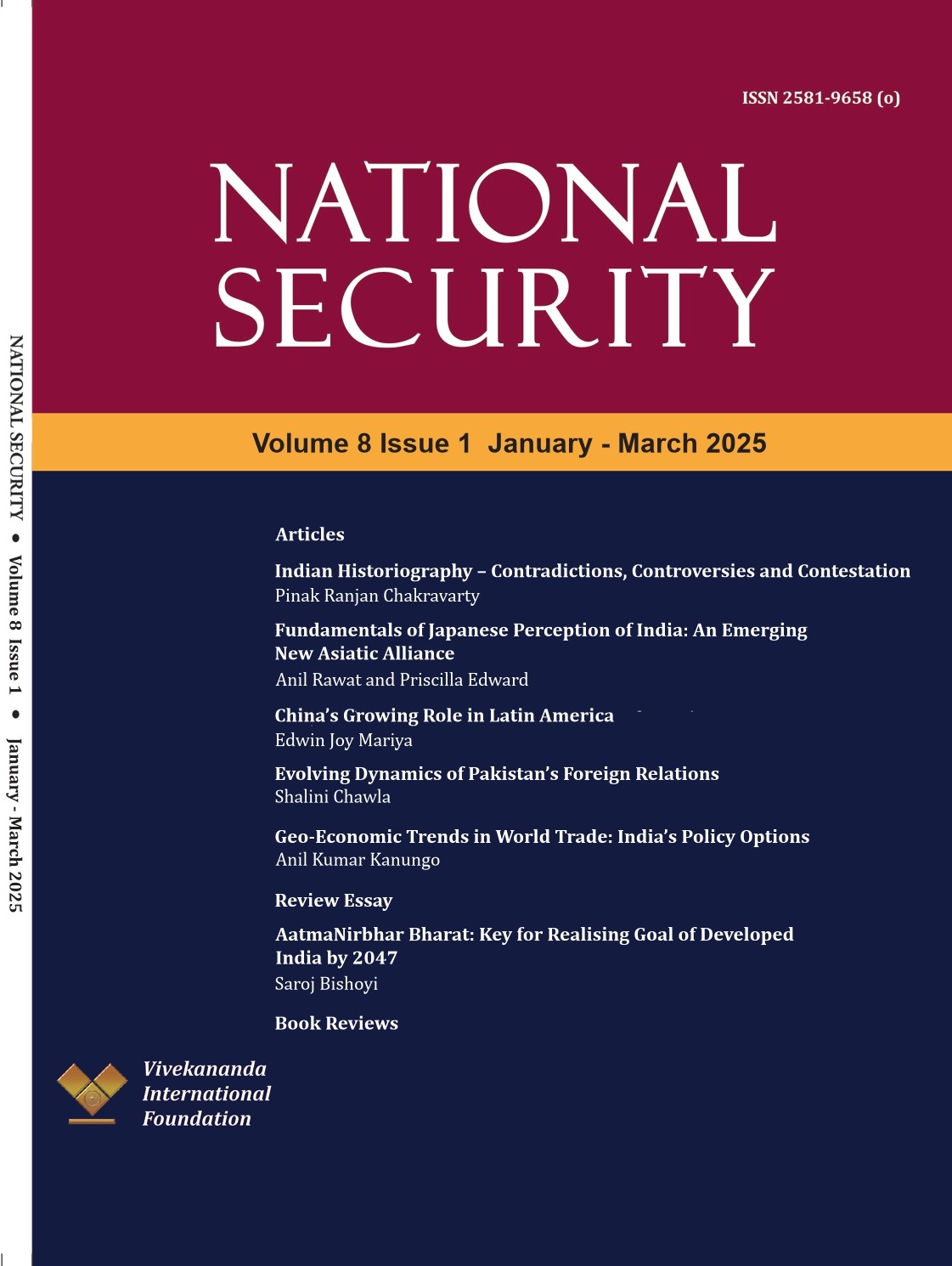
Fundamentals of Japanese Perception of India: An Emerging New Asiatic Alliance
By : Anil Rawat , Priscilla Edward
Page No: 27-53
Abstract
Buddhism is considered to be the principal factor in the development of the India-Japan relationship. However, in our research, we have found that the Japanese perception of India has been more deeply influenced by the pre-Buddhist-Vedic civilisational value system since the Classical Period. A unique theoretical framework has been developed to explain this civilisational expansion and content of India-Japan relations, which eventually evolved into the “Tenjiku Conception” of India. “Tenjiku” was a cultural cognitive construct, comprising of those civilisational values that people imbibed in the early years of Japanese civilisation. The Japanese began to develop civilisational characteristics from the Yayoi Period and imbibed Indian Vedic values during their interactions with China. The kind of Buddhism adopted by the Japanese was enmeshed deeply within Vedic philosophical thought. Therefore, it may be more appropriate to describe it as “Brahmanical-Buddhism.” Furthermore, the Japanese found Indian spiritualism and attitudes towards nature very encouraging. The Vedic value system is attributed for the intimate relationship it nurtured among the Japanese people and their speedier expansion throughout Japan’s main islands. The core values of spiritualism and their analysis of nature provided decisive underpinnings of the “Tenjiku” Conception, which became the abiding basis of Japan’s perception of India.
Authors :
Dr. Anil Rawat is an academician, an institution builder and an edupreneur who has spent several years in Japan at the University of Tokyo and subsequently as Senior Fellow on Japan Foundation Fellowship at the Yokohama National University.
Priscilla Edward has double Masters - an Executive MBA and followed by a full time Post-Graduate Diploma in Business Management (MBA). Career wise she combines a very good experience of industry and academia. Being in academics also enabled her to pursue her passion for research. Along with her administrative work she also works as Associate Researcher.
DOI: http://doi.org/10.32381/NS.2025.08.01.3