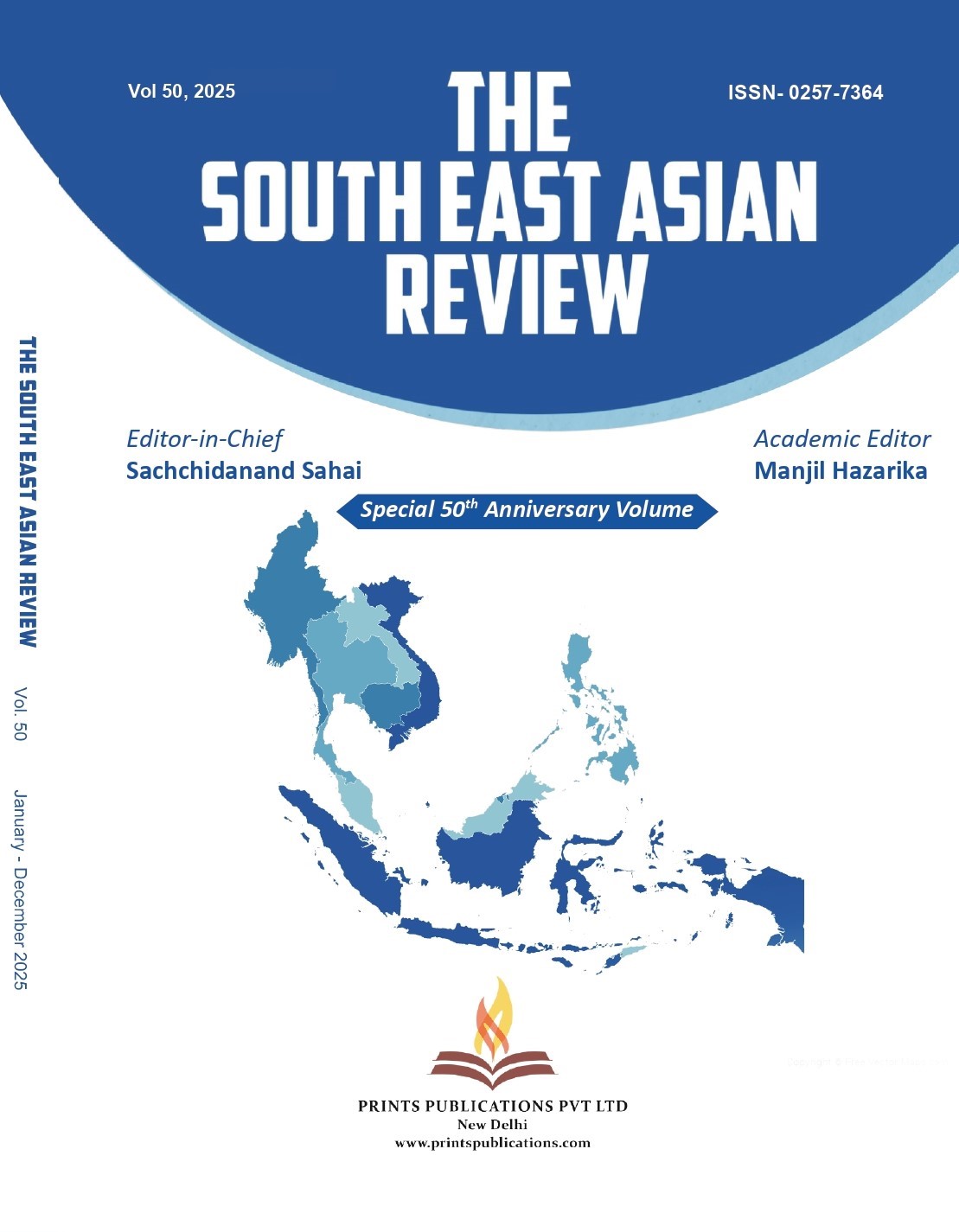


The South East Asian Review
Founded by Dr. Sachchidanand Sahai and late Dr. Sudha Verma
Current Volume: 50 (Special 50th Anniversary Volume) (2025 )
ISSN: 0257-7364
Periodicity: Yearly
Month(s) of Publication: December
Subject: Anthropology Social Science Archaeology
DOI: 10.32381/SEAR
Online Access is Free for Life Member
Iconography and Symbolism of a Javanese Ganesha Sculpture housed at the National Museum in Bangkok, Thailand
By : Sanathana Y.S. , Manjil Hazarika , Worrawit Boonthai
Page No: 277-287
Abstract
This paper examines the iconography and symbolic significance of a colossal stone image of Ganesha originating from Candi Singhasari in East Java and presently preserved in the National Museum, Bangkok. The sculpture was brought to Siam during King Chulalongkorn’s visit to the Dutch East Indies in 1896 and represents one of the most remarkable examples of East Javanese sculptural art outside its original cultural setting. Through a detailed iconographic analysis of the figure’s posture, attributes, ornaments and pedestal, the study situates the sculpture within the broader artistic and religious milieu of the thirteenth-century Singhasari kingdom. Particular attention is given to the pervasive skull (kapala) imagery incorporated in the pedestal, crown and ear ornaments of the sculpture. These motifs are interpreted within the framework of Tantric symbolism associated with Shaiva and Buddhist traditions that flourished in East Java during the reign of King Kertanagara (1268–1292 CE). The skull-adorned iconography, together with elements such as the serpent yajnopavita and the bowl toward which the trunk bends, suggests that the image embodies not only the familiar auspicious aspect of Ganesha but also a more esoteric dimension connected with ritual transformation and mastery over death. By comparing this sculpture with related Ganesha and Bhairava images from the Singhasari complex, the paper highlights the integration of Tantric symbolism within the sacred art of late classical Java. The Singhasari Ganesha thus emerges as both an artistic masterpiece and a significant testament to the religious synthesis and cultural exchanges that shaped Southeast Asian temple art.
Authors
Sanathana Y.S. : Director (Research & Projects), Pleach India Foundation, Hyderabad.
Manjil Hazarika : Assistant Professor, Department of Archaeology, Cotton University, Guwahati, Assam.
Worrawit Boonthai : Associate Professor, Faculty of Sociology and Anthropology, Thammasat University, Thailand.
DOI: https://doi.org/10.32381/SEAR.2025.50.15