


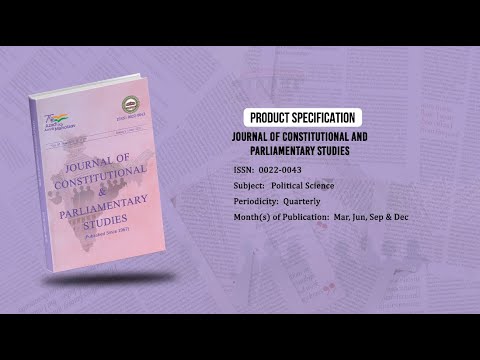
Journal of Constitutional and Parliamentary Studies
Published in Association with Institute of Constitutional and Parliamentary Studies
Current Volume: 59 (2025 )
ISSN: 0022-0043
Periodicity: Quarterly
Month(s) of Publication: March, June, September & December
Subject: Political Science
Political Representation of Women in Parliament: A Comparative Study of India and Rwanda
By : Harpreet Kaur , Avneet Kaur
Page No: 19-35
Abstract
This article compares women’s parliamentary representation in India and Rwanda, two large Global South democracies with starkly different political systems and outcomes for women in legislatures. Rwanda has led the world for over a decade in women’s share of the lower house reaching 63.8 per cent after its July 2024 elections through a combination of constitutional guarantees, reserved seats, and proportional representation list design. India, the world’s largest democracy, which uses single-member plurality (FPTP) system, has historically lagged on women’s descriptive representation in the national legislature despite pioneering large-scale quotas at the local level since the 1990s; women constitute roughly 14 per cent of the 18th Lok Sabha (2024). In 2023, India enacted a historic constitutional amendment reserving one-third of seats for women in the Lok Sabha and State Assemblies, though implementation is tied to post-census delimitation. Drawing on official statistics and scholarly research, the article analyses the institutional levers (electoral systems and quotas), political-party strategies, socio-cultural factors, and policy consequences of women’s representation. It concludes with lessons India can draw from Rwanda’s experience and cautions about the limits of quotas in more centralised or hegemonic political contexts.
Authors
Harpreet Kaur: Principal, Mata Sundri College for Women, University of Delhi.
Avneet Kaur: Assistant Professor, Department of Political Science, Mata Sundri College for Women,University of Delhi.