


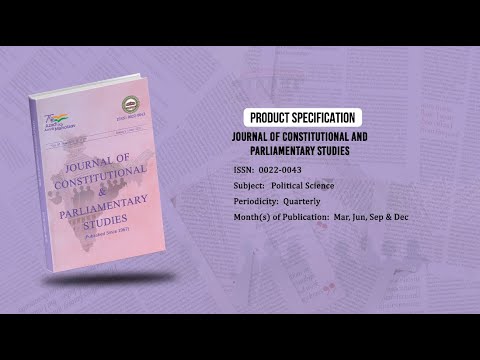
Journal of Constitutional and Parliamentary Studies
Published in Association with Institute of Constitutional and Parliamentary Studies
Current Volume: 59 (2025 )
ISSN: 0022-0043
Periodicity: Quarterly
Month(s) of Publication: March, June, September & December
Subject: Political Science
The Role of Private Members’ Bills in Strengthening Democracy in India
By : Gagan C , Tanisha , Santosh Kumar
Page No: 194-210
Abstract
Private Members’ Bills (PMBs) occupy a unique yet often underestimated space in India’s legislative landscape. While overshadowed by government bills, PMBs reflect the spirit of parliamentary democracy by empowering individual legislators to raise diverse and often neglected issues. This paper explores the evolution, contributions, challenges and potential reforms related to PMBs in India. Beginning with their roots in the British parliamentary tradition, the study traces the trajectory of PMBs from the first Lok Sabha to the present, highlighting important milestones such as the Proceedings of Legislature (Protection of Publication) Bill, 1956 and the Rights of Transgender Persons Bill, 2014. Through detailed case studies, including the initial drafts of the Protection of Women from Domestic Violence Bill, the paper underscores the role of PMBs in bringing controversial and marginalised topics into the mainstream legislative discourse.
Despite their symbolic and discursive importance, PMBs face numerous obstacles, including limited legislative time, procedural complexities, party dominance and a lack of research support. Public and media indifference further dilutes their impact. Drawing on comparative insights from countries like the United Kingdom and Canada, the paper proposes a set of reforms
aimed at revitalising PMBs, including increasing dedicated discussion time, establishing robust research infrastructure for MPs, encouraging bipartisan cooperation and promoting greater public engagement.
Ultimately, PMBs represent more than legislative proposals; they symbolise a participatory, inclusive and accountable democratic ethos. Strengthening them can help reclaim parliament’s role as a true forum for diverse voices and innovative ideas, fostering a legislative culture that genuinely reflects the aspirations of all sections of society.
Authors:
Gagan C :Student, Central University of Punjab.