


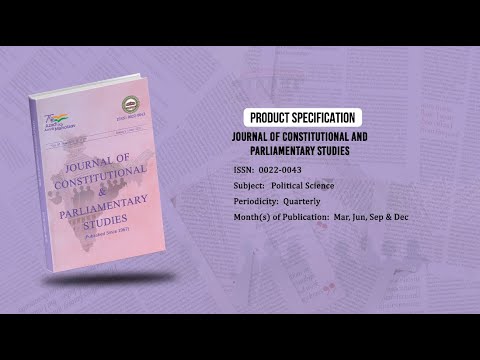
Journal of Constitutional and Parliamentary Studies
Published in Association with Institute of Constitutional and Parliamentary Studies
Current Volume: 59 (2025 )
ISSN: 0022-0043
Periodicity: Quarterly
Month(s) of Publication: March, June, September & December
Subject: Political Science
Climate Justice from Below: The Constitutional Role of Panchayats in Environmental Governance
By : Tanisha
Page No: 168-180
Abstract
Climate justice brings together environmental protection with social equity, recognising that the impacts of climate change are unevenly distributed across regions and communities. While wealthier nations have historically contributed the most to greenhouse gas emissions, poorer countries and vulnerable groups are experiencing its harshest consequences. In India, the challenge of balancing rapid development with ecological sustainability is especially significant, given the country’s dependence on natural resources and its vast population exposed to climate risks. The constitutional framework of decentralisation through the 73rd Amendment provides Panchayati Raj Institutions (PRIs) with a unique role in advancing environmental governance at the grassroots level. These local bodies, being closely connected with communities, can draw on traditional ecological knowledge and ensure participatory decision-making through Gram Sabhas. Evidence from across states, such as water conservation initiatives in Maharashtra, community forest rights in Odisha, and renewable energy projects in Rajasthan and Gujarat, illustrates how empowered Panchayats can drive climate resilience. However, their potential remains constrained by administrative control, limited financial autonomy, and gaps in technical capacity. Strengthening PRIs with adequate resources, training, and legal authority is essential to bridge the gap between constitutional intent and field realities. This paper argues that building climate resilience in India cannot be achieved through top-down policies alone; it must be rooted in democratic decentralisation that allows local voices, especially those of women, Dalits, and Adivasis, to shape responses. Empowering panchayats is therefore not just an administrative reform but a moral imperative towards climate justice.
Author :
Tanisha: M.A Political Science student, Central University of Punjab, Punjab.