


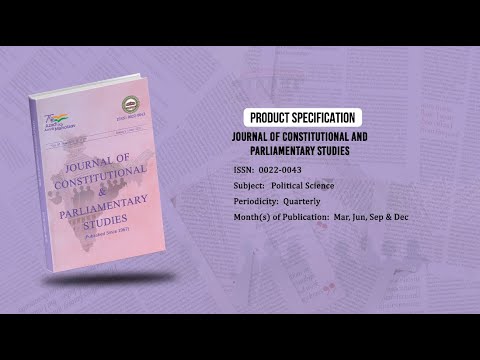
Journal of Constitutional and Parliamentary Studies
Published in Association with Institute of Constitutional and Parliamentary Studies
Current Volume: 59 (2025 )
ISSN: 0022-0043
Periodicity: Quarterly
Month(s) of Publication: March, June, September & December
Subject: Political Science
Right to Silence of the Accused Under Constitution of India
By : Shiv Narayan Dhingra
Page No: 194-203
Abstract
In this article,# the author discusses how judicial interpretation of Article 20(3) of the Constitution of India in some of the cases wherein courts have held that an accused cannot be compelled to give his blood/ hair sample etc. during investigation or during the trial since this would infringe the right of the accused conferred by Article 20(3) has created an anomalous situation. The author affirms that the Right to Silence under Article 20(3) granted to an accused needs to be interpreted in consonance with the other statutory provisions and that the right is not an absolute and unqualified right. The author then explains how the interpretation is not in consonance with the spirit of Section 27 of the Indian Evidence Act and has made it difficult for the investigating agencies in securing evidence against and guilt of the accused. The author also explains how by extending the scope of Article 20(3), the courts are shutting the doors towards scientific investigation and how the interpretation is antithetical to the interests of the society and the State. The author argues that since the courts are parts of the State, judicial interpretations must serve the cause of the State and must be in the benefit of the society.
Author :
Shiv Narayan Dhingra : The then Justice, Delhi High Court.