


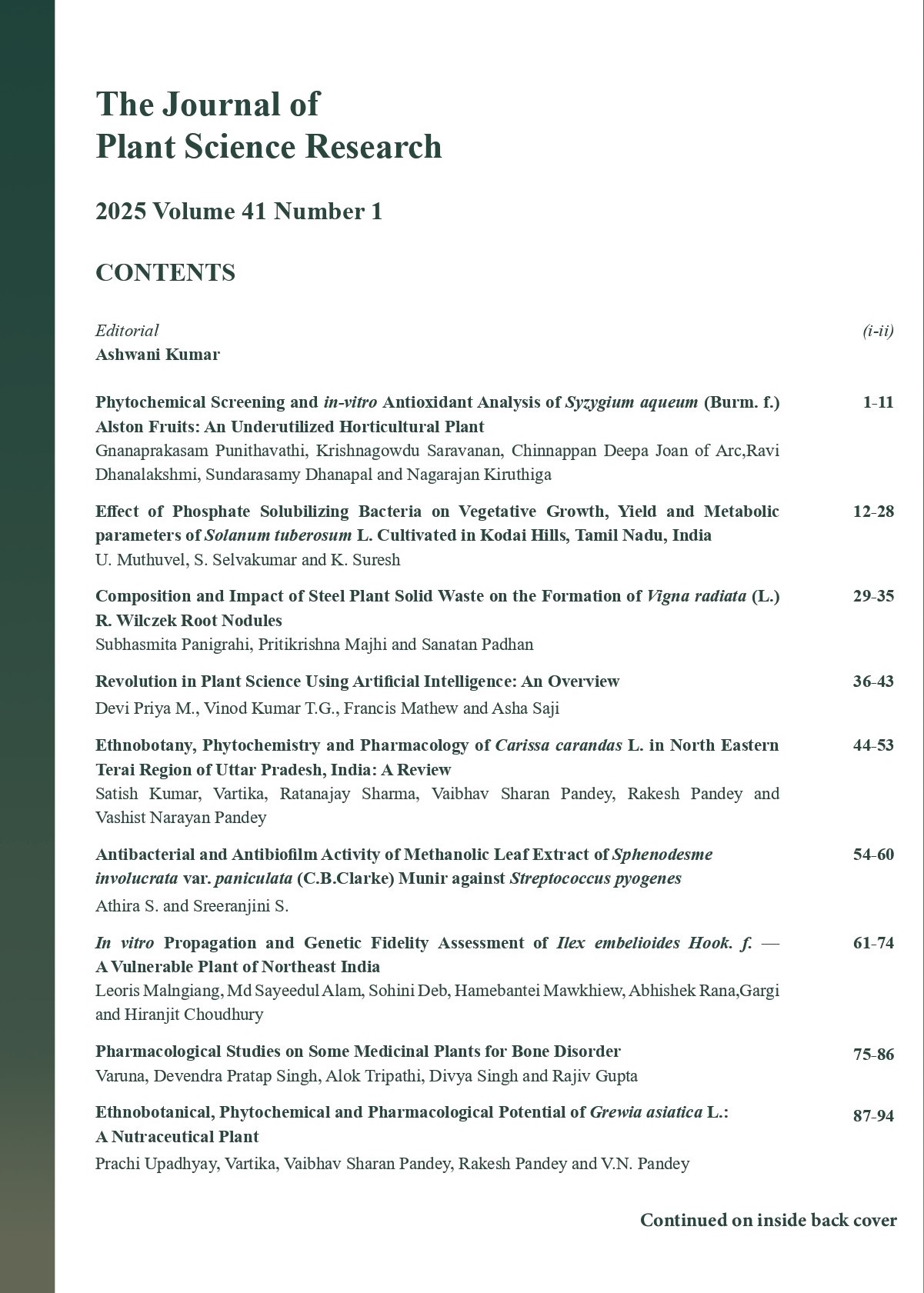


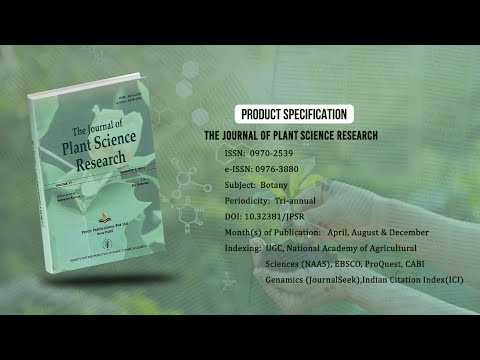
The Journal of Plant Science Research - A UGC Care-Listed Journal
Published in Association with Forum For the Promotion of Plant Science Research
Current Volume: 42 (2026 )
ISSN: 0970-2539
e-ISSN: 0976-3880
Periodicity: Tri-annual
Month(s) of Publication: April, August & December
Subject: Botany
DOI: 10.32381/JPSR
Online Access is Free for Life Member
Role of Rhizobia to Improve Zinc Phytoremediation by Legumes
By : Neha Batra , Ameeta Sharma
Page No: 389-402
Abstract
High metal availability arising from mining and industrial activities, disposal of sludge or soil acidification, is an important problem in agricultural and forestry. Plants exposed to high concentrations of metals must respond in order to avoid the deleterious effects of metal toxicity at the structural, physiological and molecular levels. Plant strategies for coping with metal toxicity are genotype-specific and at least to some extent, modulated by environmental conditions. Physiology and biochemistry with regard to phytotoxicity, uptake and transport of Zinc and tolerance and its characterization were studied in Vigna unguiculata plants. Parameters studied were photosynthetic pigments, proline content, lipid peroxidation content, protein content, relative water content and antioxidant enzymes (SOD, EC 1.15.1.1; CAT, EC 1.11.1.6; APX, EC 1.11.1.11). Metal stress inhibits chlorophyll activity and induces alterations in protein level. Increase in CAT, SOD and APX activity along with RWC was seen at the earlier stages with the decline at the last stages of plant growth. An immense increase in the proline and MDA content was observed. This may possibly be due to either down regulation of photosynthesis or photo inhibition process. Further, Rhizobium was used as soil fertilizer to prevent the stress of Zinc on growing Vigna unguiculata. The experiment tolerance index of plants was increased in the presence of Rhizobium than in their absence in polluted soil. Our results demonstrate that cowpea plants perform better when amended with Rhizobium under metal stress, as indicated by a lower sensitivity to photoinhibition, proline accumulation and higher antioxidant enzyme activity.
Authors :
Neha Batra and Ameeta Sharma
Department of Biotechnology, IIS (Deemed to be University), Jaipur, Rajasthan, India.
DOI: https://doi.org/10.32381/JPSR.2022.38.01.42