


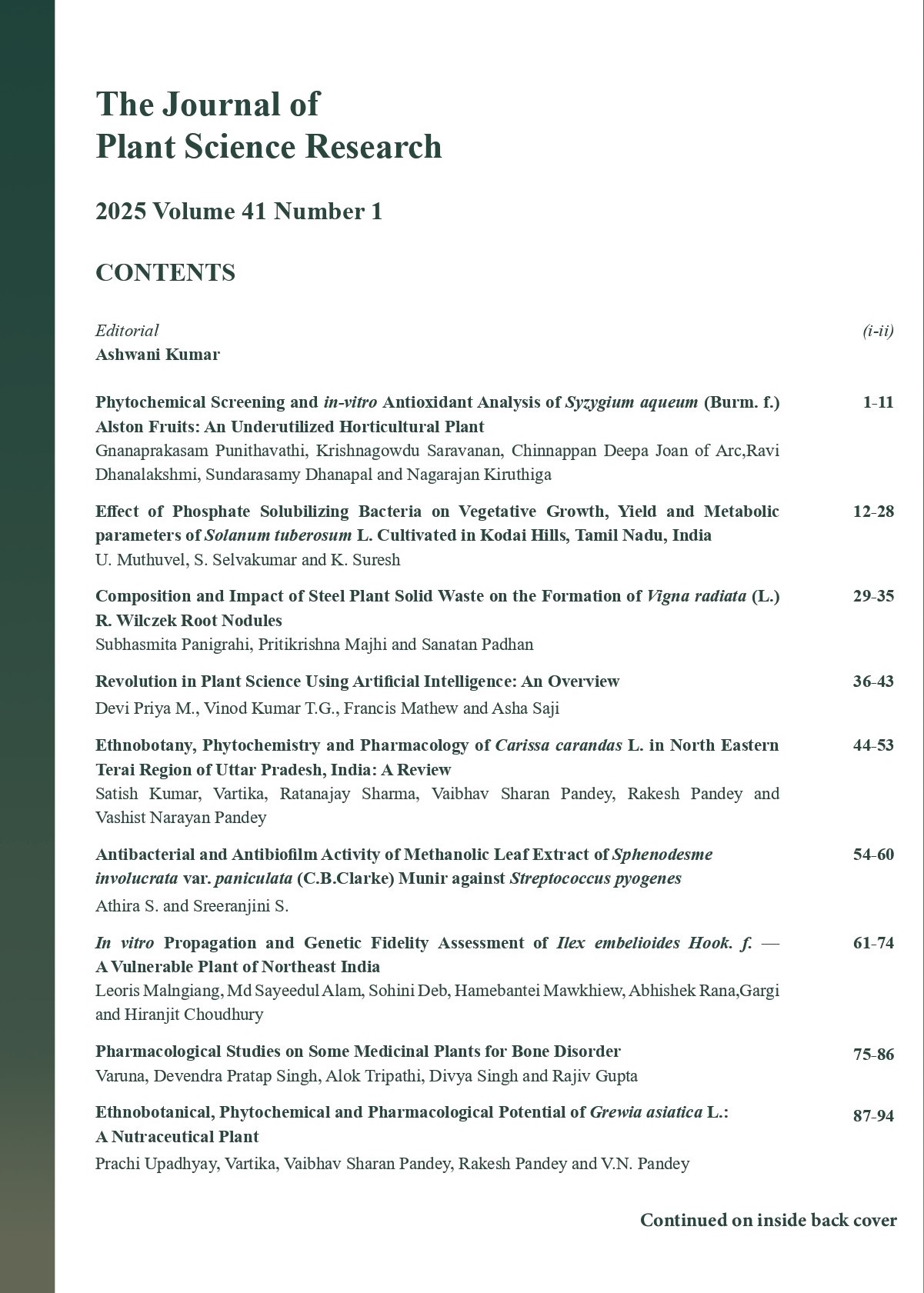


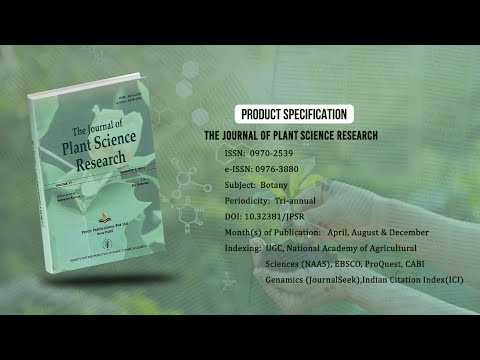
The Journal of Plant Science Research - A UGC Care-Listed Journal
Published in Association with Forum For the Promotion of Plant Science Research
Current Volume: 42 (2026 )
ISSN: 0970-2539
e-ISSN: 0976-3880
Periodicity: Tri-annual
Month(s) of Publication: April, August & December
Subject: Botany
DOI: 10.32381/JPSR
Online Access is Free for Life Member
Minimizing Allelopathic Effect of Grewia optiva on Germination and Growth of Finger Millet Using Plant Growth Promoting Rhizobacteria
By : Rakesh Singh , Yashwant Singh Tariyal , J.S. Chauhan
Page No: 301-310
Abstract
Interaction among plant species has both beneficial and harmful effect on one or both the species. It plays an imperative role in the plant growth and survival. Grewia optiva (Bhimal) is widely grown fodder tree usually grown on boundaries of crop fields. The plant is reported to have allelopathic effect on crop growth but its importance as a fodder tree cannot be ignored. The present investigation is carried out with Plant growth-promoting rhizobacteria (PGPR) strains (Pseudomonas FP-11 and Bacillus BS-10) in alleviating allelochemical (biotic) stress of Grewia optiva (Bhimal) on Finger millet. Due to presence of Grewia optiva leaf extract there was inhibition in germination, reduction in seedling fresh and dry weight, root and shoot length of finger millet in contrast to control. This inhibition was recovered with PGPR treatment of Pseudomonas FP-11 and Bacillus BS-27. The results indicated that the seeds inoculation with PGPR strains under allelochemical stress significantly improved germination, plant growth, vigour and chlorophyll contents of leaf. The root length, shoot length, seedling length, seedling fresh and dry weight were also considerably increased by seeds treatment with PGPR. The plant growth promoting rhizobacteria (PGPR) Pseudomonas FP-11 strain and Bacillus BS-10 strain in combination could alleviate allelopathic effect of Grewia optiva on finger millet. Plant growth promoting rhizobacteria (PGPR) was observed replacing the use of chemicals in agriculture, horticulture practices. This is due to the emerging demand for minimizing harmful impacts and utilization of chemical products to the growing necessity of sustainable agriculture within a holistic apparition of development and to emphasize environmental protection.
Authors :
Rakesh Singh : Department of Seed Science & Technology, HNB Garhwal University (A Central University), Srinagar Garhwal, Uttarakhand, India.
Yashwant Singh Tariyal : High Altitude Plant Physiology Research Centre, HNB Garhwal University (A Central University), Srinagar Garhwal, Uttarakhand, India.
J.S. Chauhan : Department of Seed Science & Technology, HNB Garhwal University (A Central University), Srinagar Garhwal, Uttarakhand, India.
DOI: https://doi.org/10.32381/JPSR.2022.38.01.32