


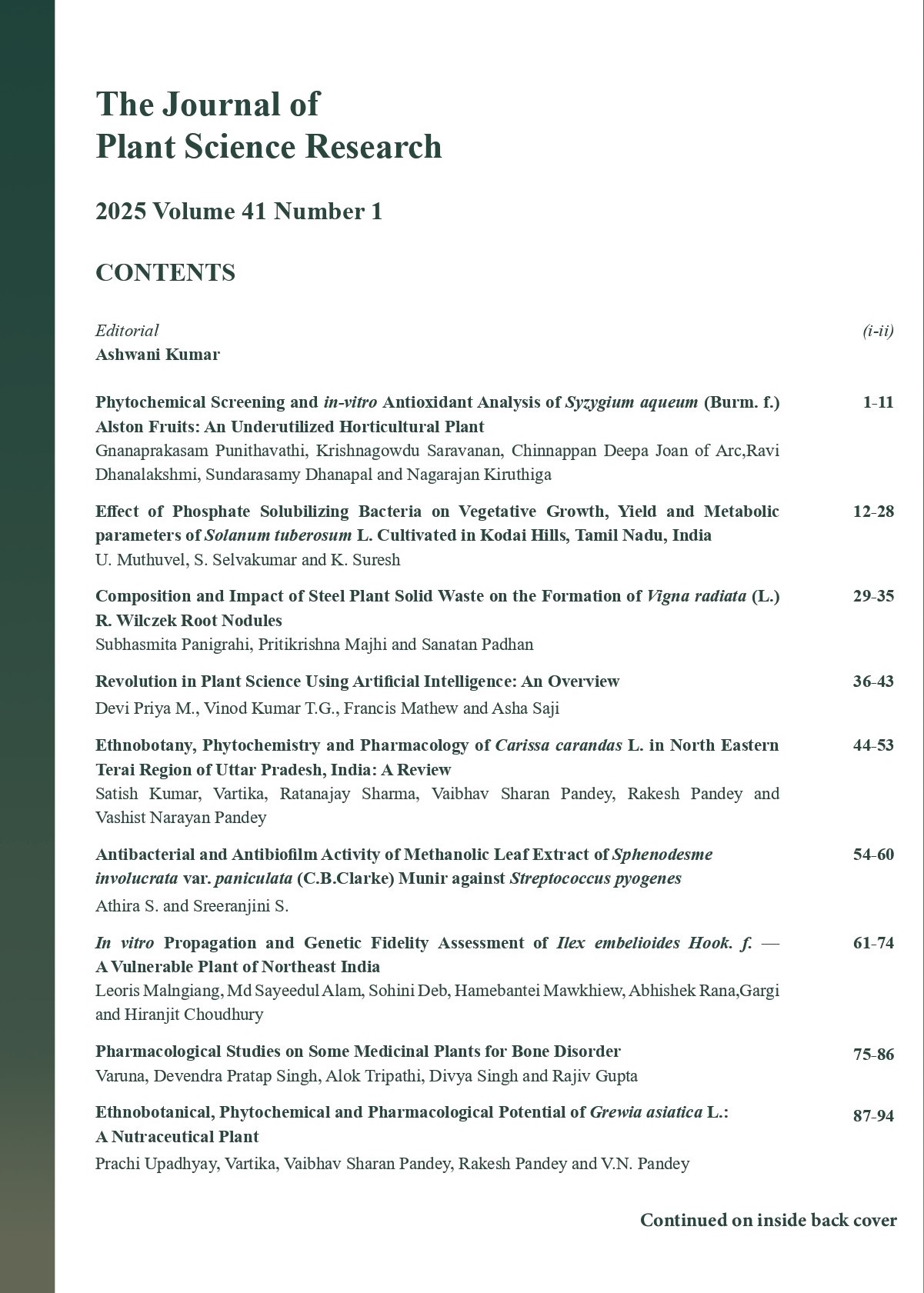


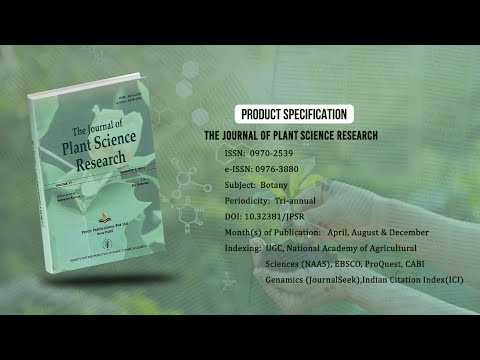
The Journal of Plant Science Research - A UGC Care-Listed Journal
Published in Association with Forum For the Promotion of Plant Science Research
Current Volume: 42 (2026 )
ISSN: 0970-2539
e-ISSN: 0976-3880
Periodicity: Tri-annual
Month(s) of Publication: April, August & December
Subject: Botany
DOI: 10.32381/JPSR
Online Access is Free for Life Member
Effect of Integrated Nutrient Management on Sustainable Tasar Silk Production and Soil Health
By : Soma Karmakar , A.K. Srivastava , T. Pandiaraj , Jyostna Tirkey
Page No: 227-233
Abstract
Tasar silk production is highly associated to natural ecosystem. Deterioration of natural ecosystem can directly affect the quality and production of tasar silk. Since regular use of chemical fertilizers reduce the fertility and total microbial biomass thus affecting soil health and productivity in tasar ecosystem. Hence, a field experiment was conducted at Central Tasar Research and Training Institute, Ranchi with an aim of improving the soil nutritional status using INM practices. The experiment was comprised 20 treatments including control which laid down in randomised block design with three replications. The soil samples were collected from each plot and analysed for different parameters. The study revealed that the pH of different experiment plots was acidic range (5.42 to 5.99). SOC was found to be higher in the treatment of 75% RDF with 25% VC + Azotobacter + PSB (1.33%) followed by 100%RDF with 2 kg/plant VC + Azotobacter + PSB (1.31%). The treatment T19 (495.5 kg ha?1 ) had recorded higher available nitrogen followed by T17 and lower in control. In case, the available phosphorus was found to be the ranges from medium to high (12.93 to 38.33 kg ha?1 ) in different treatments. In the present investigation, available potassium was observed in the range of 213.3 kg ha?1 ¹ to 513.3 kg ha?1 ¹ which resulted in medium to high range. All the micronutrients (Cu, Zn, Mn and Fe) in the experiment were found to be sufficient amount. Overall, the treatment that integrated chemical fertilizers with organic manure and bio fertilizers showed greater response to increase in soil nutrients content. Hence, the treatment i.e. 75% RDF with 25% VC + Azotobacter + PSB could prove a better and viable for nutrient demand of Tasar culture.
Authors :
Soma Karmakar : Department of Botany, Ranchi University, Ranchi, India.
A.K. Srivastava : Department of Botany, Ranchi University, Ranchi, India.
T. Pandiaraj : Narendra Deva University of Agricultural Technology, Azamgarh, UP, India.
Jyostna Tirkey : Narendra Deva University of Agricultural Technology, Azamgarh, UP, India.
DOI: https://doi.org/10.32381/JPSR.2022.38.01.24