


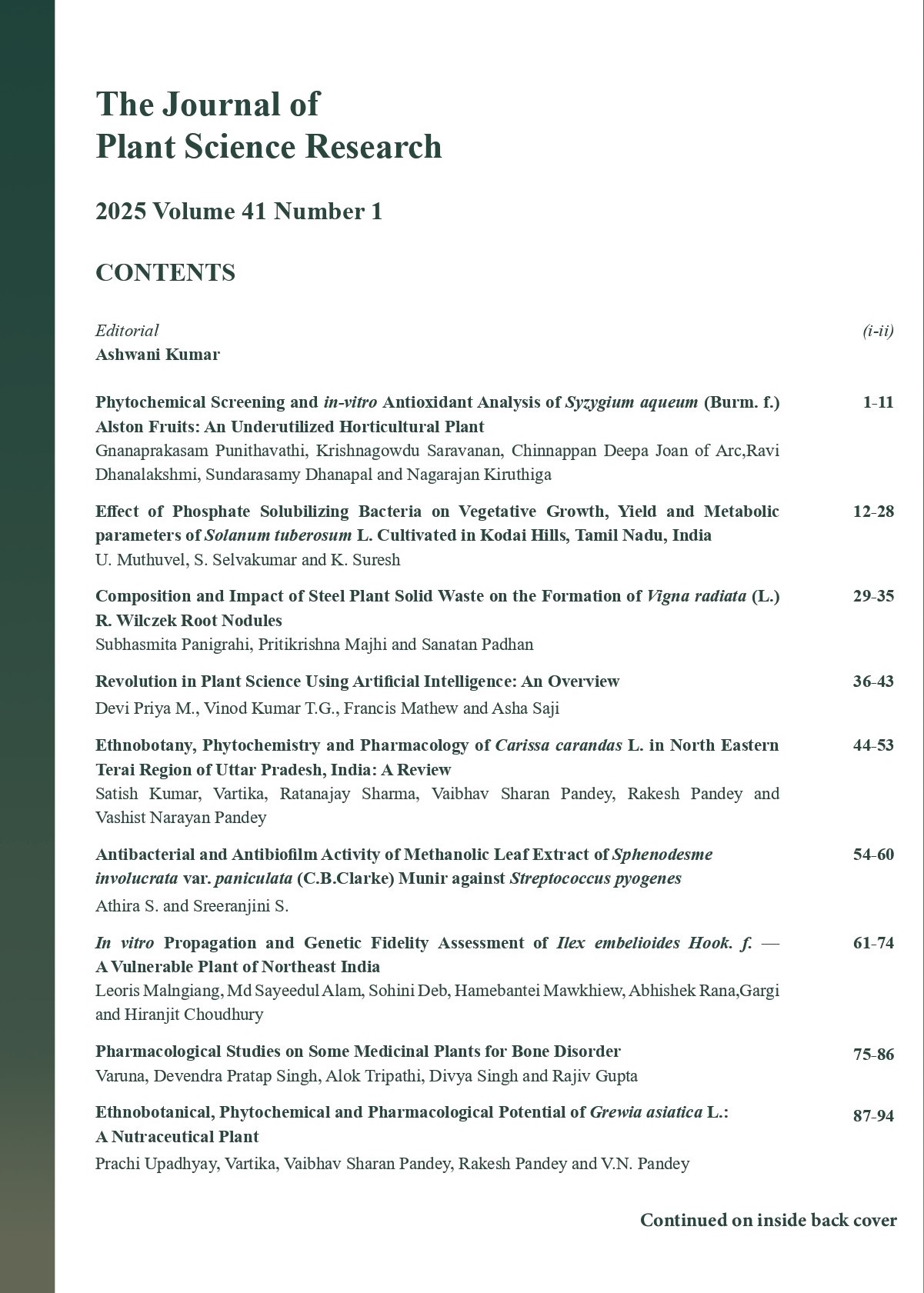


The Journal of Plant Science Research - A UGC Care-Listed Journal
Published in Association with Forum For the Promotion of Plant Science Research
Current Volume: 42 (2026 )
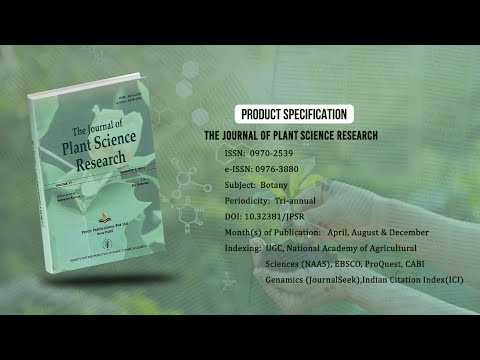
ISSN: 0970-2539
e-ISSN: 0976-3880
Periodicity: Tri-annual
Month(s) of Publication: April, August & December
Subject: Botany
DOI: 10.32381/JPSR
Online Access is Free for Life Member
Appraising Physical Properties of Soil Under Different Prevailing Land Use Systems in the Sub-humid Southern Plans and Aravalli Hills of Rajasthan
By : R. B. Meena , S. C. Meena , R. H. Meena , Ramu Meena , Mahaveer Nogiya , R. L. Meena , R. S. Meena , Shiv Singh Meena
Page No: 205-214
Abstract
Information about the impacts of different land-use systems on the physical properties of soil is essential for the sustainable utilization of existing soil resources. The main objective of this study was to examine the variation in selected physical properties across the different prevailing land-use systems in the Sub Humid Southern Plains and Aravalli hills of Rajasthan. A total of 120 composite soil samples were collected for laboratory analysis from barren, cultivated, agri-horticulture, horticulture, grass, and natural forest land-use systems by four different soil depths (0-20, 20-40, 40-60 and 60-80 cm) with five replications. The two-way analysis of variance (Two ways ANOVA) was used to test the effect of different land-use systems and soil depths on measurable soil physical properties. The results of the study revealed that the soil separates (sand, silt, and clay fractions) were not differed significantly across the land use systems as the texture is an inherent property of soil that cannot be changed easily by agricultural management practices. However, soil depth was affected significantly to the particle size distribution under studied land use systems. The mean bulk density of the soil varied from 1.51 to 1.62 Mg m-3 and the mean total porosity ranged from 38.56 to 41.77%. The highest plant available water (0.362 cm3 -H2 Ocm-3 Soil) and higher moisture content at field capacity (34.55%) and permanent wilting point (10.57%) were recorded in the natural forest land use system. All the six land-use systems confirmed distinct effects on soil properties as the highest superior soil properties were observed under natural forest land-use systems, followed by grassland, horticulture, agri-horticulture, and agricultural land-use systems, whereas the barren land use was showed inferior soil properties. The result of the study suggests that the incorporation of tree components on agriculture, barren, and grassland systems could decisive to improve the properties and sustainability of the soil in the study area.
Authors :
R.B. Meena : Scientist, ICAR-Indian Institute of Soil and Water Conservation, Research Centre, Agra (U.P.) India.
S.C. Meena : Associate Professor, Department of Soil Science & Agriculture Chemistry, RCA, MPUAT, Udaipur.
R.H. Meena : Associate Professor, Department of Soil Science & Agriculture Chemistry, RCA, MPUAT, Udaipur.
Ramu Meena : Assistant Professor, Agricultural Research Station, Fatehpur Shekhawati, Sikar, SKNAU- Jobner (Rajasthan), India.
Mahaveer Nogiya : Scientist, ICAR-National Bureau of Soil Survey and Land Use Planning, Regional Centre, Udaipur (Rajasthan), India.
R.L. Meena : Scientist, ICAR-National Bureau of Soil Survey and Land Use Planning, Regional Centre, Udaipur (Rajasthan), India.
R.S. Meena : Assistant Professor, Agricultural Research Station, Sriganganagar (Rajasthan), India.
Shiv Singh Meena : Ph.D Student, GBPUAT, Pant Nagar, Uttrakhand (Rajasthan), India.
DOI: https://doi.org/10.32381/JPSR.2022.38.01.21