


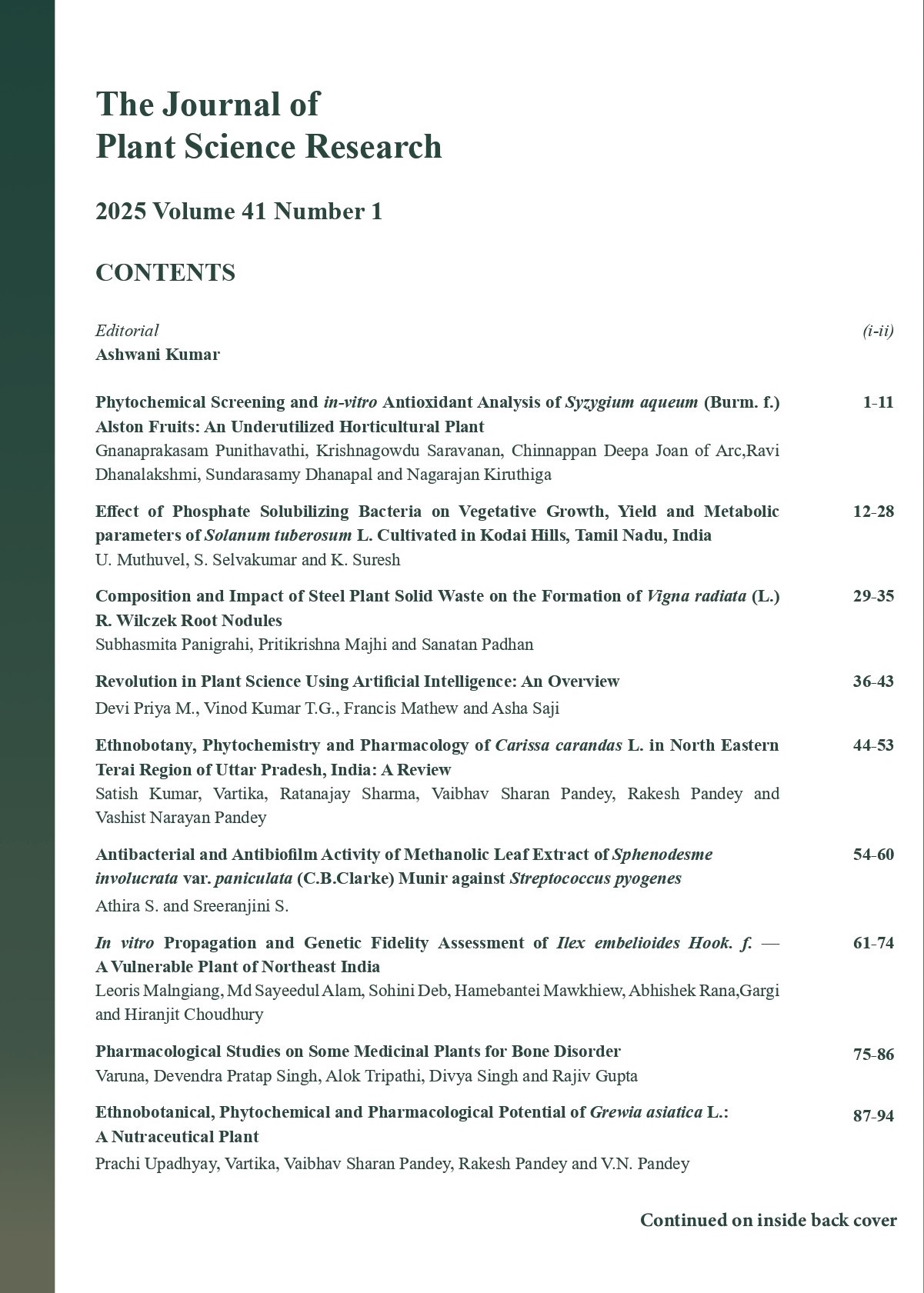


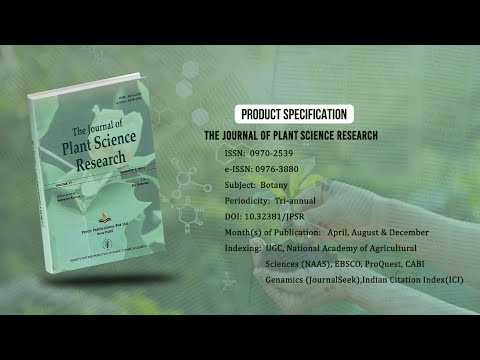
The Journal of Plant Science Research - A UGC Care-Listed Journal
Published in Association with Forum For the Promotion of Plant Science Research
Current Volume: 42 (2026 )
ISSN: 0970-2539
e-ISSN: 0976-3880
Periodicity: Tri-annual
Month(s) of Publication: April, August & December
Subject: Botany
DOI: 10.32381/JPSR
Online Access is Free for Life Member
Influence of Organic Weed and Nutrient Management Practices on Weeds, Yields and Economics of Maize in Western Rajasthan
By : Lokesh Kumar Jain , P L Maliwal
Page No: 405-411
Abstract
An experiment was conducted during 2019-20 and 2020-21 at College of Agriculture, Sumerpur, Rajasthan, India on maize comprises 6 organic weed management and 5 organic nutrient management treatments implemented in split plot design with 3 replications. Among the various weed management treatments, the minimum total in weed dry matter (215.7 kg ha-1) and maximum weed control efficiency was observed in weed free check as against weedy check while the stale seedbed+ hoeing once at 20 DAS + straw mulch at 30 DAS was found at par to weed free check and gave minimum weed index. The grain, stover and biological yields of maize was significantly higher in weed free check as compared to weedy check and almost at per treatment stale seedbed+ hoeing once at 20 DAS + straw mulch at 30 DAS. The weed free check recorded maximum grain yield of 3,358 kg ha-1 and stover yield of 6,258 kg ha-1 and recorded significantly higher maximum net return while the treatment stale seedbed + hoeing once at 20 DAS + straw mulch at 30 DAS recorded maximum benefit to cost ratio (1.59). The 75% of recommended dose of nitrogen (RDN i.e. 90 kg N equivalent) through vermicompost in two splits (75% at sowing+25% as top dressing at 30 DAS) along with seed treatment with fermented organic manure i.e. beejamurt and two spray of jeevamurt significant lowered the weed dry matter as compared to 100% RDN through FYM at harvest in pooled analysis and recorded maximum grain yield (3,169 kg ha-1), net return (Rs. 26,373 ha-1) and benefit to cost ratio (1.49) as compared to 100% RDN through FYM. Similar trend was also reported in various yield attributes.
Authors :
Lokesh Kumar Jain : Ph.D.Schloar, Department of Agronomy, Rajasthan College of Agriculture, Udaipur.
P L Maliwal : Ex-ICAR Emeritus Professor, MPUAT Udaipur Rajasthan-313001.
DOI: https://doi.org/10.32381/JPSR.2021.37.02.21