


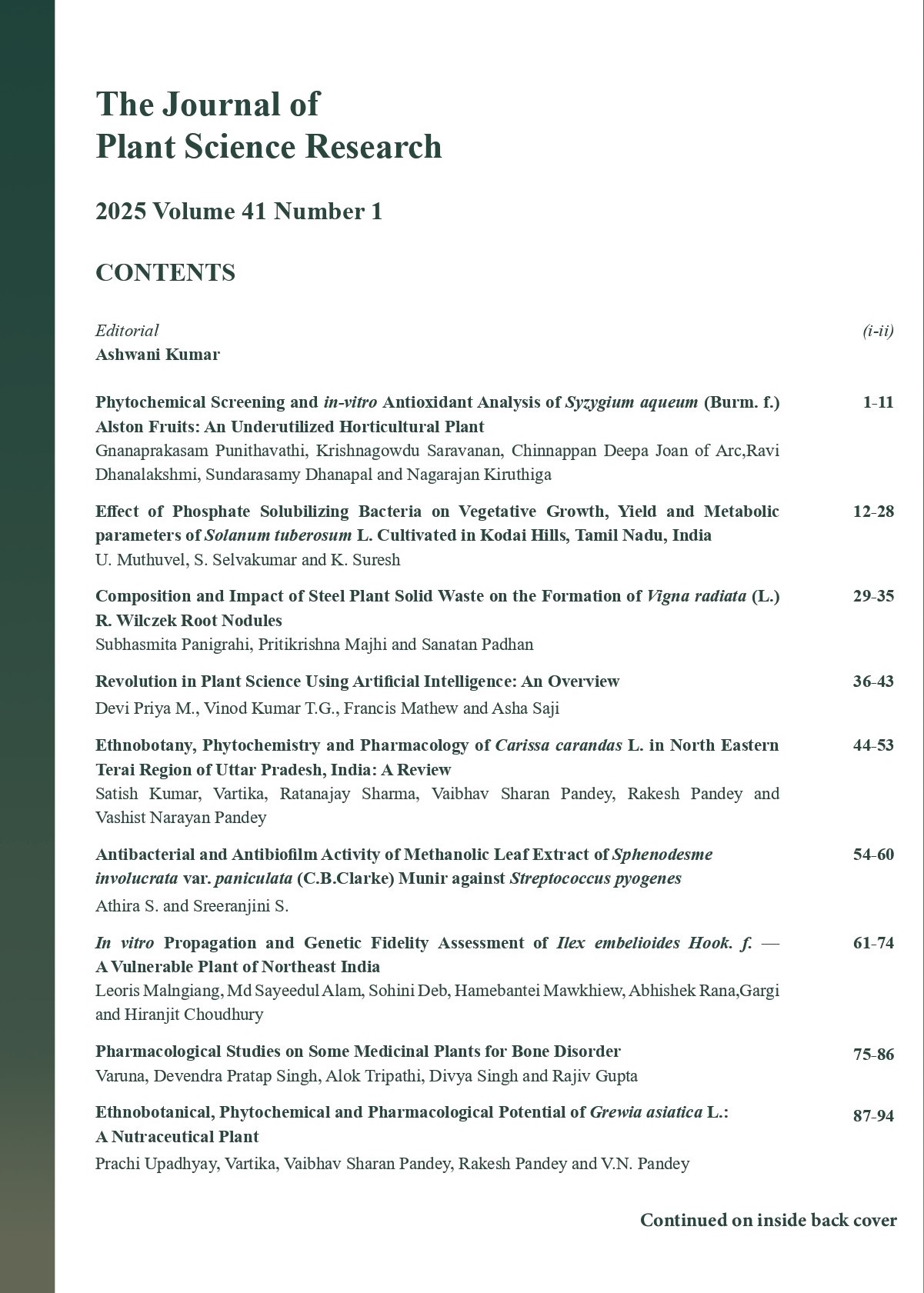


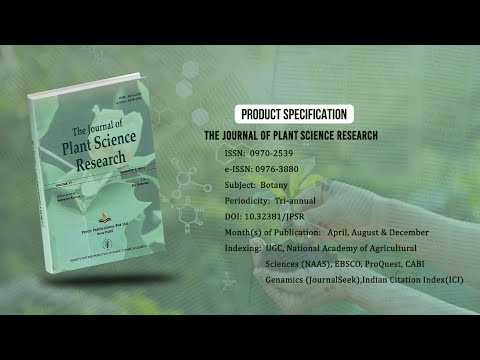
The Journal of Plant Science Research - A UGC Care-Listed Journal
Published in Association with Forum For the Promotion of Plant Science Research
Current Volume: 42 (2026 )
ISSN: 0970-2539
e-ISSN: 0976-3880
Periodicity: Tri-annual
Month(s) of Publication: April, August & December
Subject: Botany
DOI: 10.32381/JPSR
Online Access is Free for Life Member
Antimicrobial Activity of the Leaf Extracts of Strelitzia reginae
By : Ramesh L Londonkar , Rajani KS
Page No: 381-397
Abstract
The antimicrobial activity of the leaf extract of Strelitzia reginae was studied on six Gram-positive and six Gram-negative bacteria. The leaf extracts of Strelitzia reginae were obtained by the Soxhlet extraction process using the following solvents, petroleum ether, chloroform, methanol, and distilled water in the increasing order of their polarity.
In order to locate the maximum and efficient antimicrobial activity among the leaf extracts of Strelitzia reginae, three sets of experiments were conducted.
Firstly, the four extracts of leaves of Strelitzia reginae namely petroleum ether extract (PE), methanol extract (ME), chloroform extract (CE), and aqueous extract (AE) were tested for their antimicrobial activity with two bacterial species. A Gram-positive bacterium, Staphylococcus aureus ATCC 6538, and a Gram-negative bacterium Klebsiella pneumoniae ATCC 13882. The antimicrobial activity was determined using the well diffusion method. Among the test samples, samples AE, CE, ME, and PE showed antibacterial activity against Klebsiella pneumoniae; samples AE, CE, and PE showed antibacterial activity against Staphylococcus aureus. Highest activity was shown by sample CE against Staphylococcus aureus (12 mm). Samples ME and PE showed highest activity against Klebsiella pneumoniae (10 mm).
Secondly, since the highest antimicrobial activity was located with CE and ME, six Gram-positive bacteria namely; Staphylococcus aureus ATCC 6538, Mycobacterium tuberculosis MTCC 25177, Streptococcus mutans ATCC 25175, Staphylococcus epidermis ATCC 35984, Enterococcus faecalis ATCC 29212, Lactobacillus acidophilus ATCC 314, and six Gram-negative bacteria namely; Klebsiella pneumoniae ATCC 13882, Pseudomonas aeruginosa ATCC 7903, Proteus mirabilis ATCC 7002, Enterobacter aerogenes ATCC 13048, Salmonella typhimurium ATCC 733, Escherichia coli ATCC 8739 have been tested with CE and ME of Strelitzia reginae respectively. Among the test samples, sample CE showed antibacterial activity against Staphylococcus aureus, Mycobacterium tuberculosis, Streptococcus mutans, and sample ME showed antibacterial activity against Klebsiella pneumoniae, Pseudomonas aeruginosa, Enterobacter aerogenes at 4 mg concentration per well.
Thirdly, since CE showed maximum antibacterial activity with maximum zone of inhibition values against both Gram-positive and Gram-negative bacteria, minimum inhibitory concentration test was conducted on the micro-organisms that showed zones of inhibition. The sample-CE showed 50% inhibition at 1.25mg against Staphylococcus aureus, 0.625mg against Mycobacterium tuberculosis, 1.25mg against Streptococcus mutans, 2.5mg against Escherichia coli, 1.25mg against Klebsiella pneumoniae, 2.5mg against Pseudomonas aeruginosa, 2.5mg against Proteus mirabilis, 2.5mg against Enterobacter aerogenes in micro broth dilution technique.
Authors :
Ramesh L Londonkar and Rajani KS
Biopharmaceutical and Nanobiotechnology Laboratory, Department of Biotechnology, Gulbarga University, Kalaburagi -585106, Karnataka, India.
DOI: https://doi.org/10.32381/JPSR.2021.37.02.19