


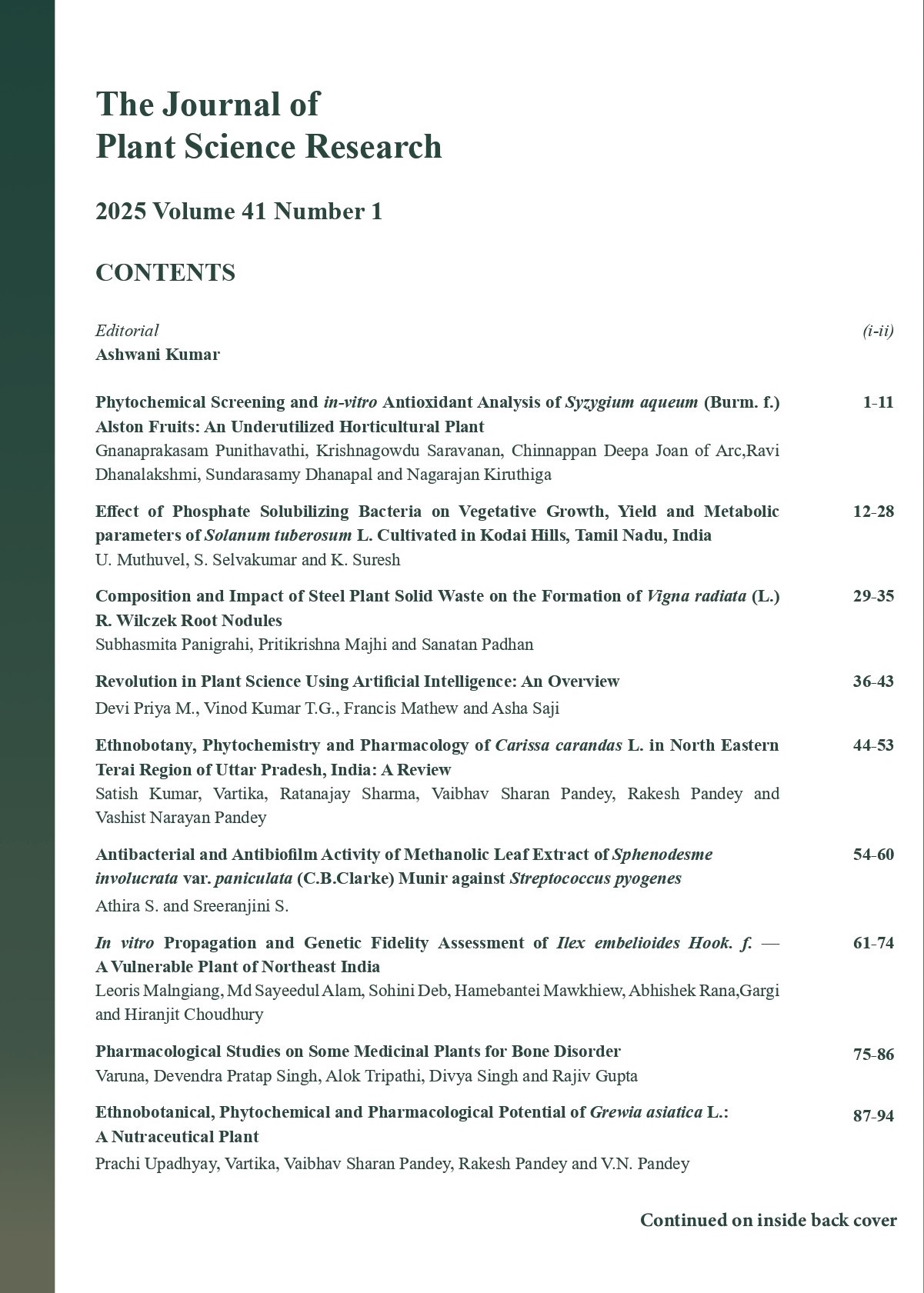


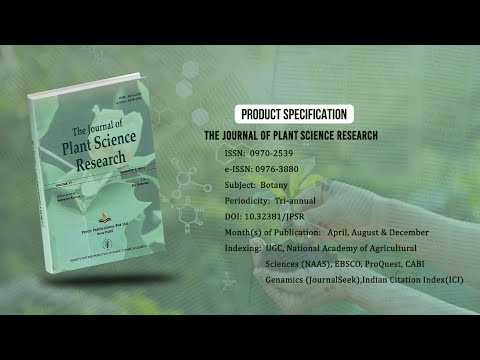
The Journal of Plant Science Research - A UGC Care-Listed Journal
Published in Association with Forum For the Promotion of Plant Science Research
Current Volume: 42 (2026 )
ISSN: 0970-2539
e-ISSN: 0976-3880
Periodicity: Tri-annual
Month(s) of Publication: April, August & December
Subject: Botany
DOI: 10.32381/JPSR
Online Access is Free for Life Member
Phytochemical, Nutraceutical and Antioxidant Studies of Portulaca oleracea L. Grown in Bidar Region of Karnataka
By : Sangeeta M.K , G. M. Vidyasagar , Shankaravva Babanagare
Page No: 313-320
Abstract
Portulaca oleracea (Pursulane) belongs to the family Portulacaceae, widely grown as weed along with crop plant, in some other regions local people consume as a vegetable and globally used as a herbal remedy for several ailments. The air dried plant powder of aqueous and solvent extract was used to investigate the phytonutrients using standard procedure. Phytochemical study of primary and secondary metabolite of pursulane reveals the presence of Protein (1.6 mg/g), Carbohydrate (2.6 mg/g), Alkaloid (2.5 mg/g), Saponin (2.2 mg/g), Flavanoid (1.7 mg/g), Tannin (1.46 mg/g) and Phenol (1.42 mg/g) with high content of Alkaloid and followed by Saponin and other constituents. The Elemental and physicochemical analysis showed highest content of Calcium 11.1561 ppm and 9.24% of ash content, 12.37% of water soluble ash, 10.41% of insoluble ash and 0.57 mg/g of crud fiber. 3.28 mg/g of Methionine and 2.26 mg/g of Ascorbic acid as a high content obtained by the estimation of Amino Acid and Vitamins respectively. The antioxidant activity was determined in methanolic extract by using DPPH radical scavenging assay with IC50 28.32±4.7 (?g/ml). Total Polyphenol Content was determined as 1.874 mg/g. On the basis of above results such nutritional reach Purslane is a Potential to use as a vegetable as well as medicinal applications and promising natural product may be obtained in future.
Authors :
Sangeeta MK, Vidyasagar GM and Shankaravva Babanagare
Department of Botany, Gulbarga University, Kalaburgi, Karnataka, India.
DOI: https://doi.org/10.32381/JPSR.2021.37.02.13