




The Journal of Plant Science Research - A UGC Care-Listed Journal
Published in Association with Forum For the Promotion of Plant Science Research
Current Volume: 42 (2026 )
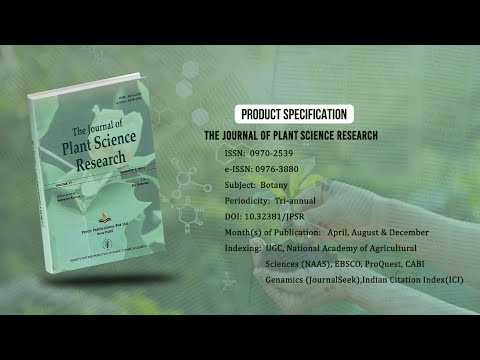
ISSN: 0970-2539
e-ISSN: 0976-3880
Periodicity: Tri-annual
Month(s) of Publication: April, August & December
Subject: Botany
DOI: 10.32381/JPSR
Online Access is Free for Life Member
Genetic Diversity Analysis in Foxtail Millet [Setaria italica (L.) P. Beauv.] Genotypes
By : D Purushotama Rao , H P Chaturvedi
Page No: 907-918
Abstract
Foxtail millet (Setaria italica) is one of the least studied crops in terms of genetic resource characterization and genetic enhancement while compare to cereals. Hundred foxtail millet lines representing the national collection were evaluated at Medziphema, Nagaland University in Summer-2022 for polygenic trait evaluation and data subjected to genetic diversity analyses. Hundred foxtail millet genetic resources were divided into ten clusters by non-hierarchical cluster analysis (k-mean) was used and Elbow method was used to find out the optimum number of clusters. Genotypes were grouped into different cluster viz. Cluster I (6), Cluster II (9), Cluster III (12), Cluster IV (4), Cluster V (9), Cluster VI (8), Cluster VII (14), Cluster VIII (17), Cluster IX (17) and Cluster X (4). Cluster X had four accessions which are characterized by desired mean values and the genotypes belongs to these clusters can be utilized for the future breeding programs. The first five PCA components generated up to 82.43 percent of the diversity across genotypes tested for various agro-morphological variables. The first principal component explained 37.50 percent while, the second, third, fourth and five principal component exhibited 16.53 percent, 10.91 percent, 9.53 percent and 7.49 percent variability respectively, among the germplasm lines for the traits under study. Genotypes G2, G5, G10, G27 have low values for days to 50% flowering, days to maturity, plant height and high values for panicle length, flag leaf length and peduncle length, biological yield, fodder yield and grain yield per plant so that these genotypes can be used for general cultivation under Nagaland conditions and these materials could be used in further breeding programme.
Authors :
D Purushotama Rao and H P Chaturvedi
Department of Genetics and Plant Breeding, Nagaland University, SASRD, Medziphema.
DOI: https://doi.org/10.32381/JPSR.2022.38.02.44