


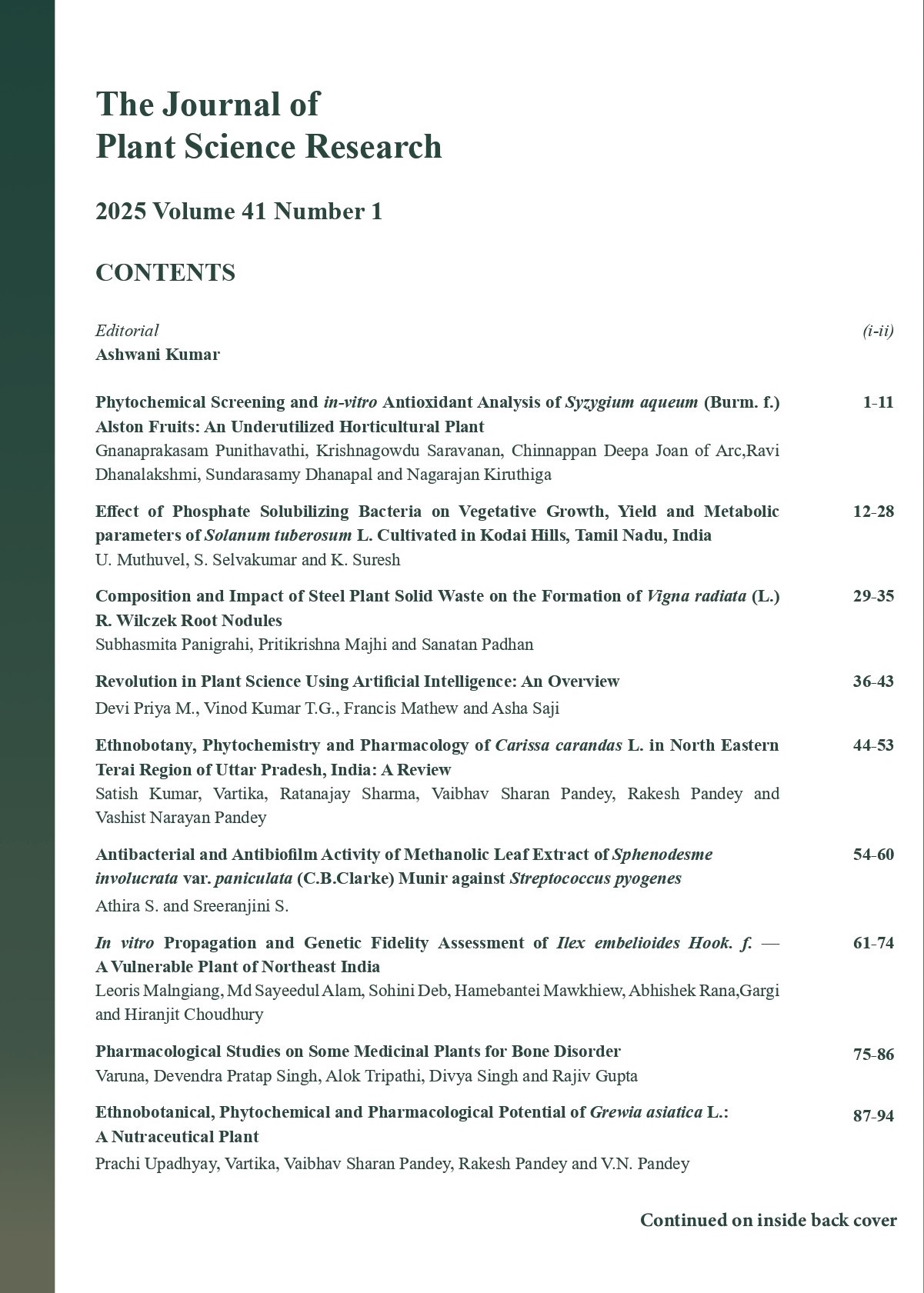


The Journal of Plant Science Research - A UGC Care-Listed Journal
Published in Association with Forum For the Promotion of Plant Science Research
Current Volume: 42 (2026 )
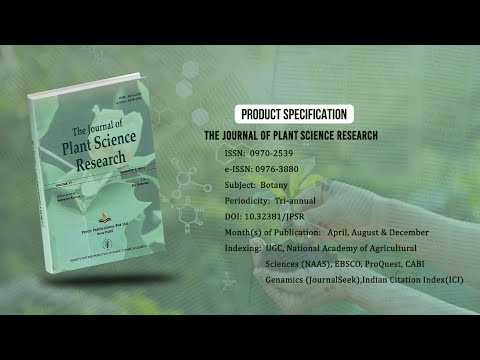
ISSN: 0970-2539
e-ISSN: 0976-3880
Periodicity: Tri-annual
Month(s) of Publication: April, August & December
Subject: Botany
DOI: 10.32381/JPSR
Online Access is Free for Life Member
Association of Pseudomonas syringae pv. apii with the Seed of Ajwain (Trachyspermum ammi L.)
By : Nanda Ram , Vishal Sharma , Indu Singh Sankhla , Kailash Agrawal
Page No: 883-892
Abstract
Present study aimed to isolate, identify and characterize the bacterial pathogens associated with ajwain seeds using biochemical and molecular methods. One hundred thirty-nine seed samples of ajwain were collected from various districts of Rajasthan. Twenty-four bacterial isolates were isolated and purified from collected seed samples. All strains were characterised for their biochemical activity. All isolates were tested for genetic diversity by using amplified rDNA restriction analysis (ARDRA). Selective strains were subjected for 16S rDNA sequencing and molecular phylogeny study. Most strains were positive for levan production, tobacco hypersensitivity, gelatine liquefaction and aesculin hydrolysis but showed negative reactions for activities of oxidase, tartrate utilisation, potato soft rot, tyrosinase and arginine dihydrolase. These isolates were distinguished into three groups based on the ARDRA pattern. Selected isolates (KANRJ 1507, KANRJ 1562 and KANRJ 1637) were subjected for 16S rRNA gene sequencing. In phylogenetic analysis all three isolates showed 99.85% similarities to each other. In addition, KANRJ 1507 showed 99.93% sequence similarity to P. syringae pv. apii strain BS426 while KANRJ 1562 and KANRJ 1637 showed 99.85% sequence similarity with P. syringae pv. apii strain BS426 isolated from Petroselinum crispum in California, USA. It was also observed that KANRJ 1507 and other two strains (KANRJ 1562 and 1637) showed 99.61% and 99.54% sequence similarities respectively with P. syringae pv. maculicola isolated from radish in the USA.
Authors :
Nanda Ram, Vishal Sharma, Indu Singh Sankhla and Kailash Agrawal
Department of Botany, University of Rajasthan, Jaipur, India.
DOI: https://doi.org/10.32381/JPSR.2022.38.02.42