




The Journal of Plant Science Research - A UGC Care-Listed Journal
Published in Association with Forum For the Promotion of Plant Science Research
Current Volume: 42 (2026 )
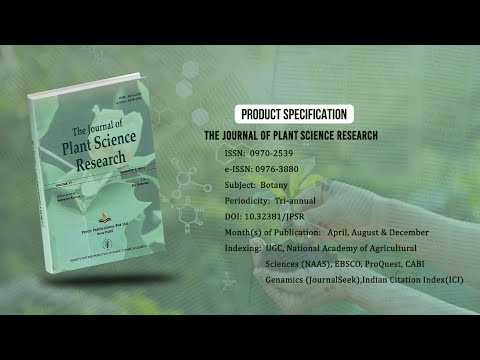
ISSN: 0970-2539
e-ISSN: 0976-3880
Periodicity: Tri-annual
Month(s) of Publication: April, August & December
Subject: Botany
DOI: 10.32381/JPSR
Online Access is Free for Life Member
HPTLC–densitometric and HPTLC–MS Methods for Analysis of Triterpenoids from Cucurbita maxima Peel
By : Apurva P. Bhatkande , Prafullchandra Teklae
Page No: 717-724
Abstract
Fruits and vegetables are integral part of our day to day. They are the main source of food for the living system. Large amount of agro-waste generated from food industries and kitchen pertaining to biggest nutritional loss, environmental problems and economical implications. Even though pomace, peels, rind and seeds are considered a waste part of plant they are still rich source of valuable compounds like polyphenols, oils, enzymes, vitamins, fiber, etc. which is just adjunct to its different uses. Present study conducted on waste pumpkin peel. HPTLC fingerprint profile of pumpkin peel methanol extract was performed using HPTLC plate of silica gel 60 F254 as the stationary phase and Toluene: Chloroform: Ethanol (4:4:1 V/V/V) as the mobile phase. After development chromatogram was scanned at 254 nm and 366 nm by densitometric scanner. Anisaldehyde in sulphuric acid is used as a detecting reagent which gives pink-violet and/or giving blue coloration after derivatization of plate. Further HPTLC-MS analysis gives the confirmation to detected terpenoids. Therefore, this waste peel part of the pumpkin can be used in an ingenious way by further purification, isolation and characterization.
Author :
Apurva P. Bhatkande and Prafullchandra Teklae
Guru Nanak Khalsa College of Arts, Science and Commerce, Matunga (East), Mumbai, India.
DOI: https://doi.org/10.32381/JPSR.2022.38.02.25