


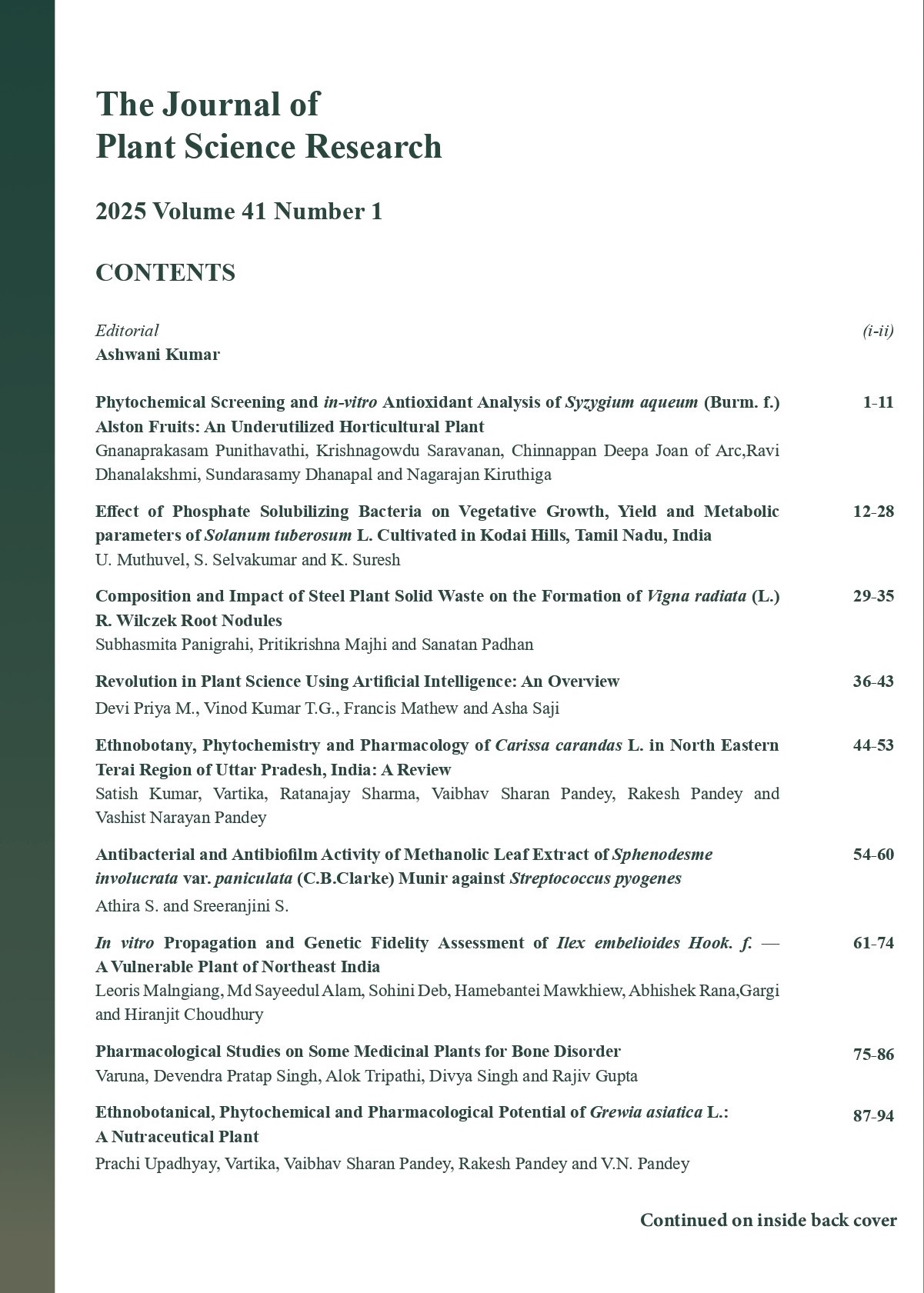


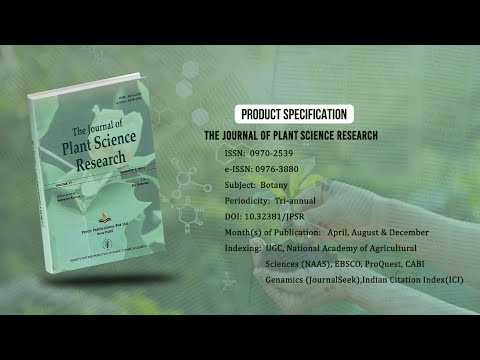
The Journal of Plant Science Research - A UGC Care-Listed Journal
Published in Association with Forum For the Promotion of Plant Science Research
Current Volume: 42 (2026 )
ISSN: 0970-2539
e-ISSN: 0976-3880
Periodicity: Tri-annual
Month(s) of Publication: April, August & December
Subject: Botany
DOI: 10.32381/JPSR
Online Access is Free for Life Member
Diversity Assessment, Utilization Pattern and Indigenous uses of Plants in Shri Naina Devi Conservation Area in District Bilaspur, Himachal Pradesh, North Western Himalayas
By : Pradeep Kumar , G K Dhingra , Rahul Chandora , L R Dangwal , Ajendra Singh Bagri , Ranjeeta Pundir , Sandeep Chand Upadhayay
Page No: 569-587
Abstract:
The Indian Himalayan region is one of the largest biodiversity hotspot in the world. In IHR most of the communities are lived in remote or rural area and are totally dependent on natural resources to fulfill their daily needs. Natural resources such as plant diversity is used as food, medicine, fodder, dye yielding, fuel, timber, rituals and various other function. Shri Naina Devi conservation reserve situated in Bilaspur districts of Himachal Pradesh has not been yet explored for plant diversity. The present study is carried out to assess the plant diversity and their utilization pattern and indigenous uses of the plants. A total 121 species recorded belonged from 107 genera and 57 families. Among these species shrub (26 spp.), tree (48 spp.), herb (47 spp.) were present. The families, Fabaceae (11 spp.), Asteraceae (10 spp.), Moraceae (8 spp.), Poaceae (7 spp.), Lamiaceae (4spp.), Solanaceae (4 spp ), Myrtaceae (4spp.) Brassicaceae (1 spp.); Euphorbiaceae (3 spp.); Rosaceae (3 spp.) were rich species. Among genera, Ficus (7 spp.), Allium (2 spp.), Bauhinia (2 spp.), Acacia (2 spp.), Cassia (2 spp.), Phyllanthus (2 spp.), Rumex (2 spp.), were the dominant genera. 91 species were of multipurpose utility and 30 species were monotypic. The species were used as medicine (107 spp.), food (27 spp.), fuel (37 spp.), fodder (57 spp.), ornamental (24 spp.) timber (9 spp.) and religious (6 spp.) by the inhabitants of the area. This paper gives the scientific name of wild plants along with common names, local names, family, life form, indigenous uses and plant part used by the local inhabitants of the area. Plant parts used such as whole plants, roots (including rhizomes and tubers), leaves, flowers, fruits, seeds and stems by the local people for curing various diseases.
Authors :
Pradeep Kumar : Department of Botany, Pt. L.M.S. Govt. PG College Rishikesh (Autonomous College), Uttarakhand, India.
G K Dhingra : Department of Botany, Pt. L.M.S. Govt. PG College Rishikesh (Autonomous College), Uttarakhand, India.
Rahul Chandora : ICAR-National Bureau of Plant Genetic Resource, Shimla, Himachal Pradesh, India.
L R Dangwal : Department of Botany and Microbiology, H. N. B. Garhwal University, Srinagar, Uttrakhand, India.
Ajendra Singh Bagri : Department of Botany and Microbiology, H. N. B. Garhwal University, Srinagar, Uttrakhand, India.
Ranjeeta Pundir : Department of Chemistry, DSB Kumaun University Nainital, Uttarakhand, India.
Sandeep Chand Upadhayay : Department of Botany, DBS PG College Deharadun, Uttarakhand, India.
DOI: https://doi.org/10.32381/JPSR.2022.38.02.13