


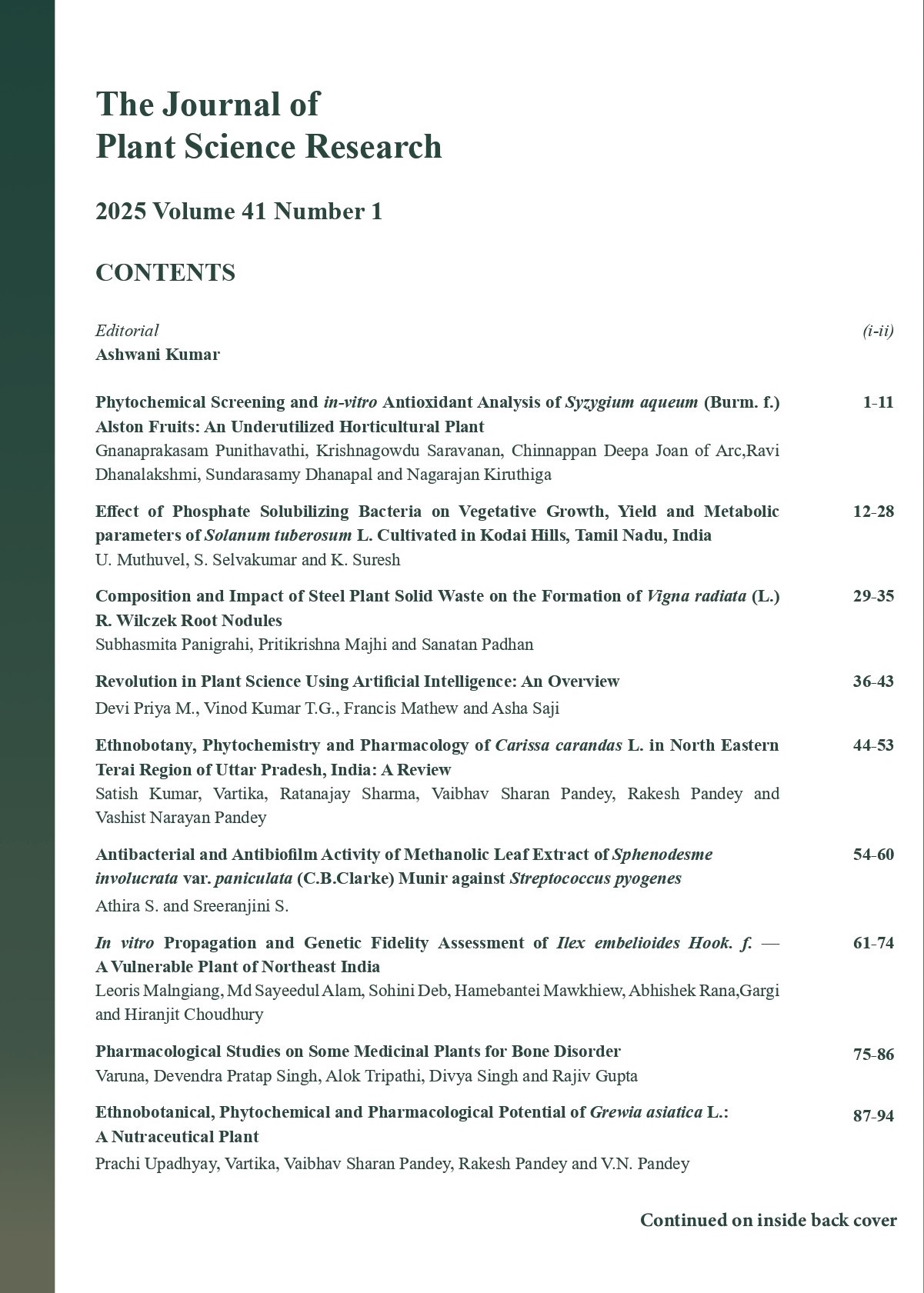


The Journal of Plant Science Research - A UGC Care-Listed Journal
Published in Association with Forum For the Promotion of Plant Science Research
Current Volume: 42 (2026 )
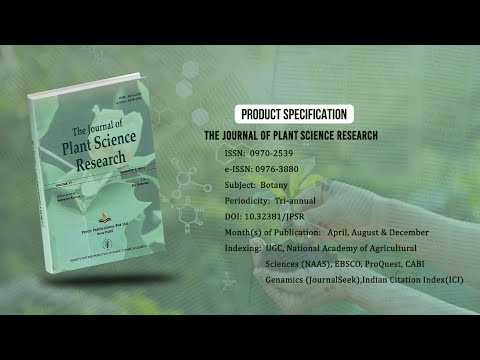
ISSN: 0970-2539
e-ISSN: 0976-3880
Periodicity: Tri-annual
Month(s) of Publication: April, August & December
Subject: Botany
DOI: 10.32381/JPSR
Online Access is Free for Life Member
Proximate Composition, Piperine Quantification, Essential Oil Profile, and Antibacterial Activity of Adi Pepper (a Farmer’s Variety) and Piper nigrum: A Comparative Assessment
By : Shalini M. J. , Komala M. , Prabhavathi S. N. , Rajkumar H. Garampalli
Page No: 9-23
Abstract
Piper nigrum (black pepper) is a globally important spice with well-documented health benefits; however, comparative studies involving indigenous farmers’ varieties, such as Adi pepper (P. relictum), remain limited. This study compared the proximate composition, piperine content (determined by UV–Visible spectrophotometry and HPLC at 343nm), essential oil profiles (analyzed by GC-MS), and antibacterial activity of Adi pepper and P. nigrum. Adi pepper had higher moisture (14.10±0.16%), crude fat (11.25±0.12%), total ash (4.3±0.14%), crude protein (14.66±0.33%), and calorific value (349.14±0.61 kcal/100 g) while P. nigrum showed greater crude fiber (9.24±0.28%) and total carbohydrate content (54.26±0.45%). Higher piperine content was observed in P. nigrum (4.94 ± 0.01% by UV–Vis; 4.71±0.03% w/w by HPLC) compared to Adi pepper.GC-MS analysis showed Adi pepper oil mainly contains caryophyllene and α-phellandrene; P. nigrum oil was sesquiterpene-rich, led by caryophyllene and β-bisabolene. Both showed antibacterial activity except against Escherichia coli, with highest efficacy against Staphylococcus aureus by disc diffusion (13.33 ± 0.33 mm zone of inhibition) and lowest MIC (6.25 mg/mL). These findings reveal distinct phytoconstituents and comparable antimicrobial activity in Adi pepper and P. nigrum.
Authors
Shalini M. J.: Research Scholar, Department of Studies in Botany, University of Mysore, Manasagangotri, Mysuru, Karnataka,
Komala M.: Professor and Chairperson, Department of Studies in Food Science and Nutrition, University of Mysore, Manasagangotri, Mysuru, Karnataka
Prabhavathi S. N. : Research Scholar, Department of Studies in Food Science and Nutrition, University of Mysore, Manasagangotri, Mysuru, Karnataka
Rajkumar H. Garampalli: Professor, Department of Studies in Botany, University of Mysore, Manasagangotri, Mysuru, Karnataka,
DOI: https://doi.org/10.32381/JPSR.2026.42.01.2