


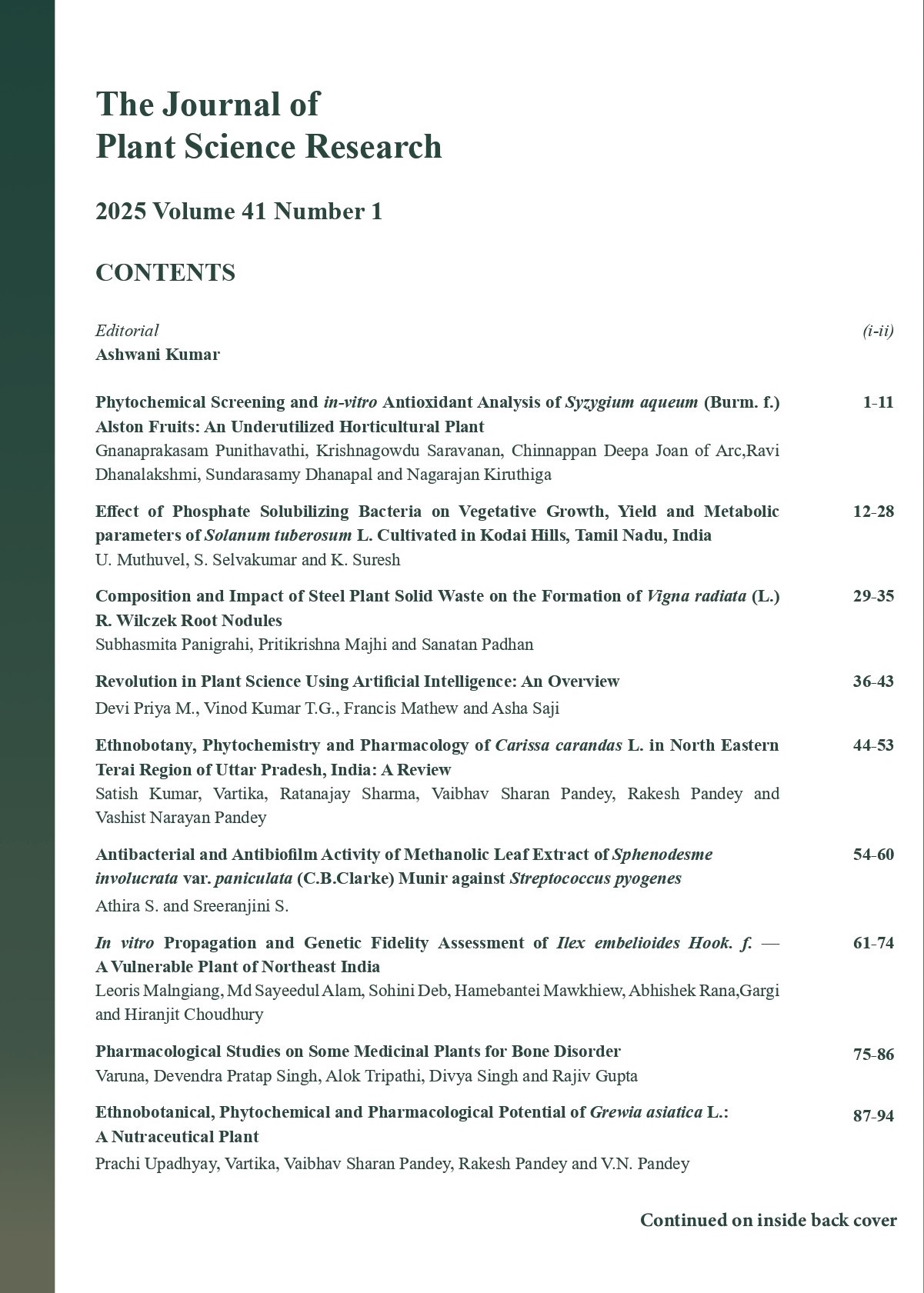


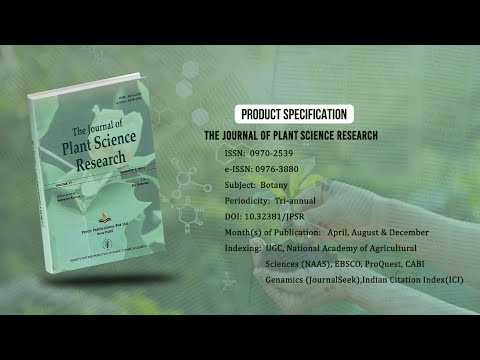
The Journal of Plant Science Research - A UGC Care-Listed Journal
Published in Association with Forum For the Promotion of Plant Science Research
Current Volume: 42 (2026 )
ISSN: 0970-2539
e-ISSN: 0976-3880
Periodicity: Tri-annual
Month(s) of Publication: April, August & December
Subject: Botany
DOI: 10.32381/JPSR
Online Access is Free for Life Member
Antibacterial Activity, Antioxidant Potential, Qualitative Phytochemical Screening, and GC-MS Identification of Phytoconstituents from Leaf and Flower of Parthenium hysterophorus L.
By : Aman Saket , Heena Choudhary , Shivani Singh , Parshant , Shivangi , A.K. Shukla , T. Srinivasan
Page No: 472-487
Abstract
Parthenium hysterophorus L. is traditionally used by local tribes to treat skin infections; however, scientific validation of its medicinal properties remains limited. The present study aimed to investigate the phytochemical composition and identify potential bioactive compounds of P. hysterophorus L. using Gas Chromatography–Mass Spectrometry (GC-MS) and evaluate the antibacterial activities of its crude extracts against plant pathogens. Crude extracts were prepared using the maceration method with water as the solvent. Preliminary phytochemical screening revealed the presence of key secondary metabolites, including phenols, flavonoids, tannins, alkaloids, and terpenoids. Quantitative analysis showed that the leaf extract contained the highest total phenolic content (9.33 ± 0.01 mg GAE/g), followed by the flower extract (6.86 ± 0.01 mg GAE/g). The leaf extract also exhibited the highest levels of flavonoids (1789.62 ± 6.70 mg QE/g) and alkaloids (1465.72 ± 1.81 mg AE/g). In contrast, the flower extract recorded the highest tannin content (11.21 ± 1.72 mg TAE/g). Antioxidant activity was assessed using DPPH, FRAP, and ABTS assays. The leaf extract demonstrated the highest antioxidant potential with 10.73 per cent DPPH scavenging, 256.92 AAE/g in FRAP, and 22.71 per cent ABTS inhibition. Antibacterial activity against Ralstonia solanacearum and Erwinia carotovora was evaluated using the agar well diffusion. At a 90 mg/mL concentration, the leaf extract exhibited antibacterial efficacy comparable to ciprofloxacin (0.5 mcg), particularly against R. solanacearum, indicating a more substantial inhibitory effect than on E. carotovora. GC-MS analysis of the leaf extract identified several bioactive compounds, including 2-Pentanone, 4-hydroxy-4-methyl-, Benzene, 2,4-dichloro-1-methyl, 1-Dodecanol, 2,4-Ditert- butylphenol, Heneicosane, Eicosane, and Neophytadiene. These compounds are known for their antibacterial, anti-inflammatory, insecticidal, antioxidant, cytotoxic, and pesticidal properties. Overall, these findings offer a novel and fundamental basis for the purification and development of plant-derived bioactive compounds with potential applications in pharmaceuticals.
Authors
Aman Saket, Heena Choudhary, Shivani Singh And Parshant: Research Scholar, Department of Botany, Indira Gandhi National Tribal University, Amarkantak, Madhya Pradesh, India.
Shivangi: MSc, Department of Botany, Indira Gandhi National Tribal University, Amarkantak, Madhya Pradesh, India.
A.K. Shukla: Professor, Department of Botany, Indira Gandhi National Tribal University, Amarkantak, Madhya Pradesh, India.
T. Srinivasan: Professor, Department of Botany, Central Tribal University of Andhra Pradesh, Vizianagaram, Andhra Pradesh, India
DOI: https://doi.org/10.32381/JPSR.2025.41.03.12