




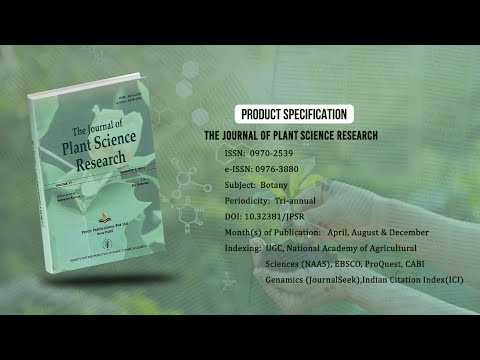
The Journal of Plant Science Research - A UGC Care-Listed Journal
Published in Association with Forum For the Promotion of Plant Science Research
Current Volume: 42 (2026 )
ISSN: 0970-2539
e-ISSN: 0976-3880
Periodicity: Tri-annual
Month(s) of Publication: April, August & December
Subject: Botany
DOI: 10.32381/JPSR
Online Access is Free for Life Member
In Vivo Evaluation of Two Medicinal Fern Extracts for Management of Leaf Spot Disease in Centella asiatica (L.) Urb.
By : D. Herin Sheeba Gracelin , S. Suga , M. Muthu Sheeba , C. Baby Shalini
Page No: 426-437
Abstract
Bacterial leaf spot disease caused by Xanthomonas campestris pv. centellae (Xcpvc) is a major constraint in the cultivation of Centella asiatica (L.) Urban. C. asiatica, a perennial herb belonging to the family Umbelliferae, is widely valued for its medicinal properties, including antihypertensive, antiallergic, anticancer, wound-healing, and bronchodilatory effects. However, the occurrence of leaf spot disease severely diminishes the quality of the leaves, thereby reducing market value and farmers’ income. Pteridophytes, one of the oldest groups of vascular cryptogams, possess notable medicinal potential, and many species have been traditionally used for therapeutic purposes. Based on their medicinal relevance, two ferns—Pteris biaurita L. and Angiopteris evecta (G. Forst.) Hoffm. were selected for the present investigation to assess their biocontrol potential against Xcpvc. The study involved determining the LD50 value of the pathogen, conducting in vivo pot experiments and field trials using the selected fern extracts, and analysing the histology of healthy and infected leaves to evaluate anatomical responses to bacterial infection. Among the two ferns tested, Pteris biaurita L. demonstrated significant efficacy in disease suppression, as evidenced by reduced symptom severity and favorable histopathological responses. These findings suggest that fern-based biocontrol strategies, particularly using P.biaurita, could serve as an eco-friendly and effective approach to manage bacterial leaf spot disease in C. asiatica.
Authors
D. Herin Sheeba Gracelin And S. Suga: Assistant Professor, Department of Botany, Sarah Tucker College, Tirunelveli, Tamil Nadu, India.
M. Muthu Sheeba: Assistant Professor, Department of Botany, Kamaraj College, Tamil Nadu, India.
C. Baby Shalini: Assistant Professor, Department of Botany, Nazareth Margoschis College, Nazareth, Tamil Nadu, India.
DOI: https://doi.org/10.32381/JPSR.2025.41.03.7