


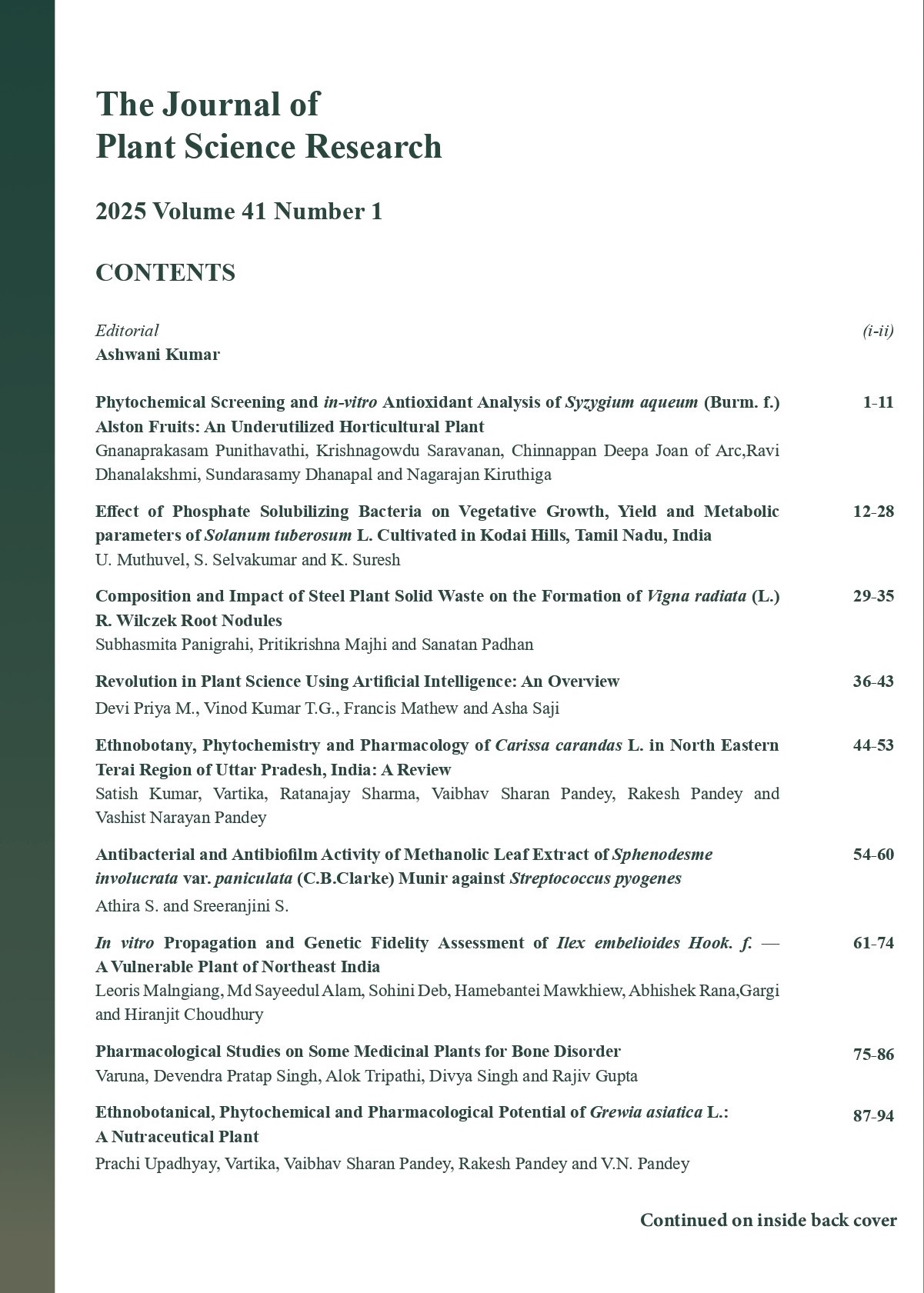


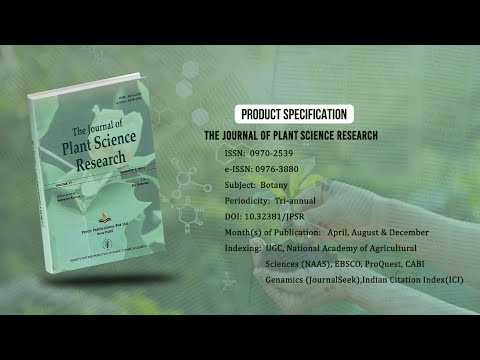
The Journal of Plant Science Research - A UGC Care-Listed Journal
Published in Association with Forum For the Promotion of Plant Science Research
Current Volume: 42 (2026 )
ISSN: 0970-2539
e-ISSN: 0976-3880
Periodicity: Tri-annual
Month(s) of Publication: April, August & December
Subject: Botany
DOI: 10.32381/JPSR
Online Access is Free for Life Member
Studies on the Reproductive Output and GC-MS Analysis of a Mehak Cultivar of Coriander from Jammu Region
By : Urvashi , Vishal Sharma , Priya Sharma , Namrata Sharma , Shivani Bharti , Ranjandeep Kour , Riya Sharma
Page No: 380-389
Abstract
Present study is based on the Mehak cultivar of Coriandrum sativum L. grown in the Union Territory of Jammu and Kashmir. Plants were analysed for their floral phenological events, reproductive output and GCMS analysis of ethanolic extract of their leaves for the first time from Jammu. Sex expression is andromonoecy with staminate and perfect flowers are present in each umbellet of every umbel. Flowering is centripetal i.e. peripheral umbellets are the first to bloom followed by the central umbellets. Each flower shows protandrous condition which is responsible for the visitation of various insects to ensure the successful pollination. Percentage fruit set was found to be higher on open pollination in comparable to bagging depicting the role of the insects in pollination. With respect to GCMS, a total of 115 compounds have been reported from ethanolic extract of coriander leaves. Among these, Z, Z-4,15-Octadecadien- 1-ol acetate is present dominantly with peak area 15.74 per cent at retention time 38.04. Various other compounds have also been observed such as Pallensin, 1-Nonadecene, Phytyl stearate, 1-Hexacosanol, Stigmasterol, 9, 12, 15-Octadecatrienoic acid, 2, 3-dihyd, 13-Docosenamide, n-Hexadecanoic acid etc. Pallensin is a eudesmanolide which has been reported for the first time from the coriander leaves. All compounds are associated with various biological activities such as antioxidant, antibacterial, anticancer, anti-diabetic, anti-tumor, antimicrobial, hepatoprotective, anti-arthritic, anti-asthma and diuretic activity. On the basis of these activities, coriander can be recommended as a plant of pharmaceutical importance.
Authors
Urvashi: Student, Department of Botany, Central University of Jammu, J&K, India.
Vishal Sharma: Indian Institute of Integrative Medicine, J&K, India.
Priya Sharma: Assistant Professor (Guest Faculty), Department of Botany, Central University of Jammu, J&K, India.
Namrata Sharma: Professor (Former Head), Department of Botany, University of Jammu, J&K, India.
Shivani Bharti, Ranjandeep Kour and Riya Sharma: Student, Department of Botany, Central University of Jammu, J&K, India.
DOI: https://doi.org/10.32381/JPSR.2025.41.03.3