


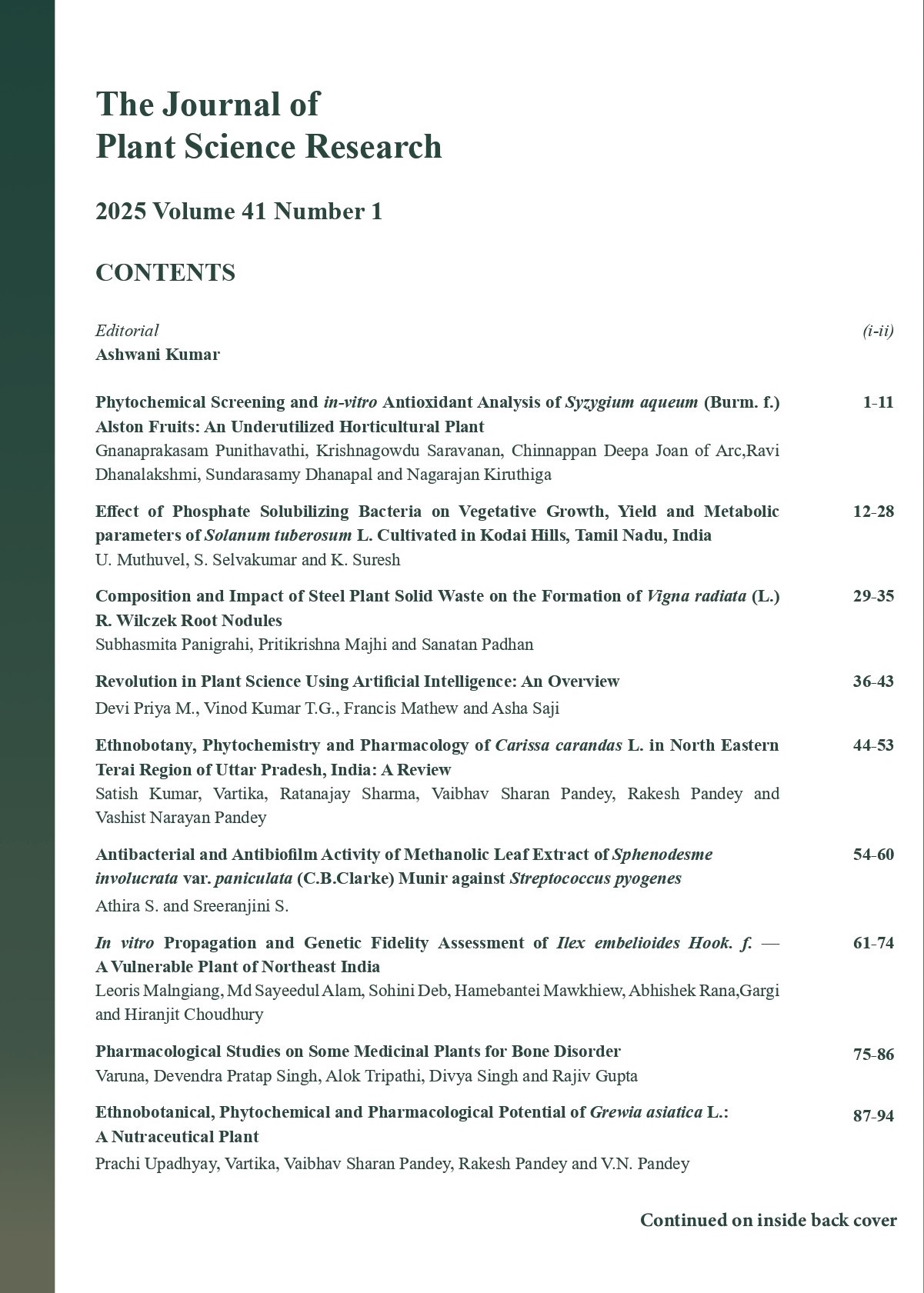


The Journal of Plant Science Research - A UGC Care-Listed Journal
Published in Association with Forum For the Promotion of Plant Science Research
Current Volume: 42 (2026 )
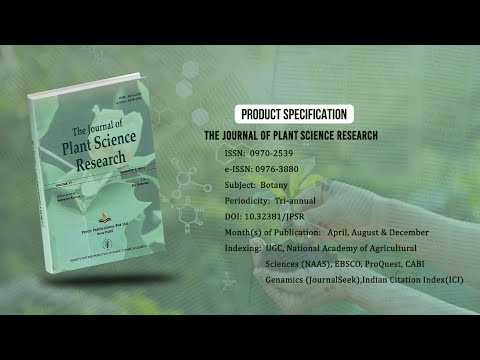
ISSN: 0970-2539
e-ISSN: 0976-3880
Periodicity: Tri-annual
Month(s) of Publication: April, August & December
Subject: Botany
DOI: 10.32381/JPSR
Online Access is Free for Life Member
Study on Pollinator Diversity and Pollen Carrying Capacity of Insects in the Mango Orchards of North Malda Region, West Bengal, India
By : Tirtharaj Choudhury , Suravi Chakraborty , Pankaj Kundu , Pallabi Mondal , Dipraj Chakraborty , Prasanta Saha , Shubhrajit Bhowmik , Partha Sarathi Nandi
Page No: 357-366
Abstract
Study of insect pollinator diversity and pollen carrying capacity was carried out in the mango orchards of the Northern part of Malda district, West Bengal, India. The diversity study of pollinators has revealed that Diptera, Hymenoptera are the most abundant groups, followed by others. Episyrphus spp, Eristalinus taeniops, Apis spp, Musca spp and Calliphora spp were the most abundant pollinator species found within the community of abundant insect pollinators in the study period. The calculated pollinator diversity indices have revealed moderate diversity as noticed by the values of the Simpson index (0.3013), Shannon index (2.308), or Margalef Index (1.637). Pollen carrying capacity was found to be comparably higher in the honey bee (Apis spp; 275±33.07) than the other pollinators due to its larger body size. A distinctive positive correlation (r = +0.80) was observed between body size and pollen load. Apis spp has a larger body size and greater pollen load, but it can’t be stated that it is the most efficient pollinator for lesser abundance (9.14). Episyrphus spp can be considered as the most efficient pollinator due to its enormous abundance (59.57) and higher visitation frequency, although it has a smaller body size with the lowest pollen load (100±19.09).
Authors
Tirtharaj Choudhury, Suravi Chakraborty and Pankaj Kundu: Post Graduate Student, Department of Zoology, Raiganj University, Raiganj, Uttar Dinajpur, West Bengal, India.
Pallabi Mondal and Dipraj Chakraborty: Research Scholar, Laboratory of Insect Ecology and Pest Management, Department of Zoology, Raiganj University, Raiganj, Uttar Dinajpur, West Bengal, India.
Prasanta Saha: Assistant Professor, Department of Zoology, Murshidabad University, Berhampore, Murshidabad, West Bengal, India.
Shubhrajit Bhowmik: Assistant Professor, Department of Zoology, Vivekananda College, East Burdwan, West Bengal, India.
Partha Sarathi Nandi: Associate Professor, Laboratory of Insect Ecology and Pest Management, Department of Zoology, Raiganj University, Raiganj, Uttar Dinajpur, West Bengal, India.
DOI: https://doi.org/10.32381/JPSR.2025.41.03.1