


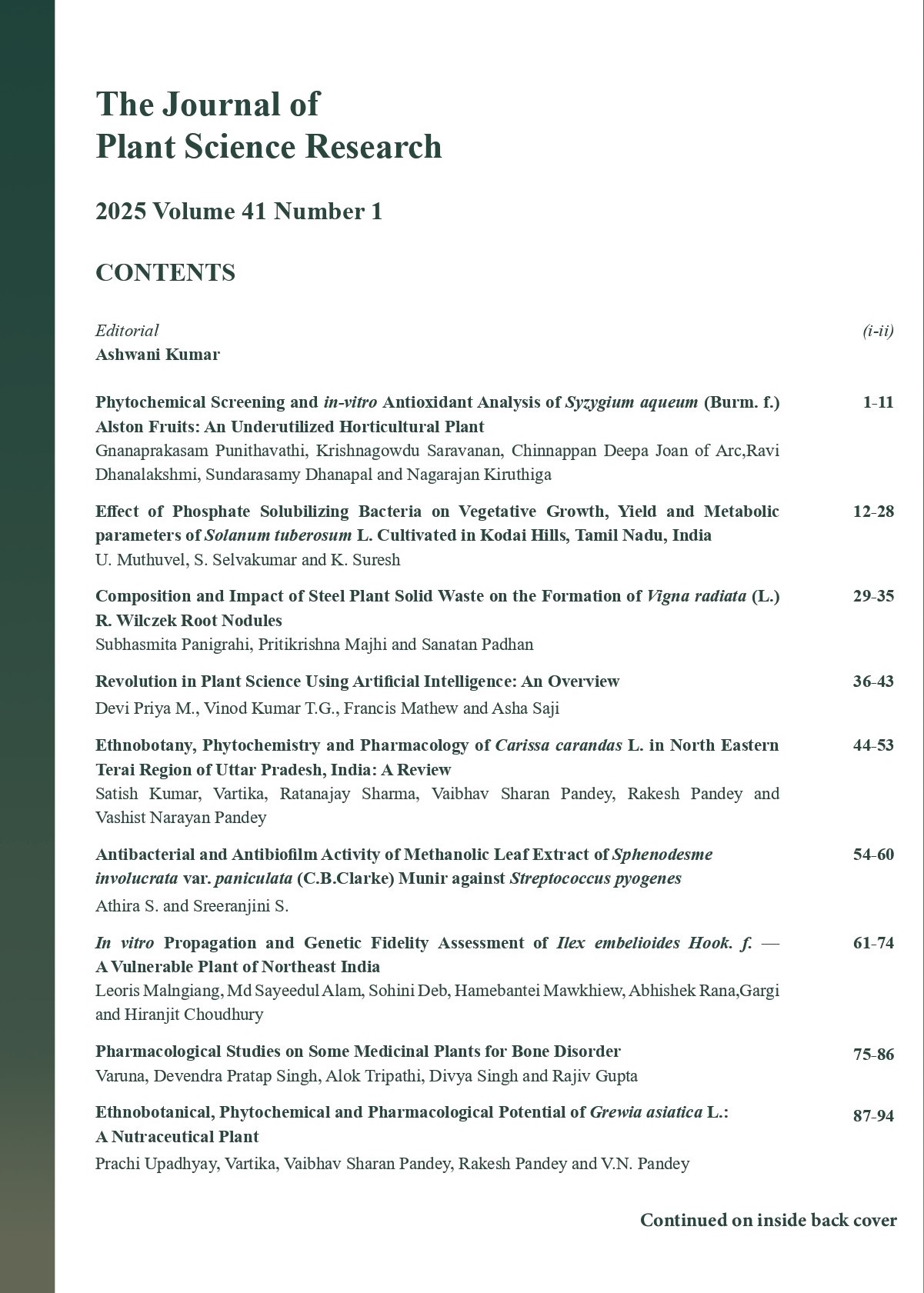


The Journal of Plant Science Research - A UGC Care-Listed Journal
Published in Association with Forum For the Promotion of Plant Science Research
Current Volume: 42 (2026 )
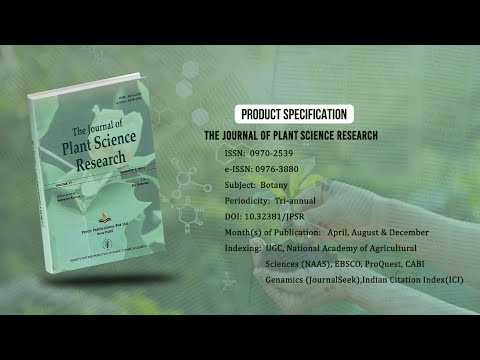
ISSN: 0970-2539
e-ISSN: 0976-3880
Periodicity: Tri-annual
Month(s) of Publication: April, August & December
Subject: Botany
DOI: 10.32381/JPSR
Online Access is Free for Life Member
Micromorphological Investigation of Trichomes in Selected Species of the Asteraceae Family from the Semi-Arid Regions of Barmer, Rajasthan, India
By : Vimala , Dinesh Hans
Page No: 236-247
Abstract:
Trichomes are delicate outgrowth appendages on plants. They are of diverse surface structure and function. Trichomes play a crucial role in identifying plants belonging to the Asteraceae family. The morphology, ultrastructure, density, and distribution of trichomes on abaxial, adaxial surfaces of leaves and stem of Echinops echinatus Roxb., Eclipta prostrata (L) L., Grangea maderaspatana (L) Poir, Tridax procumbens L. and Verbesina encelioides (Cav.) Benth. & Hook. f. were examined using compound light microscopy, and images were taken using a Samsung smartphone. All five investigated species contained Glandular and Non-glandular trichomes but differed in trichome ultrastructure and density. Echinops echinatus Roxb. and Tridax procumbens L. leaves are more hairy than those of other studies species. The glandular trichomes are biseriate, sessile with a capitate head in Grangea maderaspatana, peltate glandular-stellate, multicellular trichome in Tridax procumbens, peltate trichome- ball-shaped, multicellular in Verbesina encelioides were observed. Non-glandular were filiform, short or long with pointed or blunt end in studied species. The density of trichomes was higher on the stem and abaxial surface of leaves than on the adaxial surface of leaves.
Authors:
Vimala: Assistant Professor, Department of Botany, Multan Mal Bhikhchand Chhajed Government Girls College Barmer, Rajasthan
Dinesh Hans: Professor, Department of Botany, Seth Ranglal Kothari Government College, Rajsamand, Rajasthan,
DOI: https://doi.org/10.32381/JPSR.2025.41.02.4