



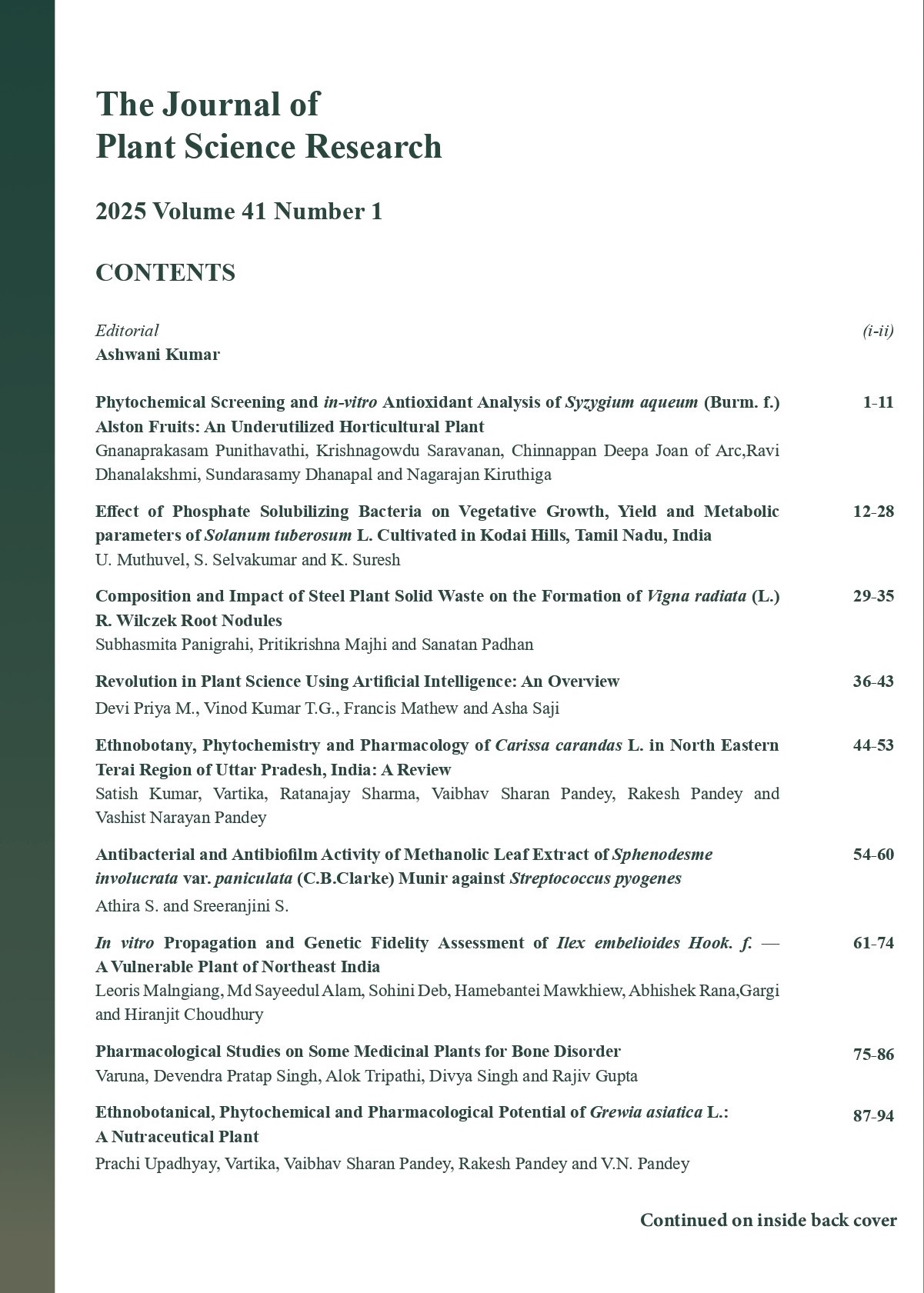

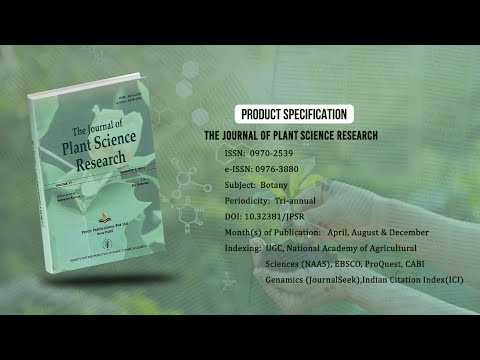
The Journal of Plant Science Research - A UGC Care-Listed Journal
Published in Association with Forum For the Promotion of Plant Science Research
Current Volume: 41 (2025 )
ISSN: 0970-2539
e-ISSN: 0976-3880
Periodicity: Tri-annual
Month(s) of Publication: April, August & December
Subject: Botany
DOI: 10.32381/JPSR
Online Access is Free for Life Member
In vitro Propagation and Genetic Fidelity Assessment of Ilex embelioides Hook. f. —A Vulnerable Plant of Northeast India
By : Leoris Malngiang , Md Sayeedul Alam , Sohini Deb , Hamebantei Mawkhiew , Abhishek Rana , Gargi , Hiranjit Choudhury
Page No: 61-74
Abstract
Ilex embelioides Hook. f. is a small evergreen tree, endemic to Arunachal Pradesh and Meghalaya, India. This species is listed as vulnerable (VU) in the IUCN Red List, and is considered to be extremely rare.It belongs to the genus Ilex under the family Aquifoliaceae. Traditionally, the species is used for the treatment of cold, cough, tuberculosis and its bark is used as natural black dye. The plant has been exploited heavily for its timber posing threat for the survival of the species in the wild. Under natural conditions, seed germination of the species is low and vegetative propagation is also slow. Thus, mass propagation through in vitro culture methods is important to compensate for the poor regeneration capacity of the natural populations of I. embelioides. With this perspective, shoots were induced in vitro from apical and nodal buds of I. embelioides on WPM and MS media supplemented with 2μM of BAP.Out of five different basal media tested (MS, ½ MS, ¼ MS, White’s medium and WPM); WPM was found to be the most effective for shoot initiation, whereas both WPM and MS was effective for callus initiation. Different plant growth regulators (BAP, KN, IAA and 2, 4-D) at different concentration (2μM - 12 μM for nodal explants and 0.1 μM- 2μM for leaf explants) were used for the induction of shoots in different proportions. The combination of BAP (8.23 μM) and Kinetin (5.11 μM) on WPM was found optimum for shoot elongation from apical buds with minimum browning of the explants. Whereas, combination of BAP (1.11 μM) and 2, 4-D (1.25μM) both in WPM and MS resulted in optimum and healthy callus formation from leaf explants. Half strength WPM and ½ MS were supplemented with different concentration of IBA, NAA and IAA for root induction. 71.11 per cent of root initiation was achieved on ½ WPM with 9.08 μM of IBA, but no rooting response was obtained in other combinations of plant growth regulators. Acclimatization and final establishment of rooted plantlets were done in potting mixture of soil, sand and perlite (1:1:1 v/v/v) with 60 per cent survivability rate. SPAR method was employed to confirm the genetic uniformity among the randomly selected in vitro plantlets raised from young mother plant (YMP) and mature mother plant (MMP) explant sources. Results revealed that young plants are better choices for explant collection with regenerants from YMP showing 4.37 per cent while MMP having 7.69 per cent polymorphism with that of the mother plant. Minor variations among the regenerants especially with YMP explants guarantee the safety and efficacy of the micropropagation procedure for the purpose of producing true to type genotype for species recovery and conservation of the species as well as ethnomedicinal uses.
Authors :
Leoris Malngiang, Md Sayeedul Alam, Sohini Deb, Hamebantei Mawkhiew, Abhishek Rana and Gargi
Research Scholar, Department of Biotechnology and Bioinformatics, North-Eastern Hill University, Shillong, Meghalaya, India.
Hiranjit Choudhury : Associate Professor of Biotechnology (Supervisor), Department of Basic Sciences and Social Sciences, North-Eastern Hill University, Shillong, Meghalaya, India.
DOI: https://doi.org/10.32381/JPSR.2025.41.01.7