


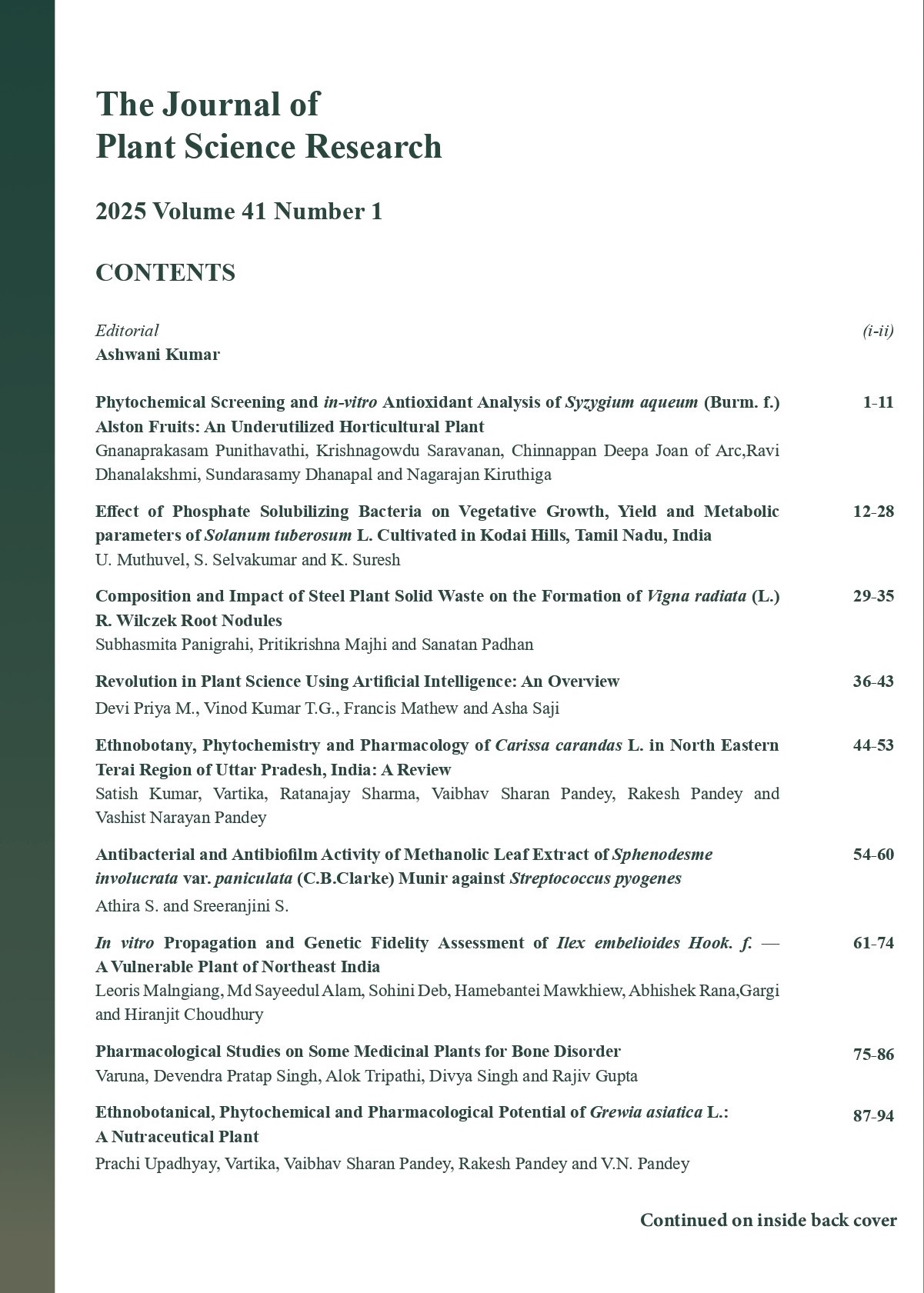


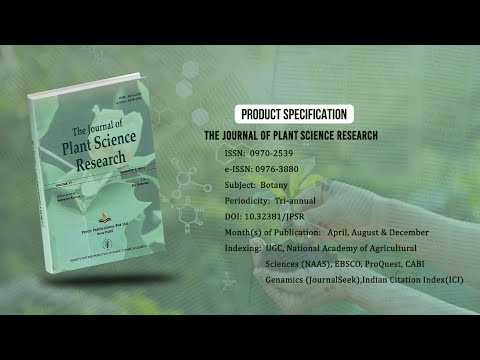
The Journal of Plant Science Research - A UGC Care-Listed Journal
Published in Association with Forum For the Promotion of Plant Science Research
Current Volume: 42 (2026 )
ISSN: 0970-2539
e-ISSN: 0976-3880
Periodicity: Tri-annual
Month(s) of Publication: April, August & December
Subject: Botany
DOI: 10.32381/JPSR
Online Access is Free for Life Member
Micropropagation of Vetiver: A Sustainable Approach to Production of Essential Oil
By : Roshita Shrivastava , Ankan Singh , Shailja Verma , Rajneesh K. Agnihotri
Page No: 458-463
Abstract
In vitro plant regeneration of Vetiveria zizanioides (L.) Nash, which is synonymously known as Chrysopogon zizanioides (L.) Roberty was successfully achieved using a callus-mediated indirect organogenesis method. Rhizomatous explants were cultured on Murashige and Skoog’s (MS), 1962 medium, supplemented with various concentrations of 2, 4-D (2, 4-Dichlorophenoxyacetic acid) and kinetin. Optimal callus induction was observed in media containing 1 µM 2, 4-D and 0.25 µM kinetin. The induced callus was subsequently transferred to MS medium supplemented with 0.5 – 2.5 µM BAP (6-Benzylaminopurine) for shoot regeneration. Among the tested concentrations, 1.0 µM BAP was identified as the most effective for both shoot induction and multiplication. For rooting, the regenerated shoots were transferred to MS medium containing 0.5 µM NAA (Naphthaleneacetic acid), which facilitated robust root development. The acclimatization process involved transferring the plantlets to husk charcoal, where a high survival rate of 90 per cent was recorded. This study highlights an efficient protocol for the in vitro propagation of Vetiver, which can be crucial for its large-scale cultivation and conservation. The successful regeneration and high survival rate during acclimatization underscore the potential of this method for commercial applications and ecological restoration projects. The use of specific hormone concentrations for different stages of regeneration (callus induction, shoot regeneration, and rooting) provides a detailed framework for optimizing tissue culture conditions for Vetiveria zizanioides (L.) Nash. This research contributes to the broader understanding the role of plant tissue culture techniques and its practical applications in agriculture and environmental management for quality improvement.
Authors :
Roshita Shrivastava , Ankan Singh , Shailja Verma and Rajneesh K. Agnihotri
Department of Botany, School of Life Sciences, Khandari Campus, Dr. Bhimrao Ambedkar University, Agra, Uttar Pradesh, India.
DOI: https://doi.org/10.32381/JPSR.2024.40.03.11