


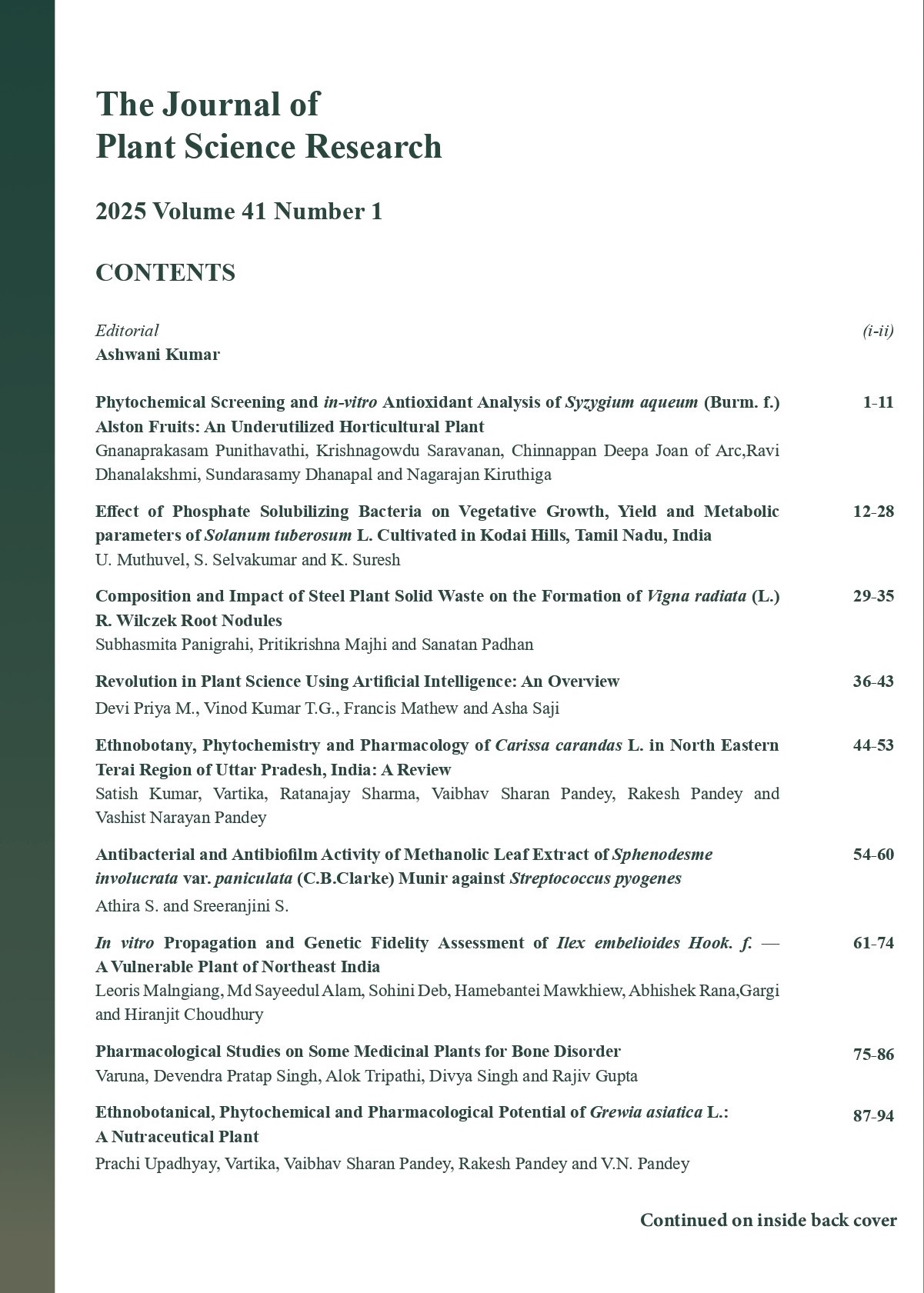


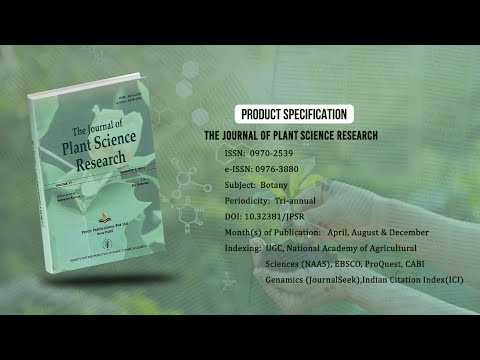
The Journal of Plant Science Research - A UGC Care-Listed Journal
Published in Association with Forum For the Promotion of Plant Science Research
Current Volume: 42 (2026 )
ISSN: 0970-2539
e-ISSN: 0976-3880
Periodicity: Tri-annual
Month(s) of Publication: April, August & December
Subject: Botany
DOI: 10.32381/JPSR
Online Access is Free for Life Member
Seed Ecology and Seedling Phenology of Canscora alata (Roth) Wall.—A Threatened Medicinal Plant of the Family Gentianaceae
By : Bubai Bera , Arabinda Samanta , Prakash Karmakar
Page No: 254-263
Abstract
We studied the seed ecology and seedling phenology of Canscora alata. Seeds of C. alata are very small with very hard blackish-brown and reticulate testa. Mechanical scarification experiments explain that the seeds require strong to moderate scarification of hard testa to break dormancy for successful germination. The seeds remain viable only for one year after successfully dispersed into the soil. The final germination percentage (FGP) was only 11%, i.e., among the total seeds produced in a population, only 11% will germinate in the next year. Due to the low Germination Index (GI), the seed lots germinated slowly in the wild. Seedling shows phanerocotylar epigeal type of germination. After the emergence of the radicle, the seedling takes, on average, 48–58 days to complete its vegetative phase. The plant species C. alata is becoming more endangered in its natural habitat as a result of decreased seed viability and germination capabilities. Seedling ecology and phenological characteristics help protect threatened medicinal plants from anthropogenic disturbances in their wild ecological habitat. We expect that our study will contribute to further research and conservation planning for this threatened medicinal plant species.
Authors:
Bubai Bera : Department of Botany, Kashipur Michael Madhusudan Mahavidyalaya, Kashipur, Purulia, West Bengal, India.
Arabinda Samanta : Department of Botany, Jhargram Raj College, Jhargram, West Bengal, India.
Prakash Karmakar : Palynology & Plant Reproductive Biology Laboratory, Department of Botany & Forestry, Vidyasagar University, Midnapore, West Bengal, India.
DOI: https://doi.org/10.32381/JPSR.2024.40.02.6