


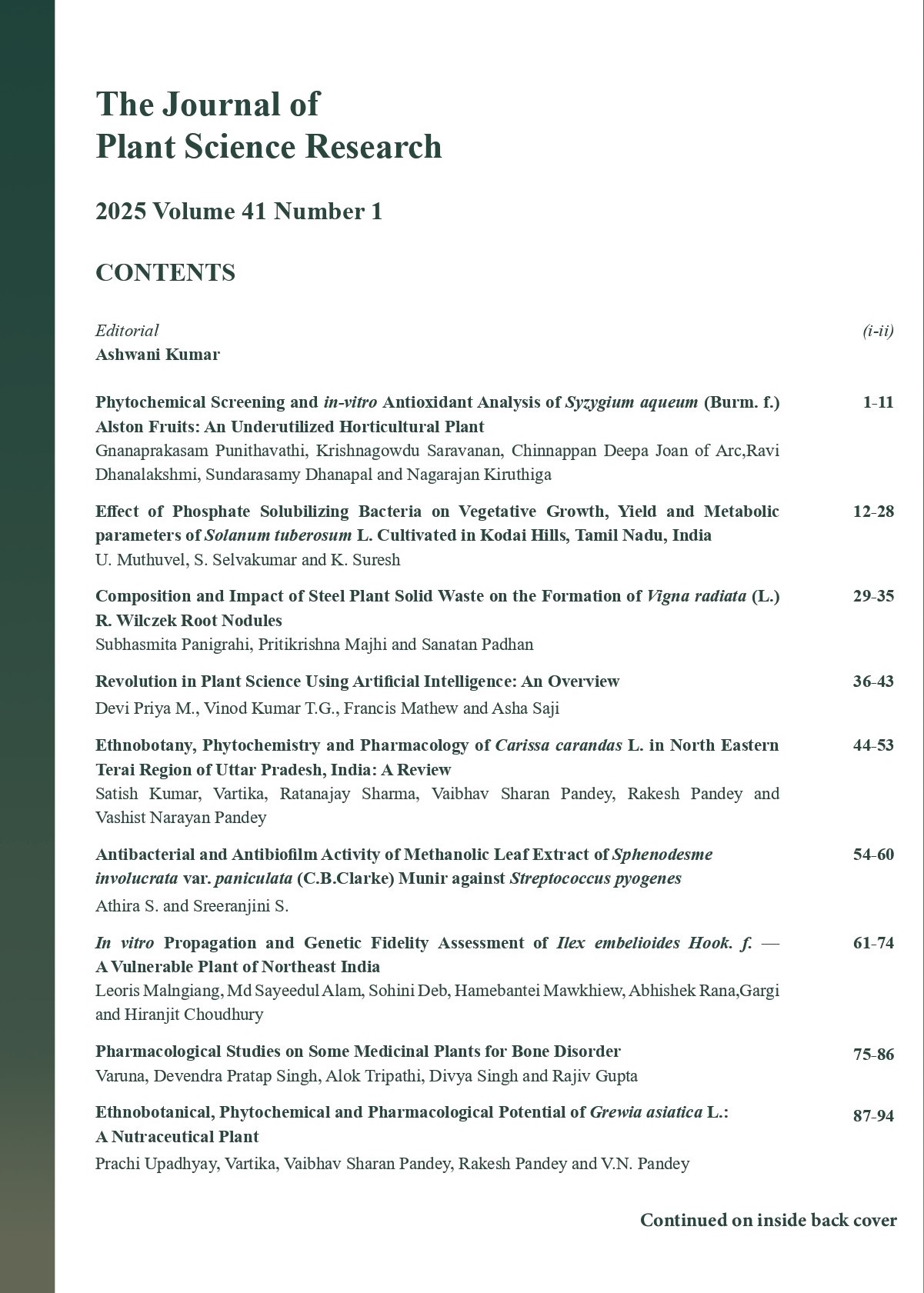


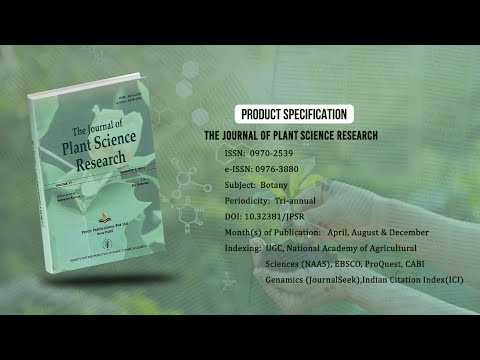
The Journal of Plant Science Research - A UGC Care-Listed Journal
Published in Association with Forum For the Promotion of Plant Science Research
Current Volume: 42 (2026 )
ISSN: 0970-2539
e-ISSN: 0976-3880
Periodicity: Tri-annual
Month(s) of Publication: April, August & December
Subject: Botany
DOI: 10.32381/JPSR
Online Access is Free for Life Member
Study of Growth Parameters in Cultivation of Pleurotus ostreatus (Jacq.) P. Kumm.
By : Manmohan Arya , Indu Singh Sankhla
Page No: 138-143
Abstract
In India the waste generated from agriculture crops does not have any proper industrial use. Mushroom is a fleshy, macroscopic fungus belonging to the basidiomycetes group of Mycota kingdom. Edible mushrooms have significant diversity in their cultivation. The climate of the northern hilly region of India is suitable for Agaricus whereas the southern is fit for Volvoriella cultivation. The subtropical region offers the perfect conditions for Pleurotus cultivation. Pleurotus has many species like P. ostreatus, P. florida, P. sapidus, P. djmor, P. eous etc. Pleurotus ostreatus is suitable for tropical and subtropical region of the country. Rajasthan produces several subtropical crops like Bajra, Mustard, and Wheat, which resulting in generation of lignocellulose-rich waste. This study investigated the impact of various agro-wastes on the growth of Pleurotus ostreatus. Three combinations of agro-crop wastes were employed and examined. Pleurotus ostreatus took the least amount of time for the spawn run in the Wheat-Mustard-Bajra (T3 ) combination, while the Wheat-Bajra (T1 ) combination saw the earliest primordia initiation. The T1 combination also saw the shortest maturation time and shortest harvesting period. Furthermore, among the three highest-weight individuals from each treatment, T3 exhibited larger dimensions compared to others, with weights of 22 gm, stem length of 6 cm, and cap dimensions of 8x9cm². Maximum harvested mushroom production (636 gm), biological efficiency (84.7%) and Moisture content (91.44%) were noted in the T2 combination. The goals of sustainable development will be met and an appropriate agro-waste for mushroom cultivation will be established with the aid of this study.
Authors:
Manmohan Arya : Department of Botany, University of Rajasthan, Jaipur, Rajasthan, India.
Indu Singh Sankhla : Department of Botany, University of Rajasthan, Jaipur, Rajasthan, India.
DOI: https://doi.org/10.32381/JPSR.2024.40.01.16