


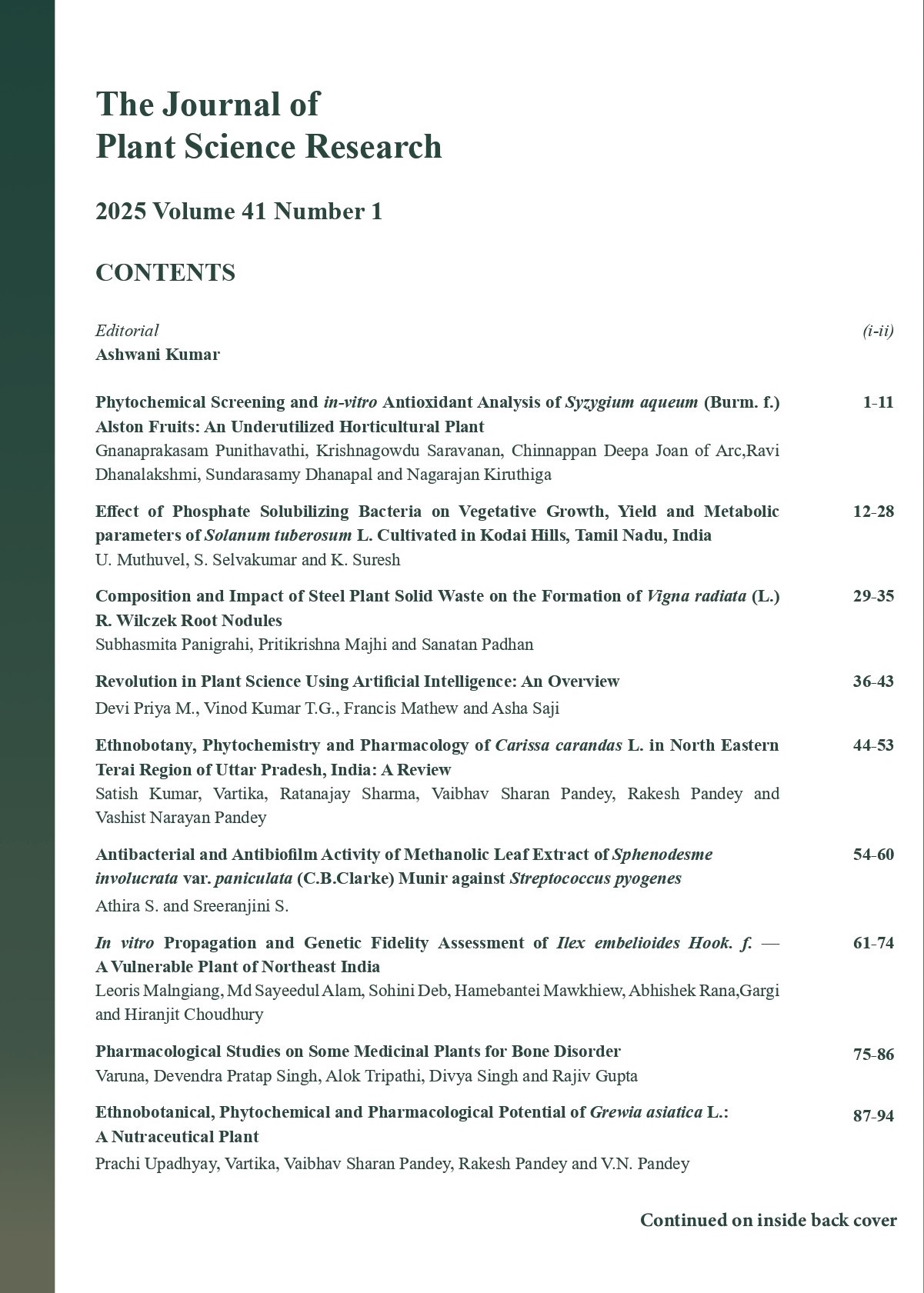


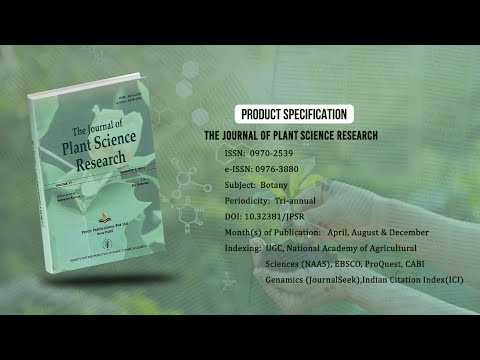
The Journal of Plant Science Research - A UGC Care-Listed Journal
Published in Association with Forum For the Promotion of Plant Science Research
Current Volume: 42 (2026 )
ISSN: 0970-2539
e-ISSN: 0976-3880
Periodicity: Tri-annual
Month(s) of Publication: April, August & December
Subject: Botany
DOI: 10.32381/JPSR
Online Access is Free for Life Member
Studies on the phytochemical constituents, antioxidant capacity and antibacterial activity of the Andrographis serpyllifolia (Rottler ex Vahl) Wight
By : Rathna Kumari B.M. , Raveesha H.R.
Page No: 119-128
Abstract
Andrographis serpyllifolia is a traditional medicinal plant used in curing wounds and jaundice for its potential antimicrobial properties. The present study was aimed to screening of phytochemical constit uents of A. serpyllifolia and to investigate its antioxidant and antibacterial property. The results showed alkaloids, flavonoids, phenols, coumarins, polysterols, terpenoids, etc. Intriguingly, higher amounts of phenolic content and alkaloids were found in the stem, flavonoids in the root and stem and tannins in the leaf. The antioxidant potential of the plant extracts determined by different methods showed differential inhibition values and was concentration dependent. The higher DPPH and ABTS scavenging activity were found in stem and leaf extract with an IC50 value of 23.81±5.71 µg/mL and 3.70±1.38 µg/mL respec tively. The reducing power scavenging activity was higher in the leaf extract (136.17±24.24µg/mL) and stem (152.7±10.13µg/mL). Whereas the total antioxidant capacity was noticed in stem and root extracts. The antibacterial activity was done against both gram-positive and gram-negative bacterial strains. Comparatively, leaf and stem extracts were more effective against B. subtilis with a maximum zone of inhibition (19.66±1.23 and 19.29±1.40 mm) followed by root extracts against E. faecalis (22.19±1.86 mm) at 30 µg/µL. Further, the leaf, stem, and root extract were efficient against E. coli with the zone of inhibition of 23.46±2.51, 19.66±2.25 and 21.66±2.15 mm respectively, at 30 µg/µL concentration. The studies conclude that A. serpyllifolia is a rich source of potential phytochemicals with antioxidant and antibacterial properties.
Authors:
Rathna Kumari B.M. : Department of Botany, Government First Grade College, Vijayanagar, Bengaluru, Karnataka, India.
Raveesha H.R. : Department of Botany, Bangalore University, Jnana Bharathi Campus, Bengaluru, Karnataka, India.
DOI: https://doi.org/10.32381/JPSR.2024.40.01.14