


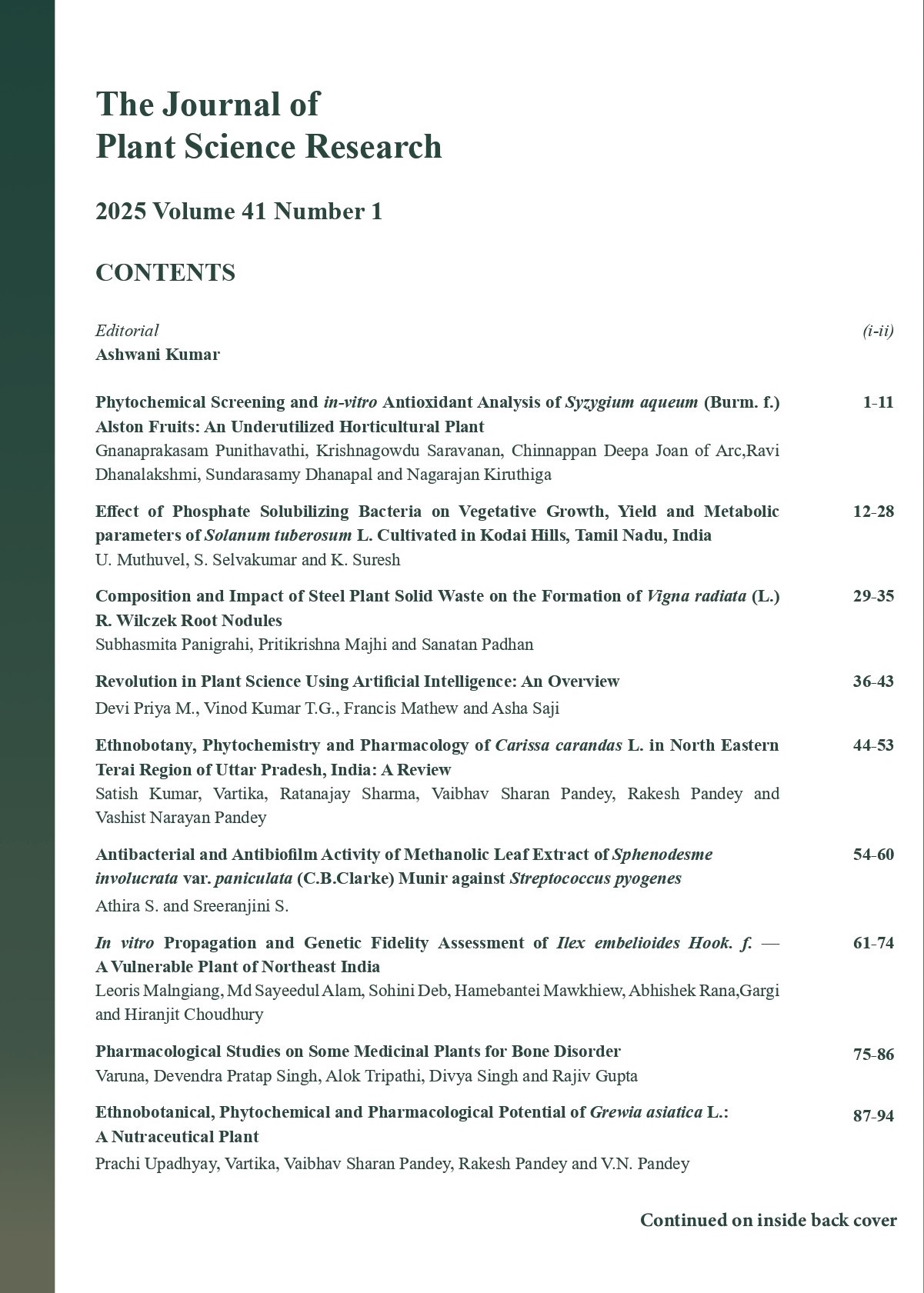


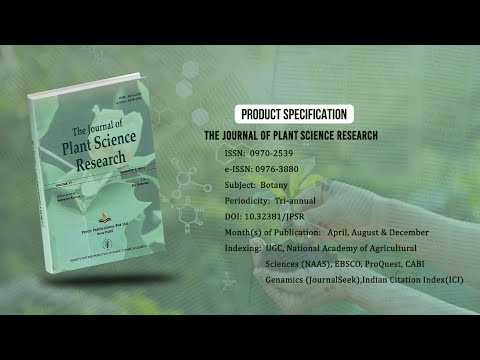
The Journal of Plant Science Research - A UGC Care-Listed Journal
Published in Association with Forum For the Promotion of Plant Science Research
Current Volume: 42 (2026 )
ISSN: 0970-2539
e-ISSN: 0976-3880
Periodicity: Tri-annual
Month(s) of Publication: April, August & December
Subject: Botany
DOI: 10.32381/JPSR
Online Access is Free for Life Member
FTIR spectroscopy and GC-MS based investigation of Urtica dioica L. roots methanol extract corroborate its usage in traditional orthopedic medicine of Darjeeling hills, West Bengal, India
By : Chandan Naskar , Projjwal Chandra Lama
Page No: 88-102
Abstract
Plants used for medicinal purposes have been used for thousands of years, and are well-known for their efficacy in a variety of treatments. Numerous plants used for medicinal purposes were identified and studied for their biochemical profile and characterized for finding functional groups. Urtica dioica L., with a common name Sishnu, belong to the family of Urticaceae. It is used traditionally to treat bone fracture healing and lowering the high blood pressure. The GC-MS analysis was carried out with methanolic extracts of Urtica dioica L. and Fourier Transform Infrared Spectrophotometer (FT-IR) analysis was done with dried Urtica dioica L. root powder. A total of 74 phytochemical constituents have been identified by comparing the chromatogram peak values of unknown compounds with entries in NIST database. The major bioactive compounds found in the extract, which acts on orthopedic healing treatment were Dodecanoic acid, Tetradecanoic acid, Diethylene glycol monolaurate, Octaethylene glycol monododecyl ether, Hexaethylene glycol monododecyl ether, n-Hexadecanoic acid, Hexadecanoic acid, 2-hydroxyethyl ester, Tetradecanoic acid, 2-hydroxyethyl ester, Methyl tetradecanoate, 15-Crown-5, 2,5,8,11-Tetraoxatridecan-13-yl benzoate, Hexaethylene glycol, TBDMS derivative, Octadecanoic acid and 2-Hydroxyethyl ester. The FTIR spectrum confirmed the presence of amines, alkene, alkyne, aromatic, alkylhalides, organic chloride, aliphatic amines and amide groups. The detailed investigation done with these processes helps in screening active compounds from plants which lead to further discovery of new drugs. Hence, this study offers fundamentals of employing Urtica dioica L. as herbal alternative for the treatment of orthopedic injuries.
Authors:
Chandan Naskar : Assistant Professor, P.G. Department of Botany, Darjeeling Government College, Darjeeling, West Bengal, India.
Projjwal Chandra Lama : Assistant Professor, P.G. Department of Botany, Darjeeling Government College, Darjeeling, West Bengal, India.
DOI: https://doi.org/10.32381/JPSR.2024.40.01.11