


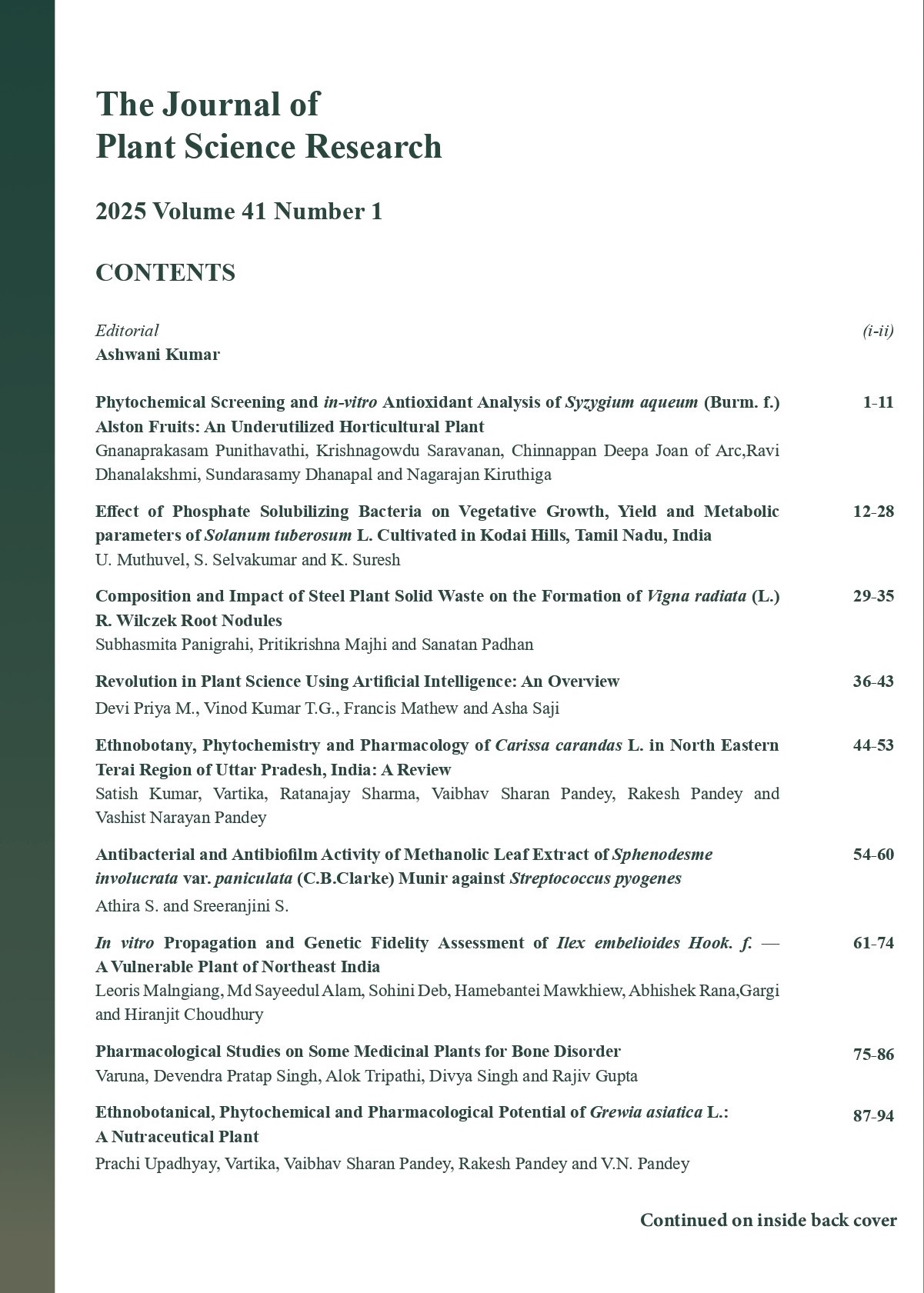


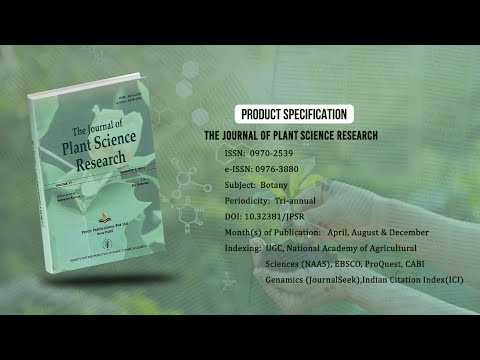
The Journal of Plant Science Research - A UGC Care-Listed Journal
Published in Association with Forum For the Promotion of Plant Science Research
Current Volume: 42 (2026 )
ISSN: 0970-2539
e-ISSN: 0976-3880
Periodicity: Tri-annual
Month(s) of Publication: April, August & December
Subject: Botany
DOI: 10.32381/JPSR
Online Access is Free for Life Member
Depiction and Annotation of Hypothetical Proteins from Oryza sativa L. by Relative Screening in Seek of Rare and Nifty Proteins
By : Arpita Banerjee , Monali Bhattacharjee , Debapriya Das , Renia Mullick , Sujata Dhar (Dutta) , Debleena Roy
Page No: 9-19
Abstract
Rice (Oryza sativa L.) of the family Poaceae has various genomes that are uncharacterized for their biochemical, biophysical, and/or cellular functions, are identified as Hypothetical Proteins (HPs). In this study, a comparative in silico pipeline has been used for the identification and functional annotation of 10HPs of O. sativa obtained from NCBI database. The structure, function, subcellular localization and interacting partners of the proteins were analysed along with orthology prediction to the hypothetical proteins of the data set. 90% successful annotation was done where most of the annotated HPs have functionally significant domains and protein superfamilies. Majority of the proteins were predicted to be Enzymes. Subcellular localization is a vital step for effective protein identification as subcellular localization of HPs elucidates their cellular mechanism. Most of the proteins were localized within the nucleus followed by cytoplasm, chloroplast, mitochondria, plasma membrane, extracellular matrix. No signal peptide was predicted. Mainly, the proteins had their closest orthologous members belonging to other species of Oryza. Functional analysis has revealed the role of few HPs in both biotic and abiotic stress management in the plants. The consequence of this research may be beneficial for outlining general set pipeline or etiquettes for an improved perception of the function of HPs in physiological development of several plant system. The understanding of the structure and function of these important proteins and their binding sites would be beneficial in understanding their role in metabolic pathway and in docking studies for aiding in the drug discovery.
Authors :
Arpita Banerjee, Monali Bhattacharjee, Debapriya Das, Renia Mullick and Debleena Roy : PG Department of Botany, Lady Brabourne College, Kolkata, India
Sujata Dhar (Dutta) : Department of Zoology, Lady Brabourne College, Kolkata, India
DOI: https://doi.org/10.32381/JPSR.2023.39.03.2