


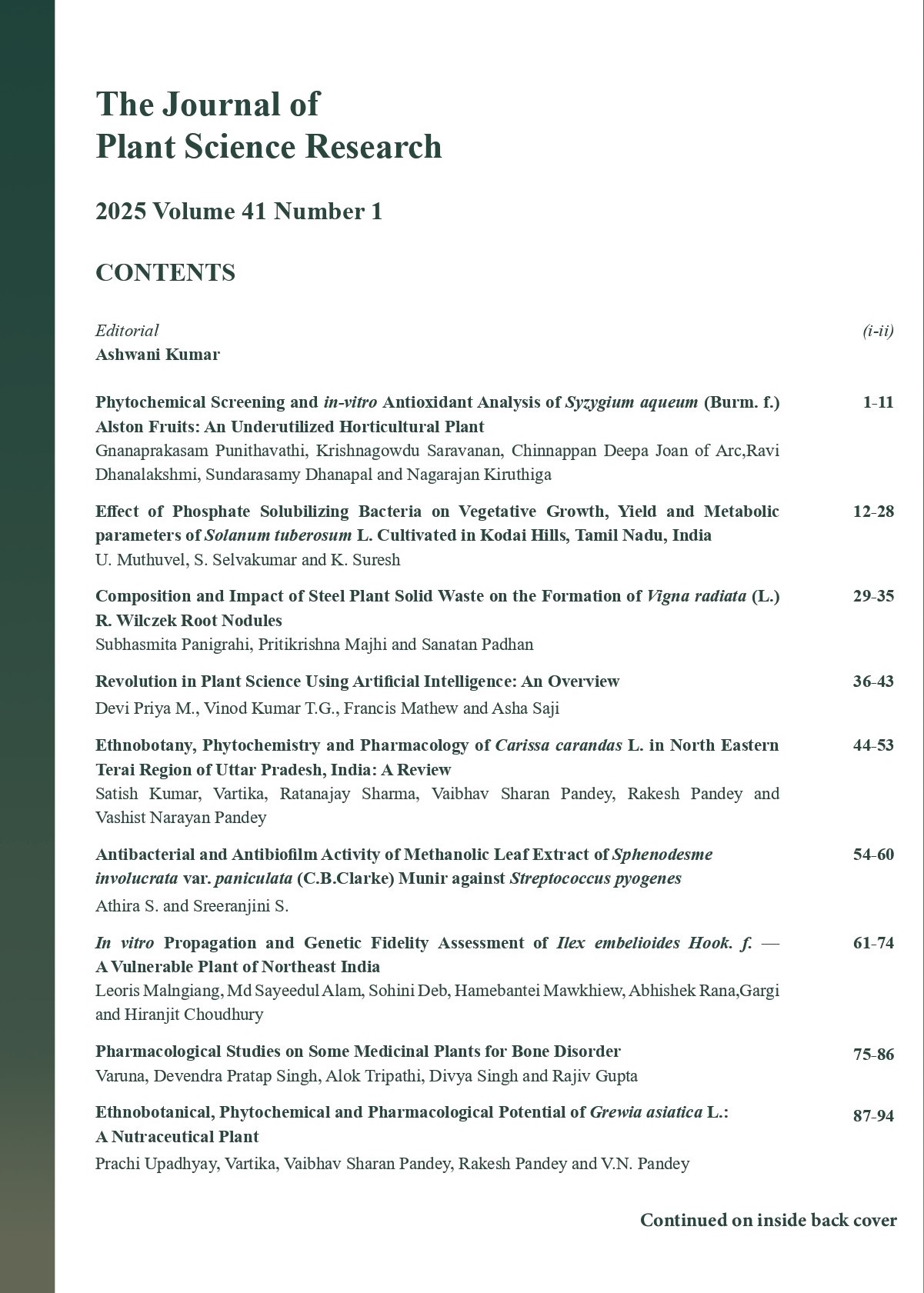


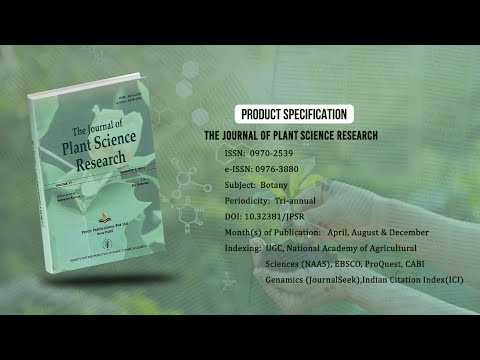
The Journal of Plant Science Research - A UGC Care-Listed Journal
Published in Association with Forum For the Promotion of Plant Science Research
Current Volume: 42 (2026 )
ISSN: 0970-2539
e-ISSN: 0976-3880
Periodicity: Tri-annual
Month(s) of Publication: April, August & December
Subject: Botany
DOI: 10.32381/JPSR
Online Access is Free for Life Member
Invitro and Mass Multiplication of Cymbidium mastersii an Ornamental Orchid through Protocorm-like Body Formation
By : A. Kavitha , A. Rajani
Page No: 31-38
Abstract
The epiphytic orchid species known as Cymbidium mastersii can only be found in the region of India known as Northeast India. The preservation of wild populations faces a significant obstacle in the form of a significant threat when it comes to the necessity of obtaining an additional source of the material required to fulfil commercial demands. The objective of this research was to build an in vitro system for the bulk multiplication of C. mastersii, and it was successful in that endeavour. This required the capacity to control the growth of the seedlings through the development of the primary protocorm and germination from a limited number of fruit capsules. Also necessary was the ability to limit the amount of fruit capsules that could be used. Each protocorm resulted in the production of a number of robust plantlings that, once they had been separated from their mother plant, flourished in the conditions of the greenhouse. The child plants, in terms of both their size and the development they underwent, were genetically identical to their parent plant. The streamlined process will make it possible to cultivate Cymbidium mastersii for use in the commercial sector, which will reduce the negative influence on remaining viable wild populations. We offer here for the very first time a method of producing C. mastersii on a commercial scale that makes use of bioreactor technology.
Authors :
A. Kavitha and A. Rajani
Department of Botany and Food & Nutrition, RBVRR Women’s College, Narayanaguda, Hyderabad, Telangana, India.
DOI: https://doi.org/10.32381/JPSR.2023.39.02.3