




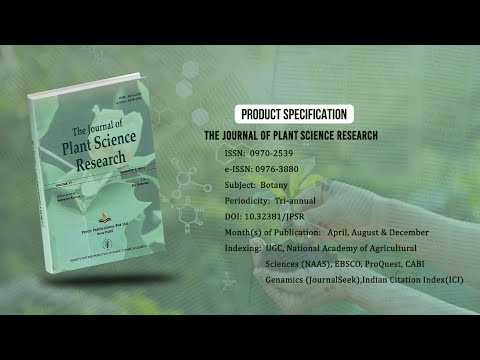
The Journal of Plant Science Research - A UGC Care-Listed Journal
Published in Association with Forum For the Promotion of Plant Science Research
Current Volume: 42 (2026 )
ISSN: 0970-2539
e-ISSN: 0976-3880
Periodicity: Tri-annual
Month(s) of Publication: April, August & December
Subject: Botany
DOI: 10.32381/JPSR
Online Access is Free for Life Member
Effect of Temperature, Relative Humidity and pH on Mycelial Growth and Sporulation of Fusarium solani Causing Root Rot of Indian Aloe (Aloe barbadensis MILL.)
By : M. K. Jat , R. R. Ahir
Page No: 197-199
Abstract
Indian aloe (Aloe barbadensis Mill. = Aloe vera) is the oldest medicinal plant commonly known as Ghritkumaree. It is a coarse looking, perennial shallow rooted plant with a short stem, 30-60 cm high and can be grown even in dry lands under rainfed situation. During survey, Indian Aloe were found infected with Root rot caused by Fusarium solani causing severe damage at seedling stage both in the field of Jobner vicinity during Spring season 2011-12. The effect of different levels of temperature (15, 20, 25, 30 and 35o C), relative humidity (60, 70, 80, 90 and 100 percent) and pH (5.5, 6.0, 6.5, 7.0, 7.5, 8.0 and 8.5) on growth and sporulation of the pathogen were tested in vitro conditions. Maximum mycelial growth and sporulation were found at 250 C temperature (84.15 mm), 100 per cent relative humidity (88.50 mm) and maximum dry mycelial weight at 6.5 pH (270g).
Authors :
M. K. Jat and R. R. Ahir : Department of Plant Pathology, S.K.N. College of Agriculture, Jobner 303329 (Jaipur), India