


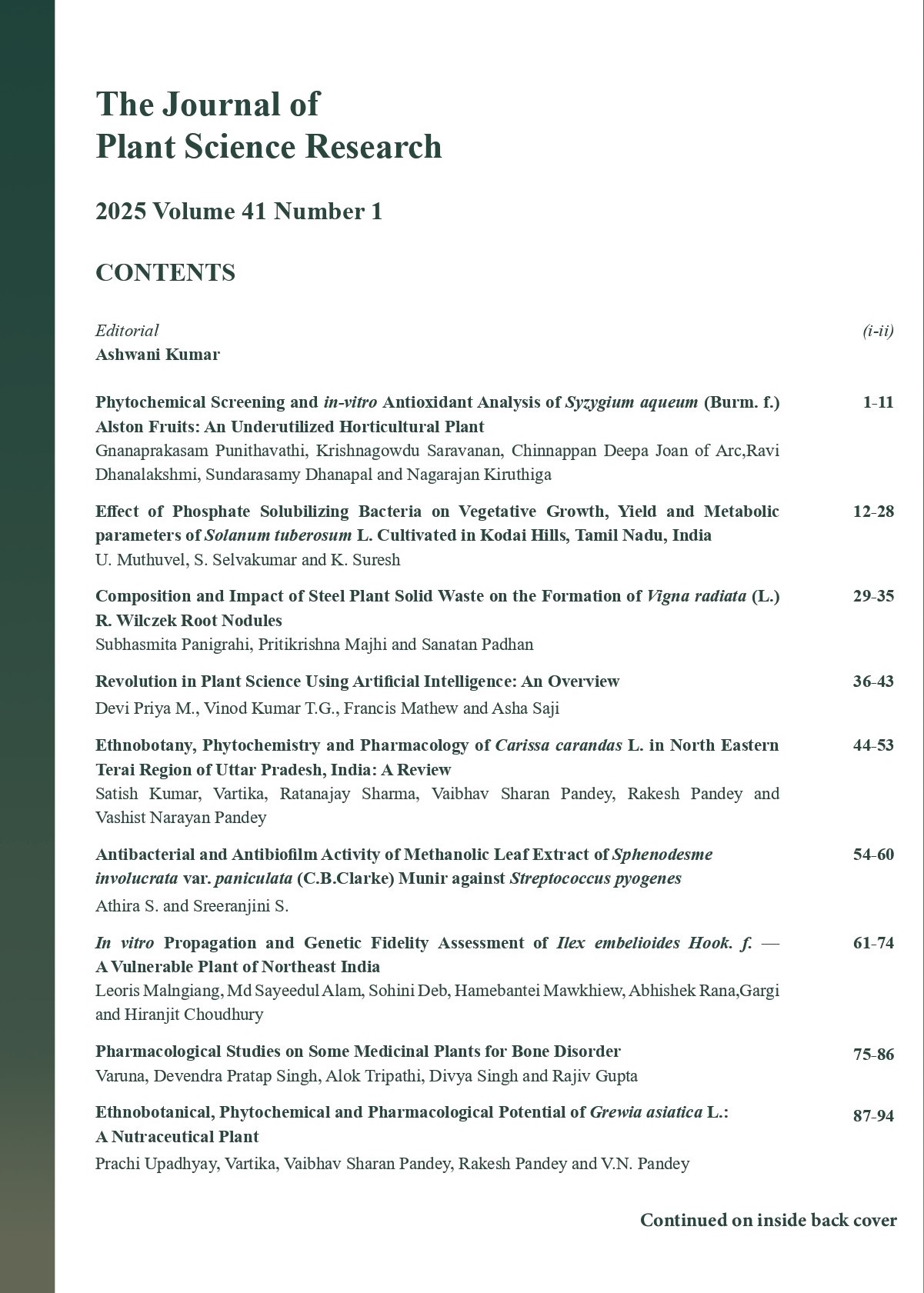


The Journal of Plant Science Research - A UGC Care-Listed Journal
Published in Association with Forum For the Promotion of Plant Science Research
Current Volume: 42 (2026 )
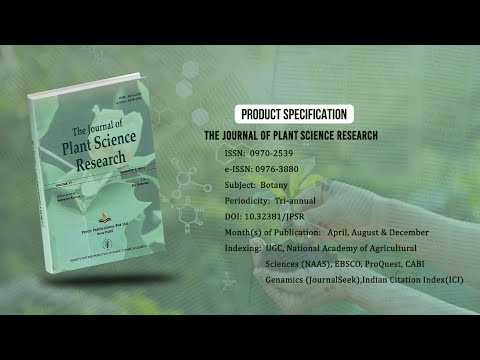
ISSN: 0970-2539
e-ISSN: 0976-3880
Periodicity: Tri-annual
Month(s) of Publication: April, August & December
Subject: Botany
DOI: 10.32381/JPSR
Online Access is Free for Life Member
Efficacy of Fungicides in vitro and in vivo of Early Blight of Tomato (Lycopersicon esculentum) caused by Alternaria solani
By : A.G. Walke , S.R. Potdukhe, , Suresh Meena , A. K. Meena , G.L. Kakralya , C.S. Choudhary
Page No: 123-137
Abstract
Tomato is an important vegetable crop grown in India. It is affected with many fungal, bacterial and viral diseases. Early blight is one of the most important known fungal diseased caused by Alternaria solani. A experiment was evaluated in randomized Block design with nine treatment in three replication at the farm of Plant Pathology Department, College of Agriculture Nagpur during 2009-10. Eight fungicides viz. copper oxychloride (0.25%), carbendazim (0.1%), mancozeb (0.2%), zineb (0.15%), Captafol (0.2%), Thiophanate methyl (0.005%), Iprodione (0.2%) and Duter (0.2%) were tested against A. solani by using poisoned food technique in vitro. The data reveals significant differences as mean radial mycelial diameter over control. Minimum colony diameter (8.97mm) was recorded in mancozeb (0.1%) and highest (88.97%) percent inhibition growth. This treatment was significantly superior as compared to all other treatments. Significant differences were noticed on percent disease incidence after 1st, 2nd, 3 rd, 4th spray of different chemicals over control. Spraying of mancozeb (0.2%) at the interval recorded minimum PDI (22.18) and maximum percent disease control (32.29%) and it was found significantly superior over all other treatment. It was followed by carbendazim (0.1%) and copper oxychloride (0.25%) reading 28.22 and 24.85 percent disease control. The highest yield was obtained by the treatment mancozeb (0.25%) 18333 kg/ha followed by carbendazim ( 0.1%) 17916 kg/ha.
Authors :
A.G. Walke, S.R. Potdukhe and C.S. Choudhary : Plant Pathology Section, College of Agriculture, Nagpur - 440 001 ( Dr.P.D.K.V. Akola).
Suresh Meena and G.L. Kakralya : College of Agriculture, Bikaner
A. K. Meena : Department of Plant Pathology SKN. College of Agriculture (S.K.N. Agriculture University) Jobner-303 329