


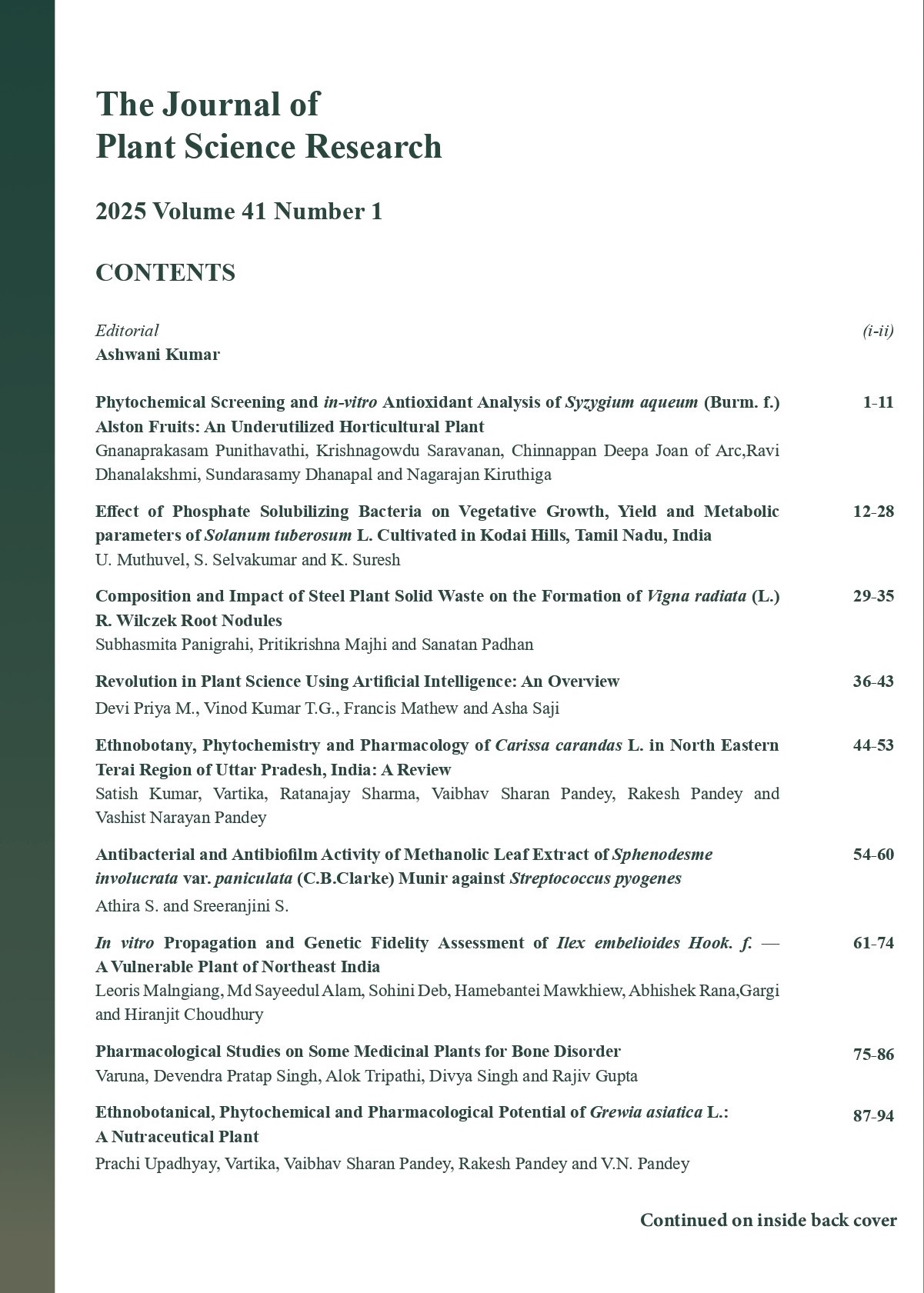


The Journal of Plant Science Research - A UGC Care-Listed Journal
Published in Association with Forum For the Promotion of Plant Science Research
Current Volume: 42 (2026 )
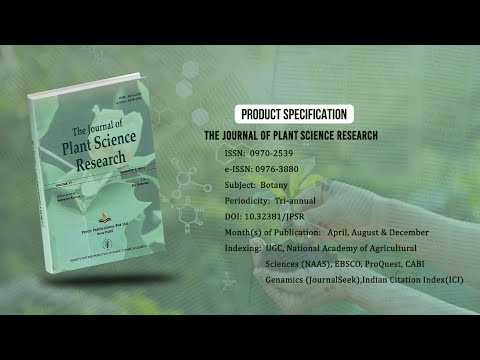
ISSN: 0970-2539
e-ISSN: 0976-3880
Periodicity: Tri-annual
Month(s) of Publication: April, August & December
Subject: Botany
DOI: 10.32381/JPSR
Online Access is Free for Life Member
Agro-molecular Diversity Analysis of Linseed (Linum usitatissimum L.) Genotypes using Microsatellite based Simple Sequence Repeats (SSR) Marker
By : K.C. Samal , Mitali Dash
Page No: 87-94
Abstract
Linseed (Linum usitatissimum L.) is an annual diploid (2n=30) old-world crop species traditionally grown for its fibre and oil. In the present study observations on various important morpho-agronomic characters viz. plant type, flower characters, maturity duration, seed character, 1000 grain weight, days to maturity and disease response of eight linseed varieties were recorded. Variety “OL-8-2-7” was found to be more different than others with respect to flower colour while the variety ‘OL-98-13-1’and ‘OL-98-15-2’were observed to share most of the morphological characters. Fifteen custom designed linseed SSR primers were screened for DNA profiling out of which 3 SSR primers yielded discrete reproducible amplicons that were used to generate the DNA fingerprint profile of eight linseed varieties. Total of eleven numbers of bands ranging in size from 100bp to 2500 bp were obtained. The SSR marker LU2 and LU3 were found to be more polymorphic than ‘LU1’. The SSR primer LU2 produced the maximum number of bands (6) followed by SSR primer LU3 (3). The average percentage polymorphism among the primers was found to be 55.44% while the polymorphism information content (PIC) value was 0.549. On the basis of Jaccard’s pairwise similarity coefficient estimates of similarity matrix ranged from 0.09 to 0.88. The average similarity coefficient (0.47) was recorded among all the varieties. Cluster analysis by using the UPGMA algorithm grouped the eight genotypes into two major clusters. The varieties ‘OL-98-6-2’ and ‘OL-98-6-4’ were placed away from the other varieties. The variety pair ‘OL-827’and ‘Padmini’ and variety pair ‘OL-98- 13-1’and ‘Padmini’ were most similar while variety pair ‘OL-98-6-2’ and ‘OL-08-3-19’. (0.09) were least similar. This indicates that these two varieties can be used further in breeding programme. The information obtained in the study may be useful in background selection as well as characterization of linseed genotypes.
Authors :
Mitali Dash and K.C. Samal : Dept. of Agricultural Biotechnology, College of Agriculture, Orissa University of Agriculture and Technology, Bhubaneswar-751003, Odisha, India.