




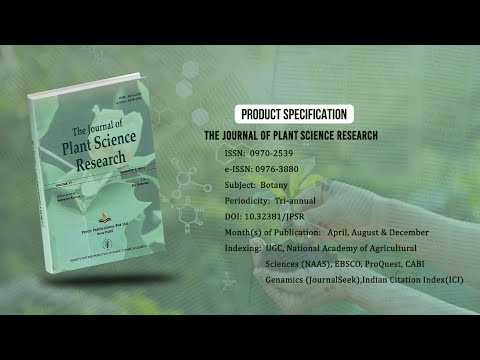
The Journal of Plant Science Research - A UGC Care-Listed Journal
Published in Association with Forum For the Promotion of Plant Science Research
Current Volume: 42 (2026 )
ISSN: 0970-2539
e-ISSN: 0976-3880
Periodicity: Tri-annual
Month(s) of Publication: April, August & December
Subject: Botany
DOI: 10.32381/JPSR
Online Access is Free for Life Member
Seed germination and seedling growth traits in different varieties of Foeniculum vulgare grown in Rajasthan
By : Staffi Grover
Page No: 37-43
Abstract
Cissus quadrangularis is a very important medicinal plant, found in tropical countries including India. The plant is used for the treatment of number of diseases specifically for healing up of fractured bone that is why known as “Hadjod”. The plant is rich in phytosterol content which is one of the major constituent and mainly responsible for healing up of wounded tissues. In the present study hadjod collected from five districts of Chhattisgarh, (Ambikapur, Korba, Raipur, Dhamtari and Jagdalpur) were compared for their phytosterol contents. Presence of stigma sterol and â sitosterol in ethanol extract of Cissus quadrangularis were confirmed by TLC. Quantitative analysis of the samples has been done spectrophotometrically. Both of the sterol content was found to be higher in the samples of district Korba. Key words: Cissus Quadrangularis, Hadjod, Photometabolites,sterols, Thin Layer Chromatography. Jour Pl Sci Res 33 (1) 37-43 2017 processes in different varieties of F. vulgare. These methods have also been adopted by several other workers (Atia et al., 2006; Sayar et al., 2010 and Godakahriz et al., 2012). It exhibits a tremendous amount of diversity at phenotypic, genotypic and biochemical levels. Fennel seeds often fail to germinate due to presence of dormancy which results in low fennel production all over the world (Neamatollahi et al., 2009). Priming can be a valuable process for improving germination and uniformity of heterogeneously matured seed lots (Olouch & Welbaum, 1996). The data thus, emanating represented the extent of genetic control over germination process in different varieties. MATERIALS AND METHODS The seven varieties of F. vulgare, were obtained from the Department of Plant Breeding and Genetics, S.K.N College of Agriculture, Jobner, Swami Keshwanand Rajasthan Agricultural University, Bikaner. It included FNL-41, 46, RF 101, 125, 143, Different germination phases were compared in the Foeniculum vulgare varieties grown in Rajasthan and differed with regard to imbibitions, time taken for the emergence of radicle, emergence of plumule, cracking of seed coat and gapping apart of cotyledons. Variability was seen in occurrence of these stages in all the varieties. Percentage germination, speed and coefficient of germination, mean germination time, germination rate and vigor, germination and Timson’s index, the seed germination parameters, were computed. Percentage germination varied from 60 to 100 %. Various seedling growth parameters assessed comprised root and shoot length, total length root/shoot ratio and root, shoot fresh and dry matter. Based upon the speed of germination; varieties were classified as fast (RF-125 and 143), modest (RF- 101 and 205) and slow (FNL-46, RF- 178 and FNL- 41) growing varieties. Seven varieties were established distinct at germination level. Studied parameters of seed germination and growth are important not only for physiologists and seed technologists, but also for ecologists because it is possible to predict the degree of success of a species based on the capacity of their harvested seed to spread the germination through time, permitting the conscription in the environment of some part of the seedlings formed.
Author :
Staffi Grover : Jaipur National University, Jaipur