


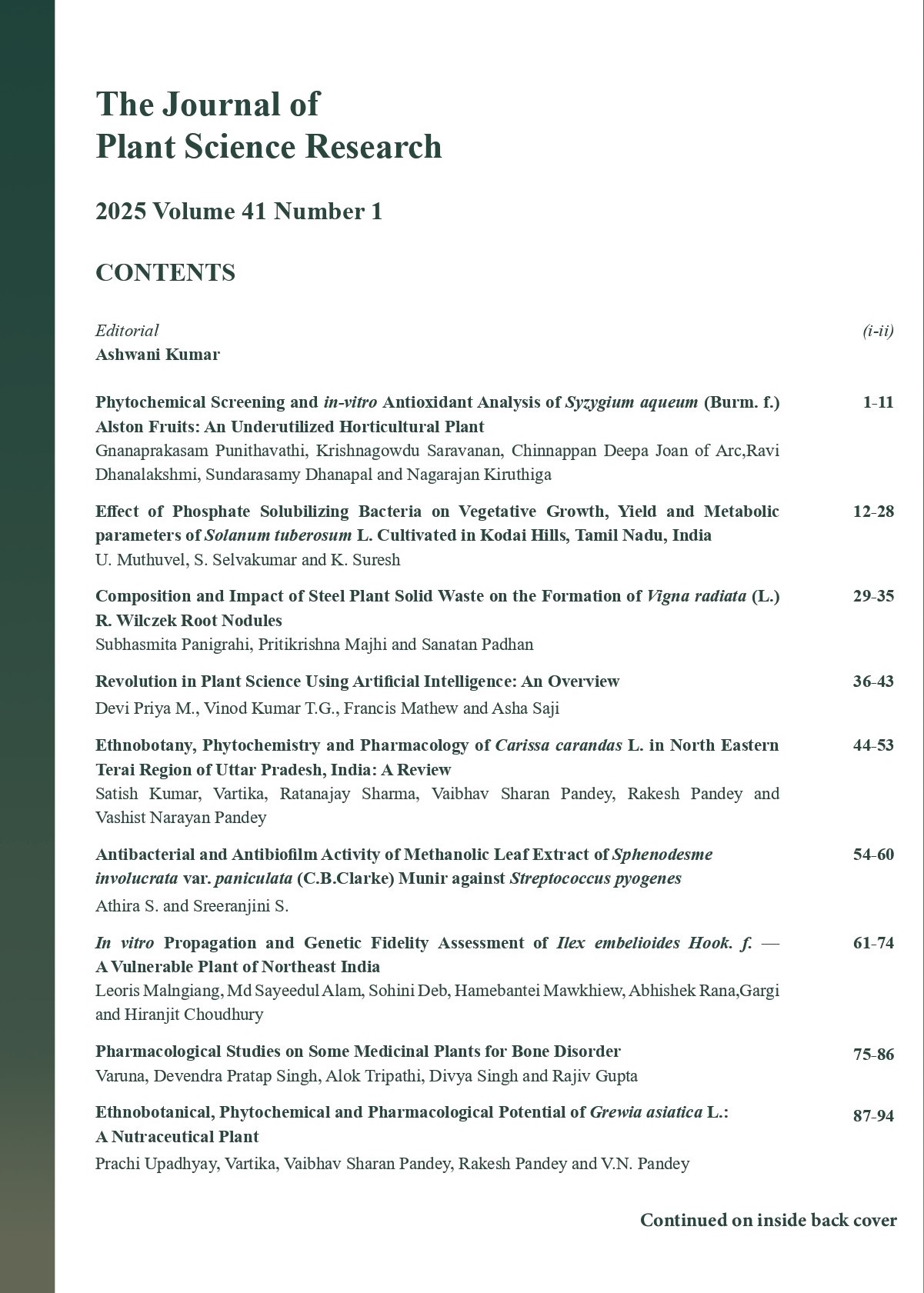


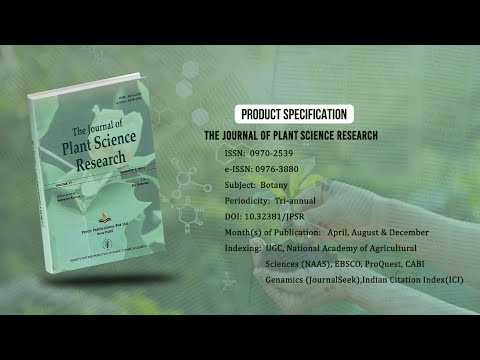
The Journal of Plant Science Research - A UGC Care-Listed Journal
Published in Association with Forum For the Promotion of Plant Science Research
Current Volume: 42 (2026 )
ISSN: 0970-2539
e-ISSN: 0976-3880
Periodicity: Tri-annual
Month(s) of Publication: April, August & December
Subject: Botany
DOI: 10.32381/JPSR
Online Access is Free for Life Member
Mitigation Effects of 24-Epibrassinolide and Thiourea in Field Pea (Pisum sativum L.) under Drought Stress
By : Prachi Garg , A. Hemantaranjan , Jyostnarani Pradhan
Page No: 229-235
Abstract
Field Pea (Pisum sativum L.) is an important cool–season pulse crop and leguminous vegetable, which is widely cultivated throughout the world. In many parts of the world the most important abiotic factor limiting the survival and yield of plants is the restricted water supply, the field pea is sensitive to drought stress. The drought stress is an adverse condition develops due to water deficit and this most important abiotic factor limiting growth, adversely affecting crop production. Brassinolides (BRs) are endogenous plant growth-promoting compound that acts on plant development and affects numerous physiological processes at low concentration whereas; Thiourea is a sulphydral compound (NH2 -CS-NH2 ) which is basically known for the breaking the dormancy and stimulating germination. The experiment focused on the field pea response under control and drought stress condition where the seeds were treated with 24-Epibrassinolide (EBL) and Thiourea (TU) having concentration of 0.01mM and 6.6mM respectively. In order to evaluate morpho-physiological traits related to drought tolerance, we grew CDC Amarillo, a yellow pea variety, of field pea under drought stress and control condition and assessed effect of drought stress on select but relevant parameters of relative water content (RWC), chlorophyll content, proline content and total soluble sugar (TSS). The drought stress significantly decreased the chlorophyll content and relative water content (RWC) while increased the proline and total soluble sugar. The application of 24-epibrassinolide and thiourea helps to mitigate the deleterious effect of drought stress in plants in which the threshold level of 6.6mM thiourea showed more significant results over 0.01mM 24-epibrassinolide.
Authors :
Prachi Garg : Department of Genetics and Plant Breeding.
A. Hemantaranjan and Jyostnarani Pradhan : Department of Plant Physiology, Institute of Agricultural Sciences, Banaras Hindu University, Varanasi-221005