


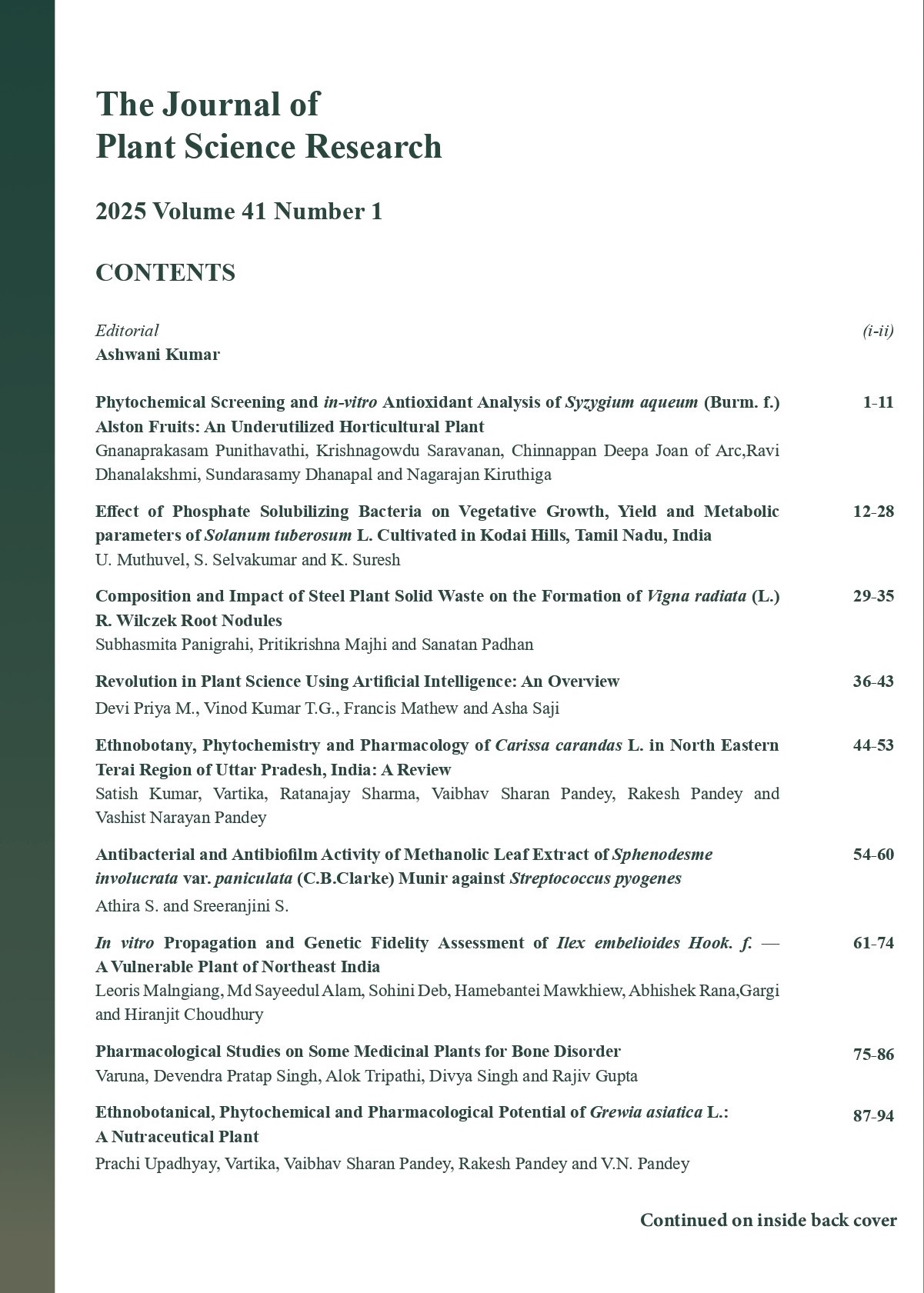


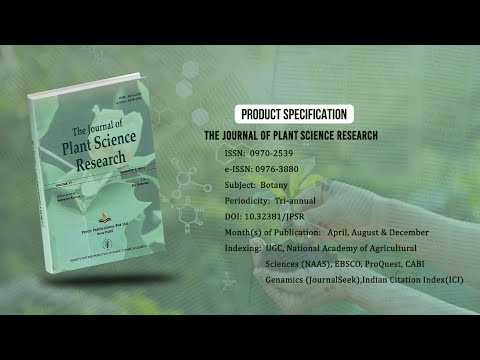
The Journal of Plant Science Research - A UGC Care-Listed Journal
Published in Association with Forum For the Promotion of Plant Science Research
Current Volume: 42 (2026 )
ISSN: 0970-2539
e-ISSN: 0976-3880
Periodicity: Tri-annual
Month(s) of Publication: April, August & December
Subject: Botany
DOI: 10.32381/JPSR
Online Access is Free for Life Member
Optimization of Growth Medium and Salt Concentration for the Growth of Dunaliella parva isolated from Sambhar Lake (Rajasthan, India)
By : Anmol Bhargava , Arvind Pareek
Page No: 229-232
Abstract
Microalga Dunaliella is a green, halotolerant genera mostly occur in hypersaline environment. This alga is the richest source of glycerol and ?-carotene, used as a food source in aquaculture. Dunaliella also accumulate others nutrients like lipids, vitamins and proteins. Modified Johnsons medium is widely used for culturing species of Dunaliella however, without adding micronutrients the growth of algae was slow. Another medium which is suggested by Ramaraj is also suitable for culturing Dunaliella species. A study was conducted to investigate the effect of these two medium on green alga Dunaliella isolates from Sambhar salt lake. The results of this experiment showed that Dunaliella species grew faster in Ramaraj medium as compared to Johnson modified medium. In another experimental setup, Dunaliella isolate from Sambhar Lake, was cultured in Ramaraj medium and were studied for its growth rate at different salinities (0.5M to 5.5M NaCl). The effect of salinity stress on their growth was investigated. Dunaliella strains were shown to withstand large variations of salinity of the growth medium, 0.5 -5.5 M NaCl. Growth of Dunaliella showed declined if NaCl concentration was above 5M in medium. This study showed optimum growth medium for Dunaliella sp. isolated from Sambhar Lake is Ramaraj medium (pH7.5) and optimum salt concentration for growth is 1.5M -2M NaCl.
Authors :
Anmol Bhargava : Banasthali Vidyapeeth, Tonk
Arvind Pareek : Maharashi Dayanand Saraswati University, Ajmer
DOI: https://doi.org/10.32381/JPSR.2019.35.02.11