




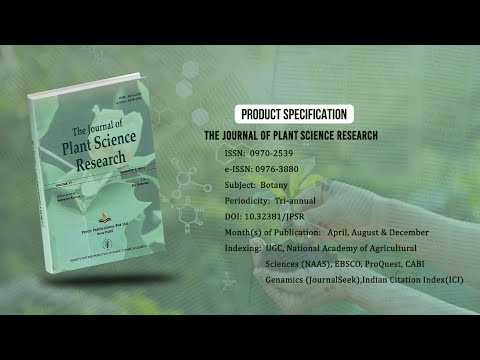
The Journal of Plant Science Research - A UGC Care-Listed Journal
Published in Association with Forum For the Promotion of Plant Science Research
Current Volume: 42 (2026 )
ISSN: 0970-2539
e-ISSN: 0976-3880
Periodicity: Tri-annual
Month(s) of Publication: April, August & December
Subject: Botany
DOI: 10.32381/JPSR
Online Access is Free for Life Member
Impact of Salinity on Growth and N2 -Fixation in Melilotus indicus
By : Malvika Srivastava , Kumari Sunita , Parveen Abbasi , M Muruganandam
Page No: 109-119
Abstract
The yellow sweet clover, Melilotus indicus, has immense potential for reclamation of degraded lands, particularly salt-affected soils, and use as fodder, green manure, medicinal herb and such other socio[1]economic and environmental benefits like nitrogen fixation owing to its higher nodulation capacity, nitrogenous activities and nitrogen fixation rates as compared to other legumes. Also, it is diversely used as anthelmintic, antipyretic, antispasmodic, emollient, analgesic, insect repellent, health tonic and as astringent. In the present study, young sweet clover plants were treated with four different NaCl concentrations (50, 100, 200 and 300 mM, milli Moles) to study the impacts of salt content, especially on growth (biomass and leaf area), nodular status (number, shape, colour), nitrogenase activity, nitrogen and protein contents and N2 -fixation abilities against the untreated control plants from day 25 to 65 at every 10 days interval. While all the study parameters decreased at 200 and 300 mM NaCl salt concentration, the mild concentration (100 mM NaCl) registered a relative increase in all parameters and gave better response, as compared to control all through the study period except for the number of nodules, which declined after 45 day growth in all the treatments including control. The results indicate that M. indicus could be cultivated on moderately saline habitats, which would help utilization or reclamation of unproductive saline lands towards production of the important herb.
Authors :
Kumari Sunita and Malvika Srivastava : Plant Physiology and Biochemistry Lab., Department of Botany, D.D.U. Gorakhpur University, Gorakhpur, India
Parveen Abbasi : St. Andrew’s College, Gorakhpur, India
M Muruganandam : ICAR-Indian Institute of Soil and Water Conservation (ICAR-IISWC), Dehra Dun, India
DOI: https://doi.org/10.32381/JPSR.2019.35.01.10