


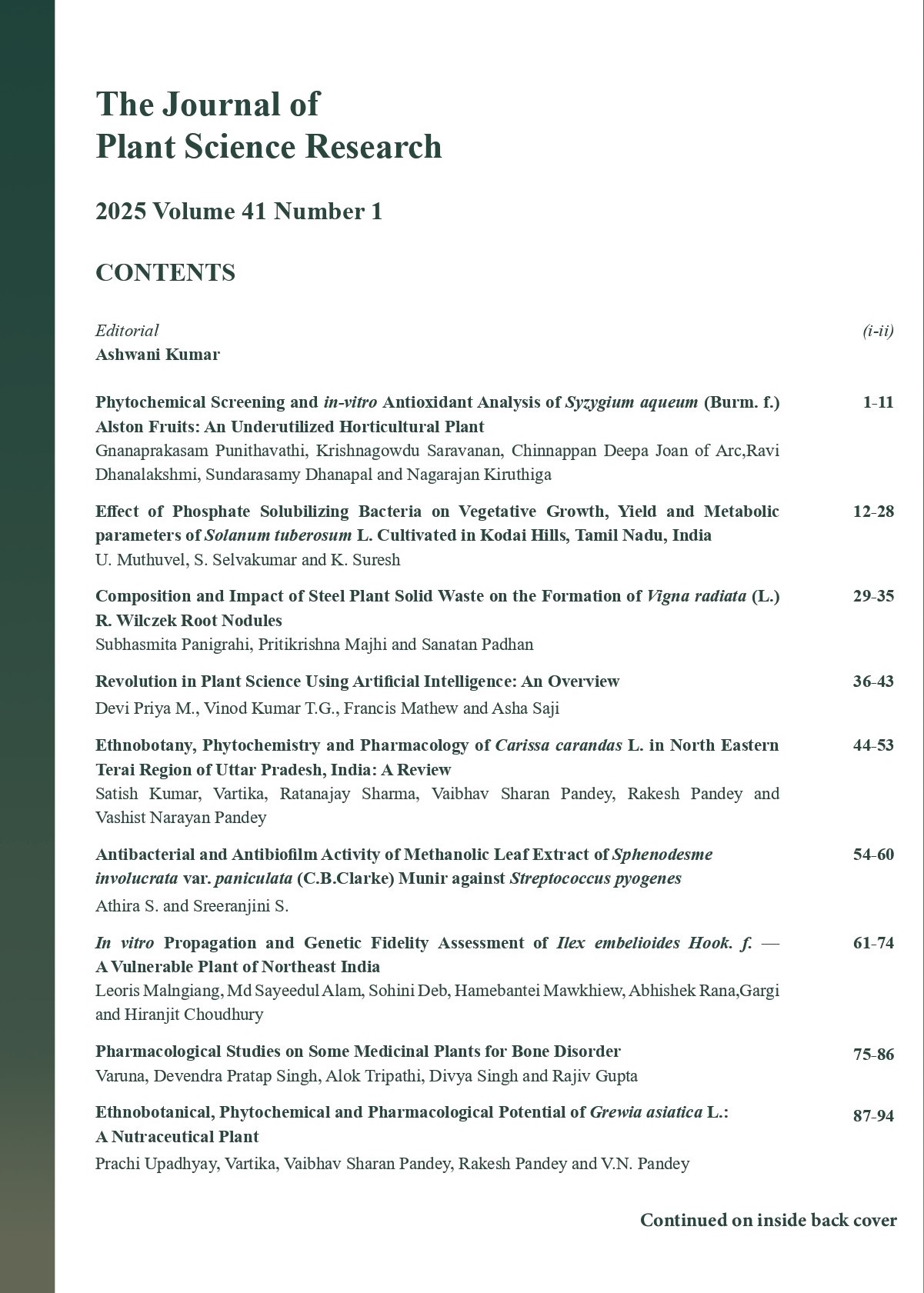


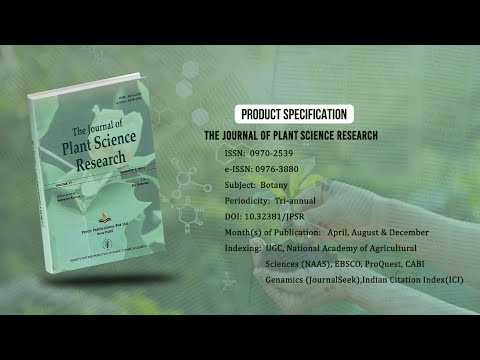
The Journal of Plant Science Research - A UGC Care-Listed Journal
Published in Association with Forum For the Promotion of Plant Science Research
Current Volume: 42 (2026 )
ISSN: 0970-2539
e-ISSN: 0976-3880
Periodicity: Tri-annual
Month(s) of Publication: April, August & December
Subject: Botany
DOI: 10.32381/JPSR
Online Access is Free for Life Member
Influence of foliar application of mineral nutrients on vegetative and fruit quality of strawberry (Fragaria × ananassa Duch.) cv. Chandler
By : Gurpias Singh , Dilip Singh Kachwaya , Venkata Satish Kuchi , Manjinder Singh , Jagmeet Singh , Bavdeep Singh
Page No: 323-328
Abstract :
An experiment was conducted at the Agriculture Research Farm, Department of Agriculture, Mata Gujri College, Sri Fatehgarh Sahib, Punjab during the year 2017-18 to study the effect of pre-harvest foliar application of nutrients on growth, yield and fruit quality of strawberry (Fragaria × ananassa Duch.) cv. Chandler. The experiment was laid out in a Randomized Block Design (RBD) having nine treatments with three replications. Treatments consisted of FeSO4 (0.4% and 0.6%), ZnSO4 (0.4% and 0.6%), Ca(NO3 ) 2 (0.4% and 0.6%) and Borax (0.1% and 0.2%), while in control water is sprayed. The results revealed that the plants treated with 0.6% FeSO4 increase vegetative growth in terms of plant height (20.91 cm), plant spread (31.37 cm), number of leaves per plant (28.50), leaf area (110.00 cm2 ), leaf area index (3.77), leaf fresh weight per plant (59.38 g) and leaf dry weight per plant (17.11 g). Maximum number of flowers per plant (17.52) and number of fruits per plant (12.19) also reported in plants treated with 0.6% FeSO4 . However, the plants treated with 0.6% ZnSO4 increase yield attributes and fruit quality attributes in the terms of fruit weight (13.52 g), fruit length (44.52 mm), fruit breadth (30.64 mm), yield per plant (129.10 g), yield per hectare (6.76 tonnes), TSS (12.67 ° B), ascorbic acid (60.53 mg/100g pulp), total sugar (7.96 %) and lowest acidity (0.78 %). Highest shelflife of fruits (2.75 days) were recorded in 0.6% Ca(NO3 )2 treated plants.
Authors:
Gurpias Singh : Mata Gujri College, Sri Fatehgarh Sahib, Punjab -140406
Dilip Singh Kachwaya : Mata Gujri College, Sri Fatehgarh Sahib, Punjab -140406
Venkata Satish Kuchi : Department of Horticulture, MS Swaminathan School of Agriculture, Centurion University of Technology and Management, R Sitapur, Gajapati, Odisha-761211, India.
Manjinder Singh : Mata Gujri College, Sri Fatehgarh Sahib, Punjab -140406
Jagmeet Singh : Mata Gujri College, Sri Fatehgarh Sahib, Punjab -140406
Bavdeep Singh : Mata Gujri College, Sri Fatehgarh Sahib, Punjab -140406
DOI: https://doi.org/10.32381/JPSR.2020.36.1-2.41