



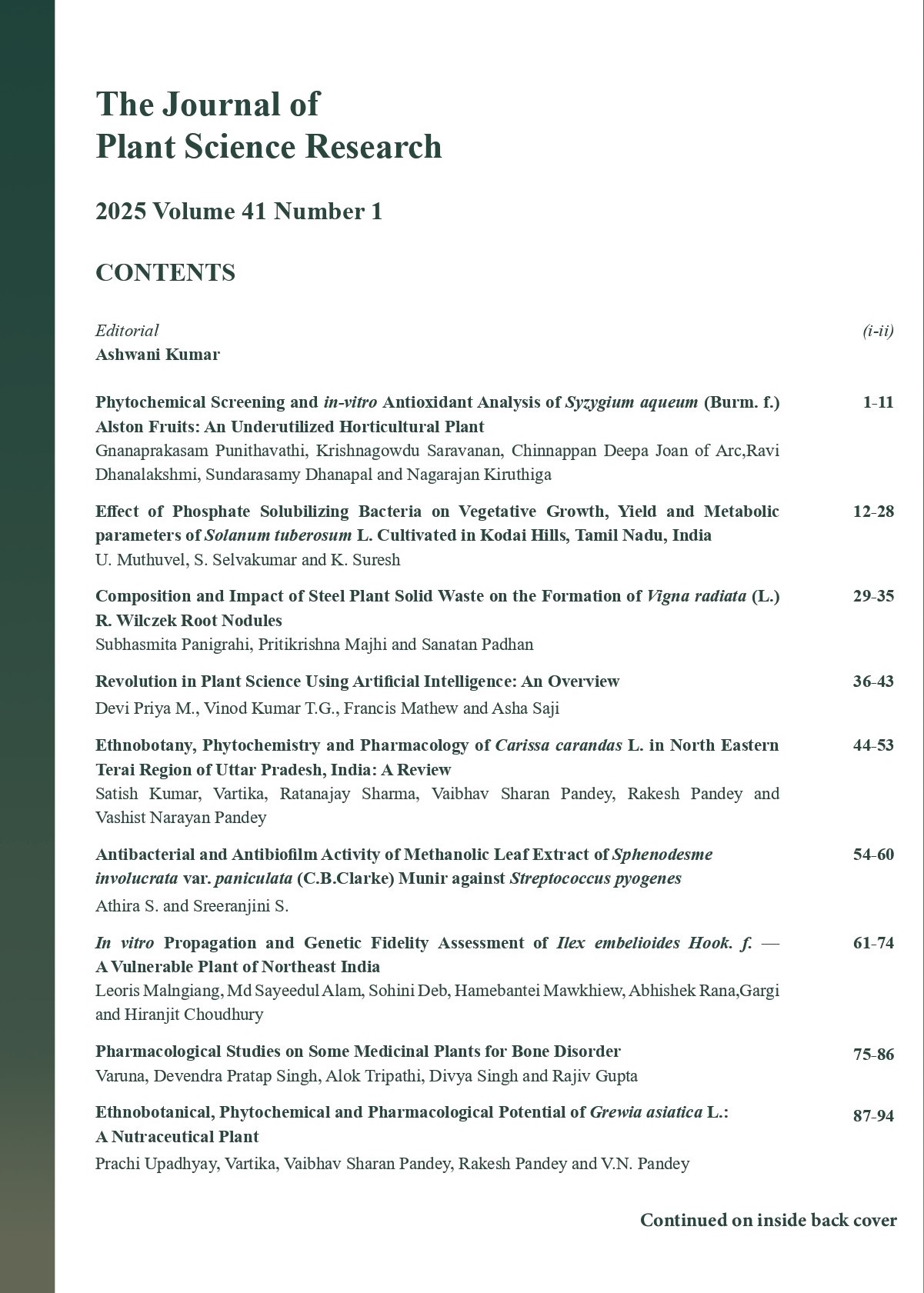

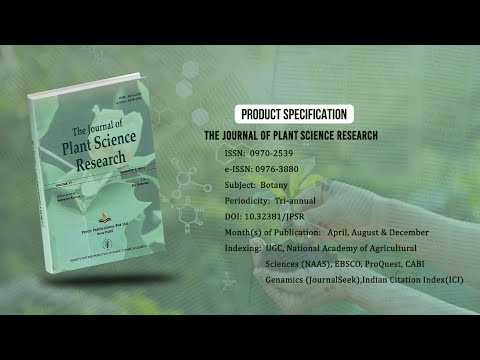
The Journal of Plant Science Research - A UGC Care-Listed Journal
Published in Association with Forum For the Promotion of Plant Science Research
Current Volume: 41 (2025 )
ISSN: 0970-2539
e-ISSN: 0976-3880
Periodicity: Tri-annual
Month(s) of Publication: April, August & December
Subject: Botany
DOI: 10.32381/JPSR
Online Access is Free for Life Member
Arbuscular Mycorrhizal and Endophytic (DSE) association in the dominant grasses of Melghat Forest (Phase -II), India
By : P.W. Deotare , S.P. Khodke , R.C. Maggirwar , S.K. Kharwade
Page No: 211-224
Abstract :
Soil fungi play a crucial role in producing fundamental ecosystem services such as soil fertility, nutrient cycling and establishment of plant community dynamics in the forest. Arbuscular mycorrhizal fungi (AMF) are one of the most important members of this soil microbial community in the ecosystem. They are beneficial soil symbionts fulfilling a key function in the complex networks of belowground biotic interactions. As Melghat Tiger Reserve of Satpura terrain India was not surveyed earlier by anybody to explore AMF diversity associated with grasses, we have carried out the survey in two phases. In the phase II of study, different grass species belonging to 35 species of 27 genera from core region were screened for association of AMF and dark septate endophyte (DSE). All these grasses were randomly collected from 9 different sites. Sporobolus indicus var. fertilis was found to be the most dominant grass species. The composite soil sample was prepared for each site and used for physico-chemical analysis by standard methods and their correlation study was carried out.
The rhizosphere soil samples were used to extract AMF spores and out of 1214 viable spores from 9 different sites in all 25 different AMF species representing 4 genera were identified. The mean % AMF was found to range between 5.83 to 47.31,% DSE from 0.22 to 29.43 and spore count from 0.66 to 65.33. Acaulosporas crobiculata Trappe was the most dominant AMF species. The roots showed hyphal penetration and appressorium, vesicles, H-connections and Y-junctions of hyphae, hyphal coils, intraradical spores, extraradical hyphae and spores which confirmed the AMF association. Various types of arbuscules have been reported such as in 17 grasses Arum type, in 28 grasses Paris type and in 2 grasses intermediate type. Intra radicle spores were found in 7 grasses.
The grass family is one of the largest and important families of the plant kingdom. It has great adaptability and is essential component of all type of ecosystems. In present investigation the consistent colonization of AMF along with DSE association with grasses suggests that these fungi have a significant ecological function. Such studies could provide very useful information for the maintenance of special habitats like Melghat Tiger Reserve forest. We need to design further studies to understand the significance of the coexistence of these fungi at the ecosystem level by using some molecular tools
Authors :
P.W. Deotare : Mycorrhizal Bio-technology Lab, P.G. Department of Botany, Shri Shivaji Science College, Amravati, Maharashtra, India.
S.P. Khodke : Vinayak Vidnyan Mahavidyalaya, Nandgaon(Kh.), Amravati, Maharashtra, India
R.C. Maggirwar : Mycorrhizal Bio-technology Lab, P.G. Department of Botany, Shri Shivaji Science College, Amravati, Maharashtra, India.
S.K. Kharwade : Mycorrhizal Bio-technology Lab, P.G. Department of Botany, Shri Shivaji Science College, Amravati, Maharashtra, India.
DOI: https://doi.org/10.32381/JPSR.2020.36.1-2.28