



Productivity : A Quarterly Journal of The National Productivity Council
Published in Association with National Productivity Council
Current Volume: 67 (2026-2027 )
ISSN: 0032-9924
e-ISSN: 0976-3902
Periodicity: Quarterly
Month(s) of Publication: June, September, December & March
Subject: Economics
DOI: 10.32381/PROD
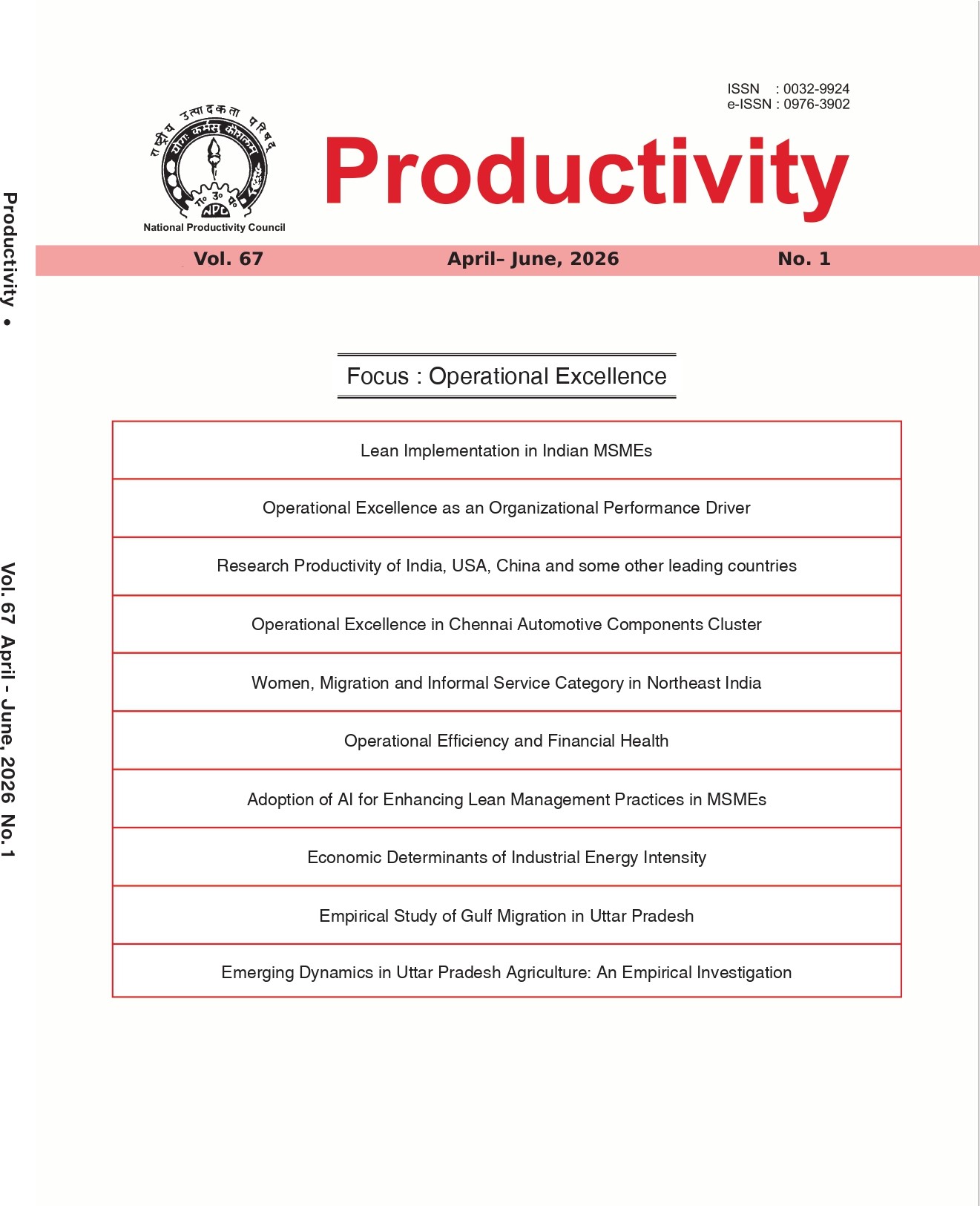
Empirical Study of Gulf Migration in Uttar Pradesh, India
By : Mohammed Taukeer
Page No: 120-131
Migration is a global phenomenon, and the migrationdevelopment nexus provides an important perspective for examining the globalisation of Gulf migration from rural Uttar Pradesh. As such, this research paper attempts to address a gap in the literature by analysing the process, determinants, and impacts of Gulf migration in the specific context of its Islamic reflections in Uttar Pradesh. Therefore, the methodology of the paper is based on an empirical, multiple-round, field-based study conducted in rural Uttar Pradesh from November 2017 to March 2018 and October 2023 to November 2023. This study adopts a longitudinal design that combines retrospective and prospective perspectives, tracing the evolution of Gulf migration from past experiences through present conditions to future expectations, thus supporting the study’s objectives. The findings from the study show a well-developed culture of internal and international migration from Uttar Pradesh to Mumbai and the Gulf countries, creating socio-economic and cultural transformation among Muslims through the emergence of a zakat-based economic system. A zakat-based economic system is based on the principle mentioned in the Surah al Baqarah (2:43) of the Quran “And be steadfast in prayer, give zakat (poor-due) and bow down your heads with those who bow down (in worship)”. These findings can contribute to a deeper understanding of Gulf migration in Uttar Pradesh and encourage academics, researchers, and policymakers to undertake further research in this area.
Author
Mohammed Taukeer, Former Research Fellow, International Institute of Migration and Development, Thiruvananthapuram, Kerala, India.
DOI: 10.32381/PROD.2026.67.01.10