


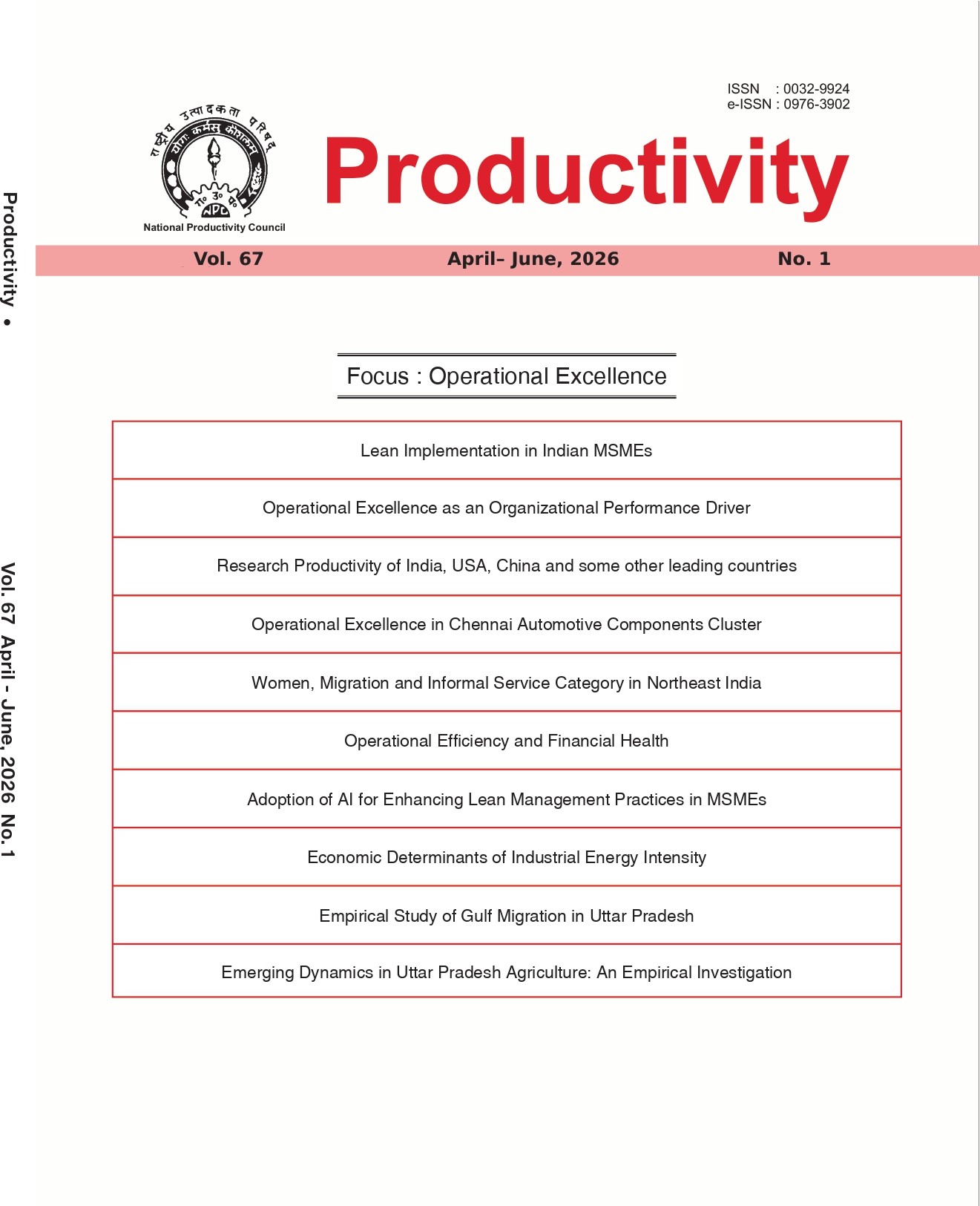

Productivity : A Quarterly Journal of The National Productivity Council
Published in Association with National Productivity Council
Current Volume: 67 (2026-2027 )
ISSN: 0032-9924
e-ISSN: 0976-3902
Periodicity: Quarterly
Month(s) of Publication: June, September, December & March
Subject: Economics
DOI: 10.32381/PROD
Adoption of Artificial Intelligence (AI) for Enhancing Lean Management Practices in MSMEs: Contributions to Organisational Resilience, Viability and Inclusive Growth
By : Patanjal Kumar , B. Prabhakar , Anju
Page No: 54-70
This literature review analytically and critically examines the overlap between Artificial Intelligence (AI) implementation and lean management improvement in micro, small and medium enterprises (MSMEs), a boundary of change in the operations of the business enterprises that comprise the heart of most national economies. The review is a summary of the existing evidence regarding the implementation of AI technologies, including machine learning, predictive analytics, computer vision, robotic process automation, and intelligent automation, as an augmentation of the traditional lean systems: Just-in-Time (JIT), Kaizen, Jidoka, Total Productive Maintenance (TPM) and Value Stream Mapping (VSM).
The review is based on the evolution of the Lean manufacturing since its beginning as a concept in the Toyota Production System and its digitalised version, Lean 4.0, to place the MSMEs in the context of this transformation by comprehending their own limitations, which are unique limitations within digital maturity, financial capacity, and human resources. It postulates a concept of integration, the AI-Lean Resilience-ViabilityInclusion (AI-LRVI) Model, which proposes that the adoption of AI is associated with the improvement of Lean, organisational resilience, system viability, and inclusive growth; the model identifies key mediators (digital capability, organisational learning), moderators (firm size, leadership orientation, policy support), and causal methodological proposals of empirical validation, including structural equation modelling (SEM), system dynamics and mixed methods, are formulated accurately. The review concludes with a statement of five gaps that are essential to existing literature and a statement of a progressive research agenda that has to be filled in the near future by scholarly research.
Authors
Patanjal Kumar, Assistant Professor, Jindal Global Business School, O.P. Jindal Global University, Sonipat Narela Road, Sonipat, Haryana, NCR of Delhi, India.
B. Prabhakar, Dy. Director, Industrial Engineering Group, National Productivity Council, New Delhi, India.
Anju, Assistant Professor, Department of Management Studies, The Technological Institute of Textile & Sciences, Bhiwani, Haryana, India.
DOI: 10.32381/PROD.2026.67.01.05