



Productivity : A Quarterly Journal of The National Productivity Council
Published in Association with National Productivity Council
Current Volume: 66 (2025-2026 )
ISSN: 0032-9924
e-ISSN: 0976-3902
Periodicity: Quarterly
Month(s) of Publication: June, September, December & March
Subject: Economics
DOI: 10.32381/PROD
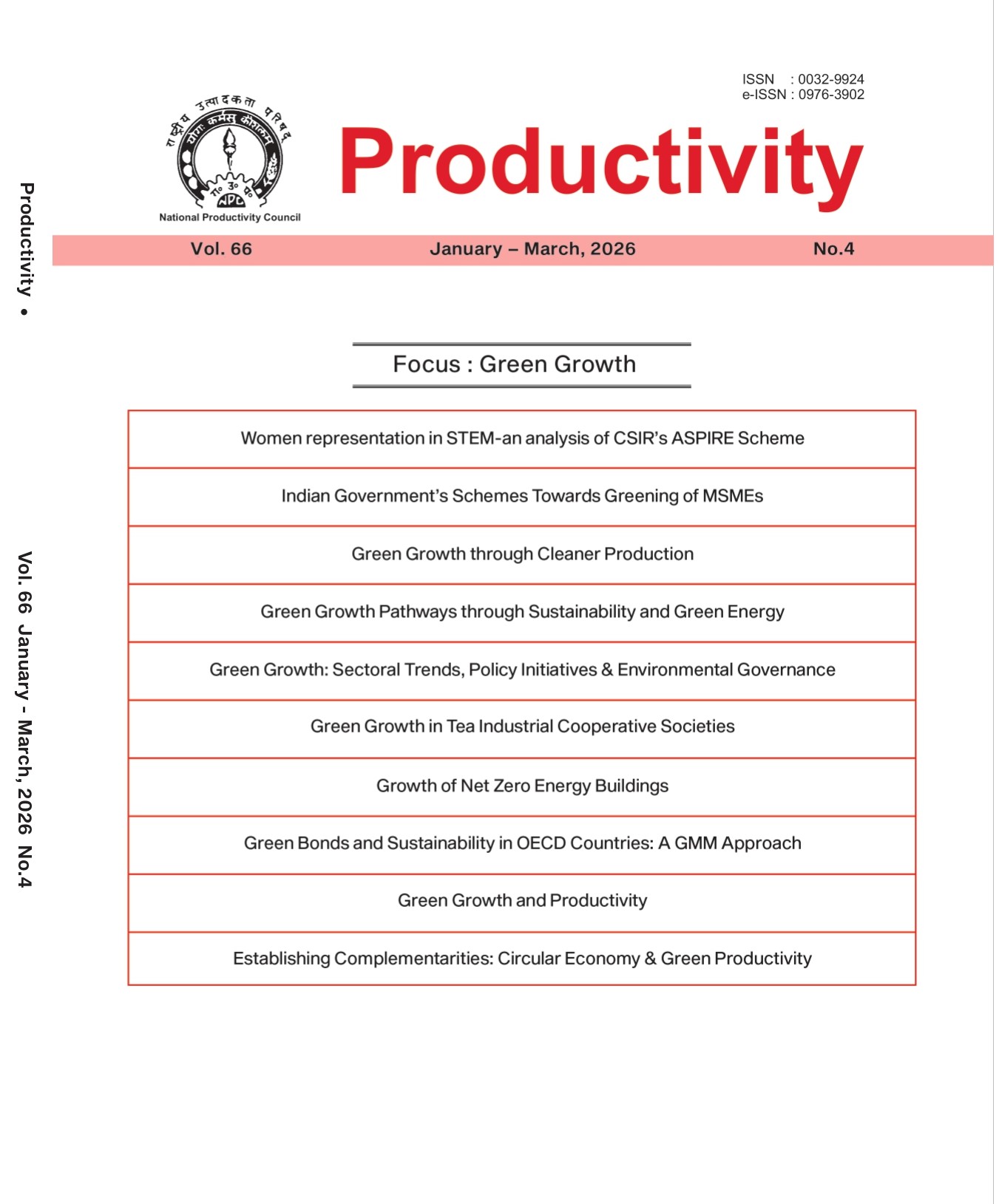
Women’s Representation in STEM: An Analysis of the CSIR ASPIRE Scheme for Women Scientists
By : Shweta Pant , S.A. Hasan
Page No: 375-387
Abstract
Sustainable development and green growth are dependent on STEM research as it plays a significant role in promoting environmental development and sustainability, driving innovation and building a green economy. STEM addresses issues like climate change, biodiversity, renewable energy, precision agriculture, green building designs, waste management, sustainable water systems, environmental impact studies and optimisation of processes through mathematical modelling. Even artificial intelligence (AI) is being used for environmental monitoring and studying the impact of climate change on the green economy. The Council of Scientific & Industrial Research (CSIR) has been focusing on green skill development and capacity building programs to create a skilled workforce for the green economy and promote sustainable practices across various sectors. Women have been contributing to STEM research for sustainable development and green economy the world over, including India. However, in India, their representation in this domain is low in spite of various schemes from multiple ministries/departments. Strenuous efforts are required to attract more women to science and engineering research by offering them competitive research grants with relaxed funding guidelines. The ASPIRE scheme of the CSIR was launched to strengthen women’s representation in research and put women power at the forefront of India’s growth journey in research and development. The response from women academics and scientists from all across the country was overwhelming. A considerable number of project proposals received had potential for technological advancement and novelty value and were approved for funding. More such efforts should be made to encourage women to participate in STEM research more vigorously so as their ratio in researchers could be raised and their contribution in sustainable development and green economy could be further enhanced.
Authors
Shweta Pant, CSIR-Human Resource Development Group.
S.A. Hasan, CSIR-National Institute of Science Communication and Policy Research, Delhi, India.
DOI: https://doi.org/10.32381/PROD.2026.66.04.06