


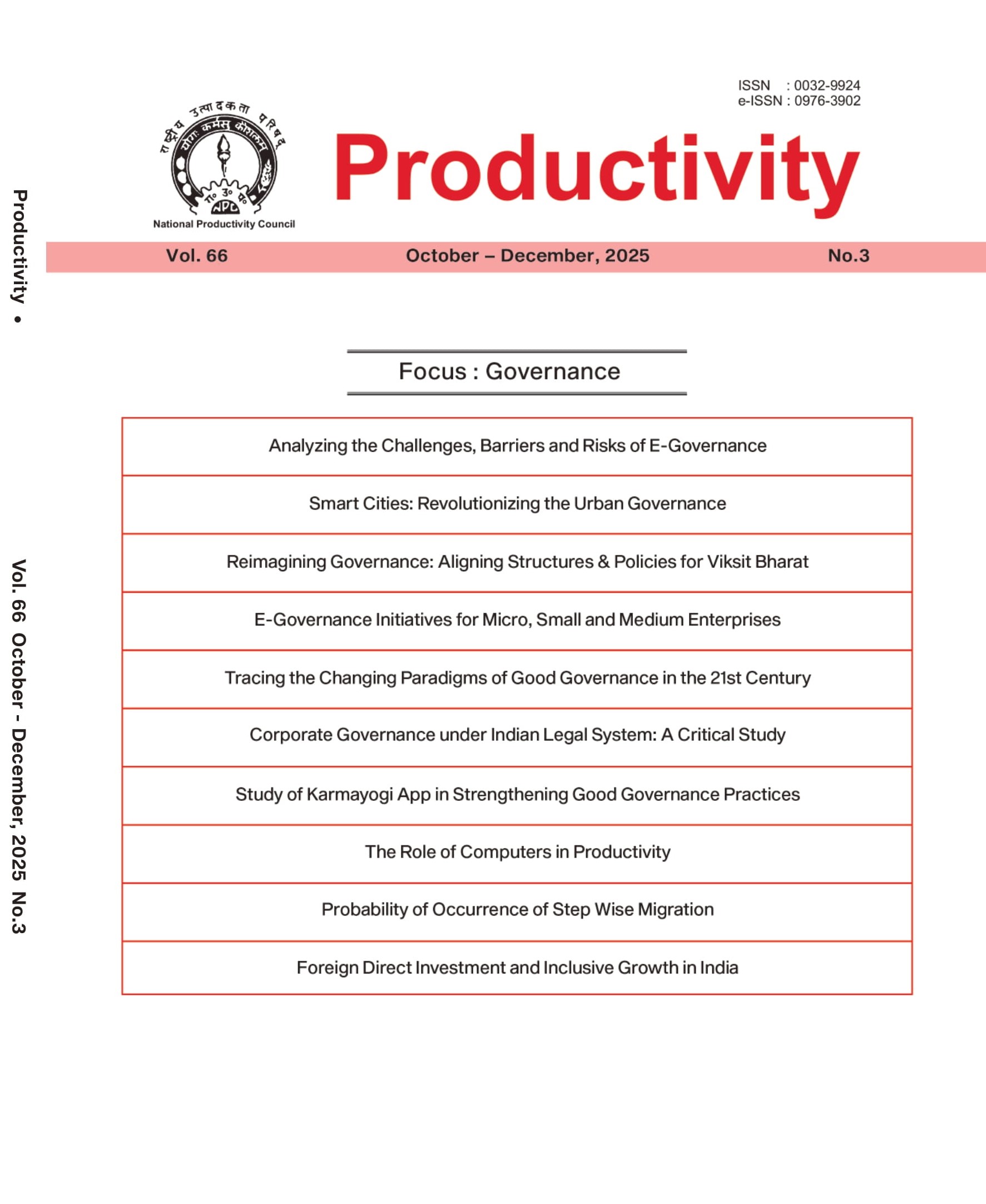

Productivity : A Quarterly Journal of The National Productivity Council
Published in Association with National Productivity Council
Current Volume: 66 (2025-2026 )
ISSN: 0032-9924
e-ISSN: 0976-3902
Periodicity: Quarterly
Month(s) of Publication: June, September, December & March
Subject: Economics
DOI: 10.32381/PROD
Digital Learning for Bureaucratic Reform: A Study of the Karmayogi App in Strengthening Good Governance Practices
By : Deeksha Chaurasia , Raju Boarkar
Page No: 282-291
Abstract
Governance in the twenty-first century is increasingly defined by transparency, accountability, efficiency, and citizen-centric service delivery. In India, the vast administrative machinery faces persistent challenges of capacity building, skill gaps, and outdated bureaucratic practices. To address these issues, the Government of India launched Mission Karmayogi: National Programme for Civil Services Capacity Building (NPCSCB) in 2020. At the core of this initiative lies the Karmayogi app, a digital learning platform designed to equip civil servants with role-based competencies, ethical orientation, and continuous learning opportunities. This research paper examines the role of the Karmayogi app in bureaucratic reform and its contribution to strengthening good governance practices. Drawing upon governance theories, administrative reforms, and digital learning frameworks, the study situates Mission Karmayogi within the global discourse on e-Governance and capacity building. Employing a qualitative and exploratory approach, it relies on secondary data, including case study analyses of selected central and state ministries and international parallels. The findings suggest that the Karmayogi app enhances bureaucratic efficiency by promoting continuous learning, transparency in training outcomes, and improved accountability in service delivery. It fosters competency development in leadership, ethical governance, and citizen responsiveness. However, challenges such as uneven digital infrastructure, resistance to change, and limited inclusivity persist. The paper concludes that integrating digital learning platforms into governance frameworks represents a transformative step for bureaucratic reform in India. Policy recommendations emphasise localised content, robust evaluation systems, and incentives for adoption to ensure the long-term success of Mission Karmayogi.
Authors
Deeksha Chaurasia, Assistant Professor, Department of Humanities, Science, Education and Research, Pandit Sunderlal Sharma Central Institute of Vocational Education, Bhopal, Madhya Pradesh, India.
Raju Boarkar, Section Officer, Pandit Sunderlal Sharma Central Institute of Vocational Education, Bhopal, Madhya Pradesh, India.
DOI: https://doi.org/10.32381/PROD.2025.66.03.07