




Productivity : A Quarterly Journal of The National Productivity Council
Published in Association with National Productivity Council
Current Volume: 66 (2025-2026 )
ISSN: 0032-9924
e-ISSN: 0976-3902
Periodicity: Quarterly
Month(s) of Publication: June, September, December & March
Subject: Economics
DOI: 10.32381/PROD
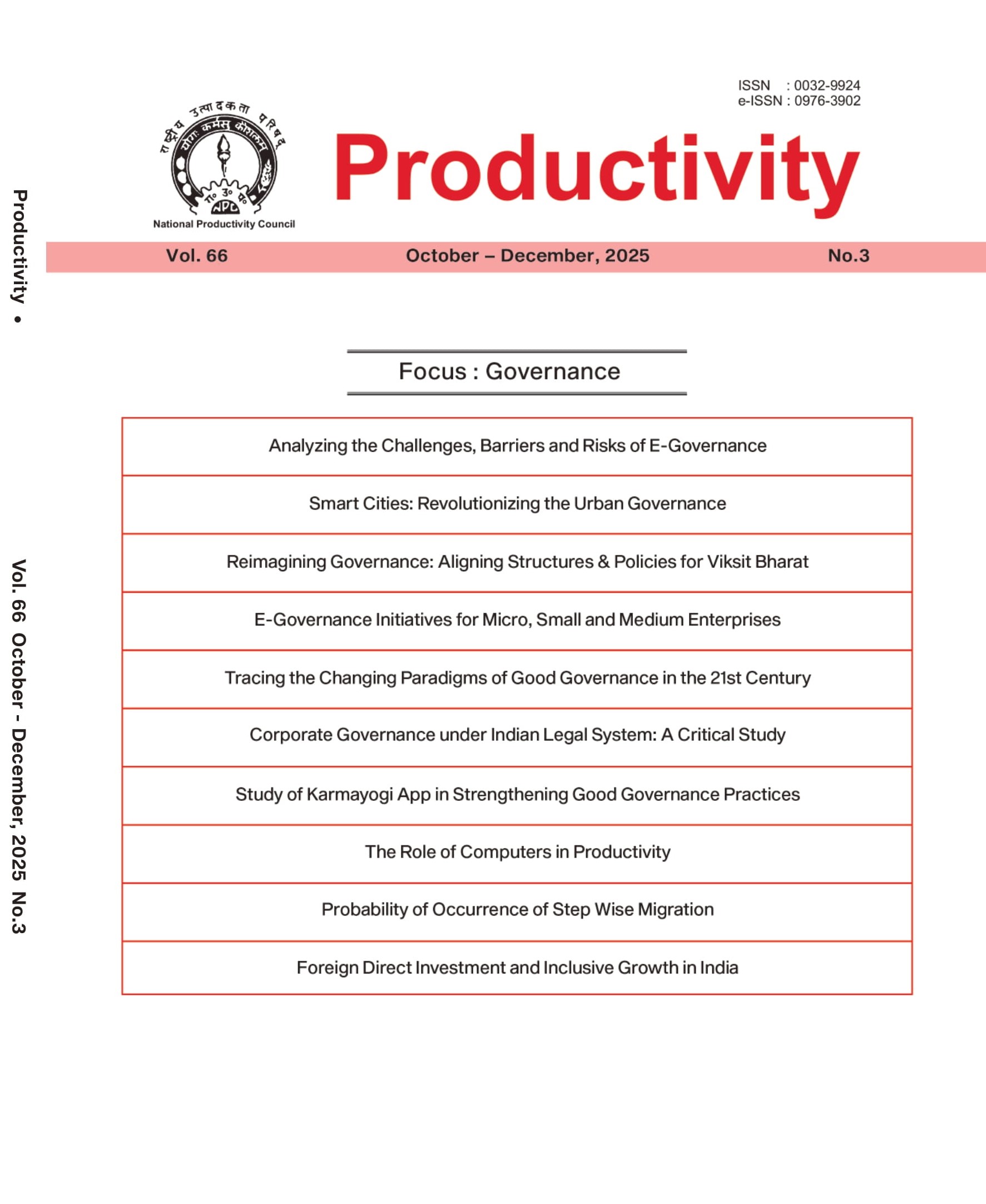
Corporate Governance under the Indian Legal System: A Critical Study
By : Qazi Mohammad Usman , Alam Musheer
Page No: 272-281
Abstract
Corporate governance, as a system for directing and controlling corporations, has gained increasing importance in the globalized economy, where transparency, accountability, and stakeholder protection are essential for sustainable growth. In India, the evolution of corporate governance has been shaped by a combination of economic reforms, corporate scandals, and judicial interventions, resulting in the development of a comprehensive legal and regulatory framework. The enactment of the Companies Act, 2013, introduced landmark provisions relating to board independence, corporate social responsibility (CSR), and disclosure requirements, while the Securities and Exchange Board of India (SEBI) has reinforced compliance through its Listing Obligations and Disclosure Requirements (LODR). These measures aim to strengthen investor confidence, safeguard minority shareholders, and align corporate practices with ethical and sustainable business models.This paper undertakes a critical study of corporate governance under Indian law by examining statutory provisions, regulatory guidelines, and judicial precedents that shape corporate behaviour. It further highlights the challenges faced in enforcement, such as superficial compliance, lack of accountability among independent directors, and the persistence of financial irregularities, as exemplified by scandals like Satyam (2009) and the IL & FS crisis (2018). The study also situates India within the global context, where governance models in the United States and the United Kingdom emphasize stricter enforcement and shareholder activism, while India has adopted a hybrid model that uniquely integrates CSR as a statutory obligation. By critically analysing the effectiveness of current laws and regulations, the paper argues that Indian corporate governance, though progressive on paper, often suffers from weak institutional enforcement and limited stakeholder participation. It suggests that reforms such as strengthening regulatory capacity, empowering whistle-blowers, and leveraging technology for transparency are essential for bridging the gap between legal mandates and corporate practice. Ultimately, robust corporate governance is not only vital for protecting investors and ensuring fair markets but also for advancing sustainable development in line with India’s broader economic and social objectives.
Authors
Qazi Mohammad Usman, Professor, Faculty of Law, Jamia Millia Islamia, New Delhi.
Alam Musheer, Research Scholar, Faculty of Law, Jamia Millia Islamia, New Delhi.
DOI: https://doi.org/10.32381/PROD.2025.66.03.06