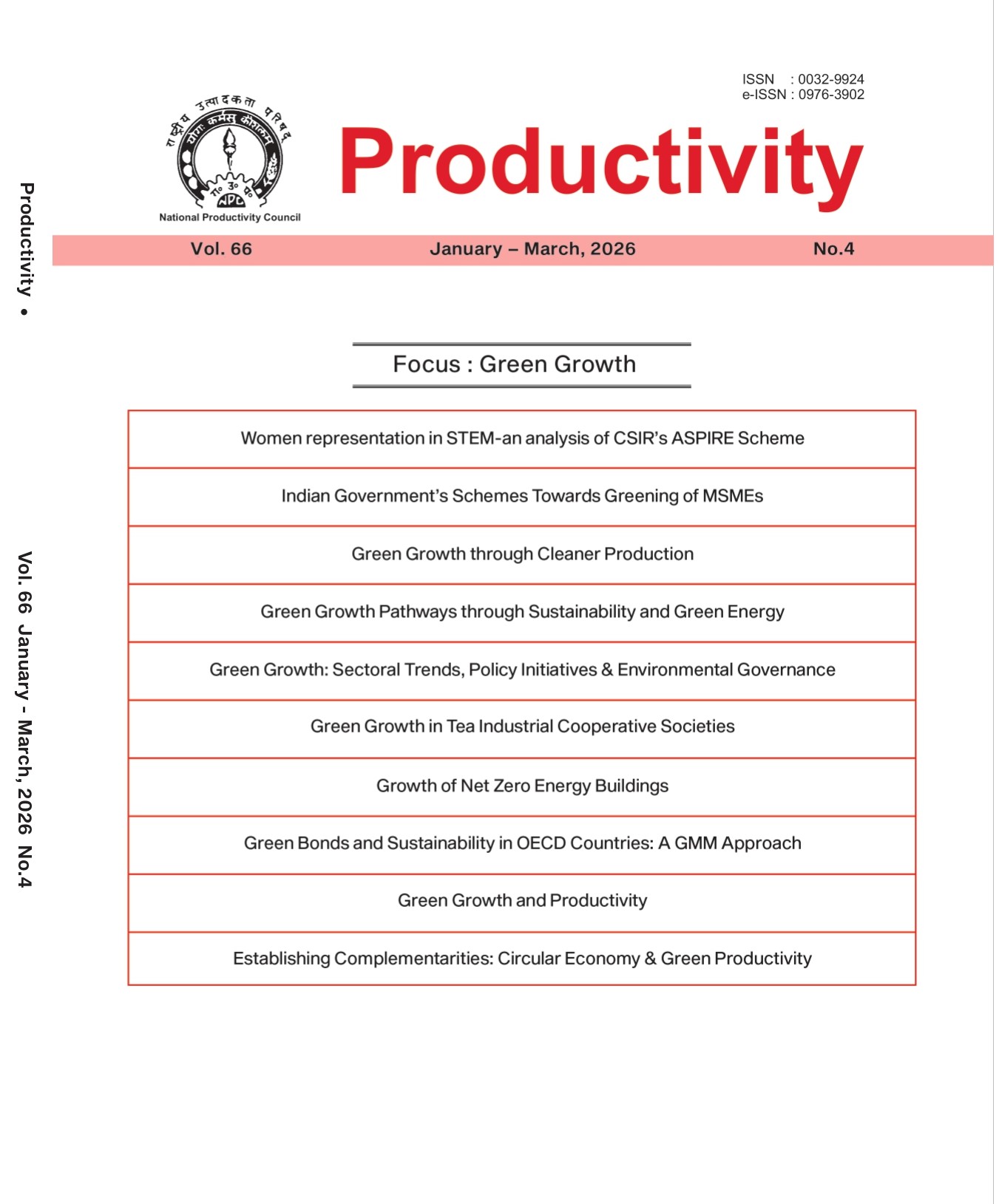

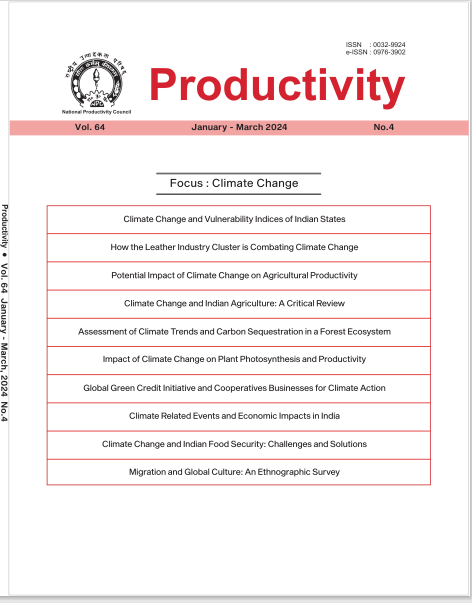


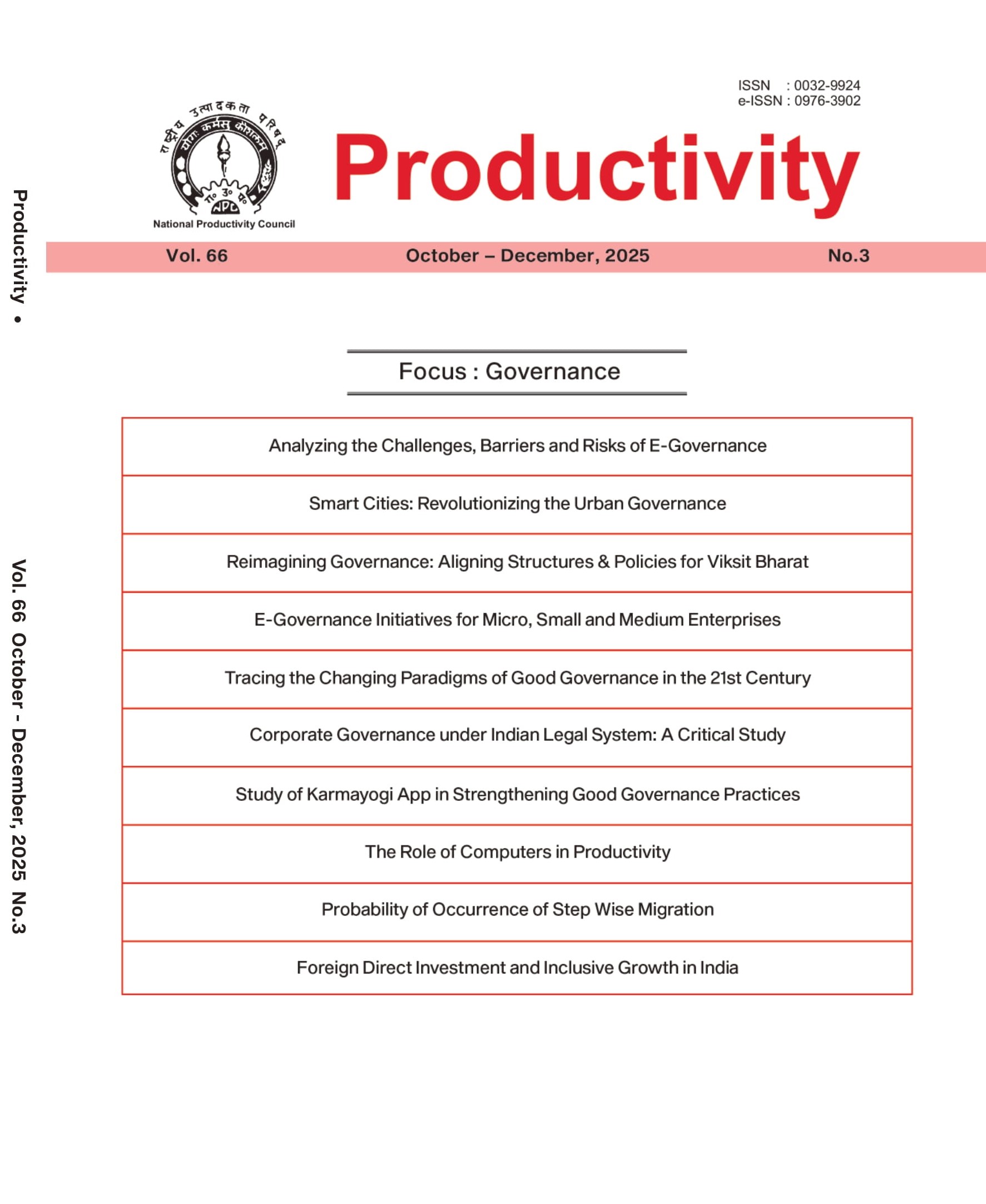

Productivity : A Quarterly Journal of The National Productivity Council
Published in Association with National Productivity Council
Current Volume: 66 (2025-2026 )
ISSN: 0032-9924
e-ISSN: 0976-3902
Periodicity: Quarterly
Month(s) of Publication: June, September, December & March
Subject: Economics
DOI: 10.32381/PROD
Assessment of Food and Nutritional Security in India: A Policy Perspective
By : Pramod Kumar , Adrita Dam , Srinatha T.N. , Anbukkani P. , Nithyashree M.L.
Page No: 63-74
Abstract
India’s food production and nutritional landscape depicts a complex interplay of progress and persistent challenges. Despite substantial increases in food grain production — from 50.83 million tons in 1950-51 to 328.85 million tons in 2023-24 — over 200 million Indians still struggle with hunger, exacerbated by starvation and droughts.This emphasizes the critical need for comprehensive food security measures. The per capita availability of foodgrains has improved, yet variability in pulse production and shifts in spending patterns reflect ongoing challenges. India’s performance on the Global Hunger Index, though improved from “Extremely Alarming” in 1990 to “Serious” in recent years, reveals persistent food security issues. The calorie and protein intake show improvements, but disparities and rising fat consumption highlight nutritional challenges. Food production and procurement have increased, but maintaining consistent buffer stocks remains crucial. India’s ranking on the Global Hunger Index has faced criticism from the government, with question raised on the representativeness of the data used. Despite progress in certain areas, the ongoing high levels of hunger and economic disparities indicate the need for sustained and enhanced efforts to ensure comprehensive food security and address malnutrition. Various government programs such as the Public Distribution System (PDS), Mid-Day Meal Scheme, and the POSHAN Abhiyan aim to address malnutrition. The government is emphasizing production, processing and consumption of millets. Steps are also being taken for the fortification of food and for reaching to the poorest of the poor through various government schemes. A number of climate resilient varieties are being developed and released by National Agricultural Research System (NARS) in order to stabilize food production by overcoming the challenge of climate change.
Authors
Pramod Kumar, Principal Scientist, Division of Agricultural Economics, IARI, New Delhi, India.
Adrita Dam, Research Scholars, Division of Agricultural Economics, IARI, New Delhi, India.
Anbukkani P., Senior Scientist, Division of Agricultural Economics, IARI, New Delhi, India.
Nithyashree M.L., Senior Scientist, Division of Agricultural Economics, IARI, New Delhi, India.
DOI: https://doi.org/10.32381/PROD.2025.66.01.8