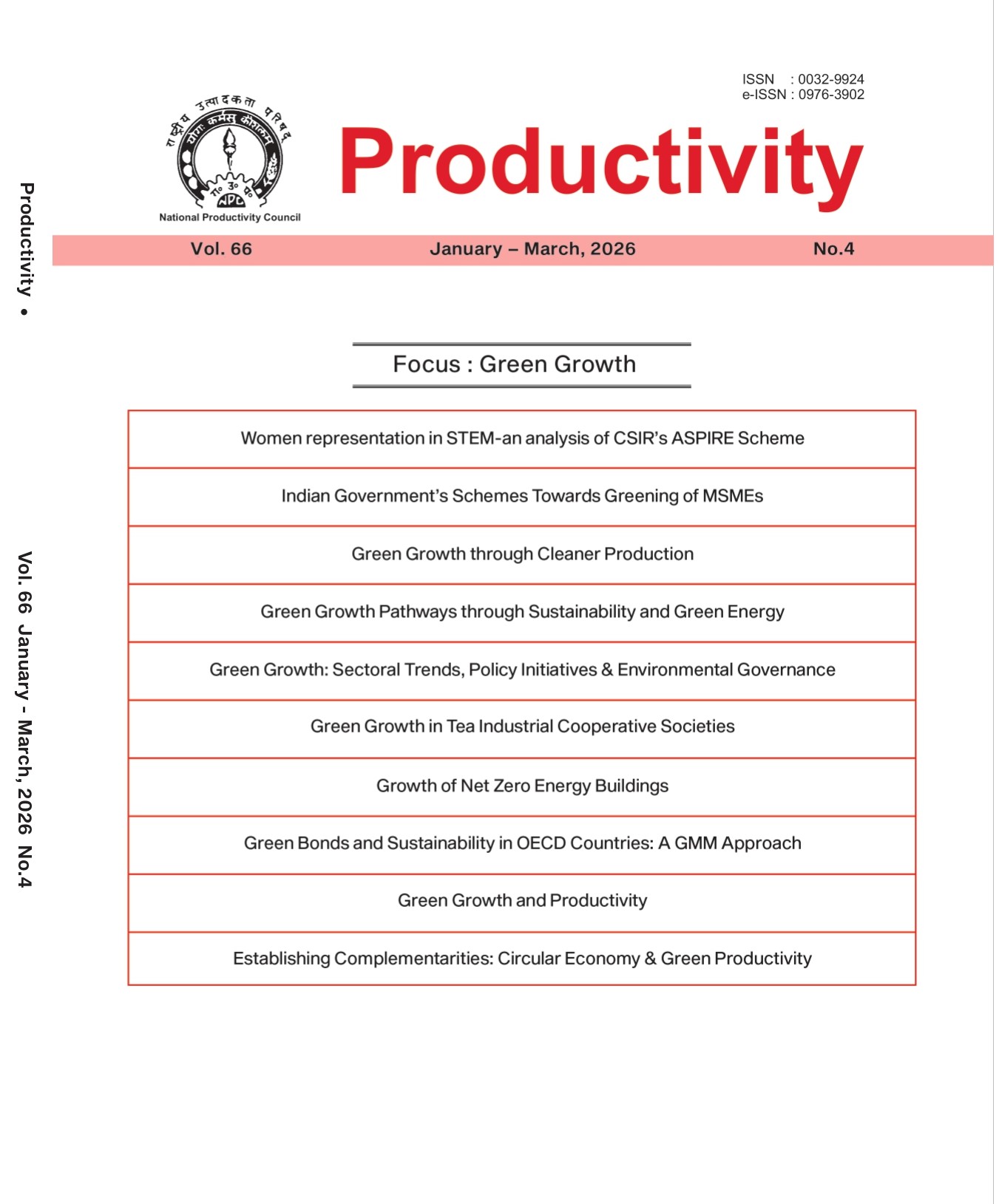



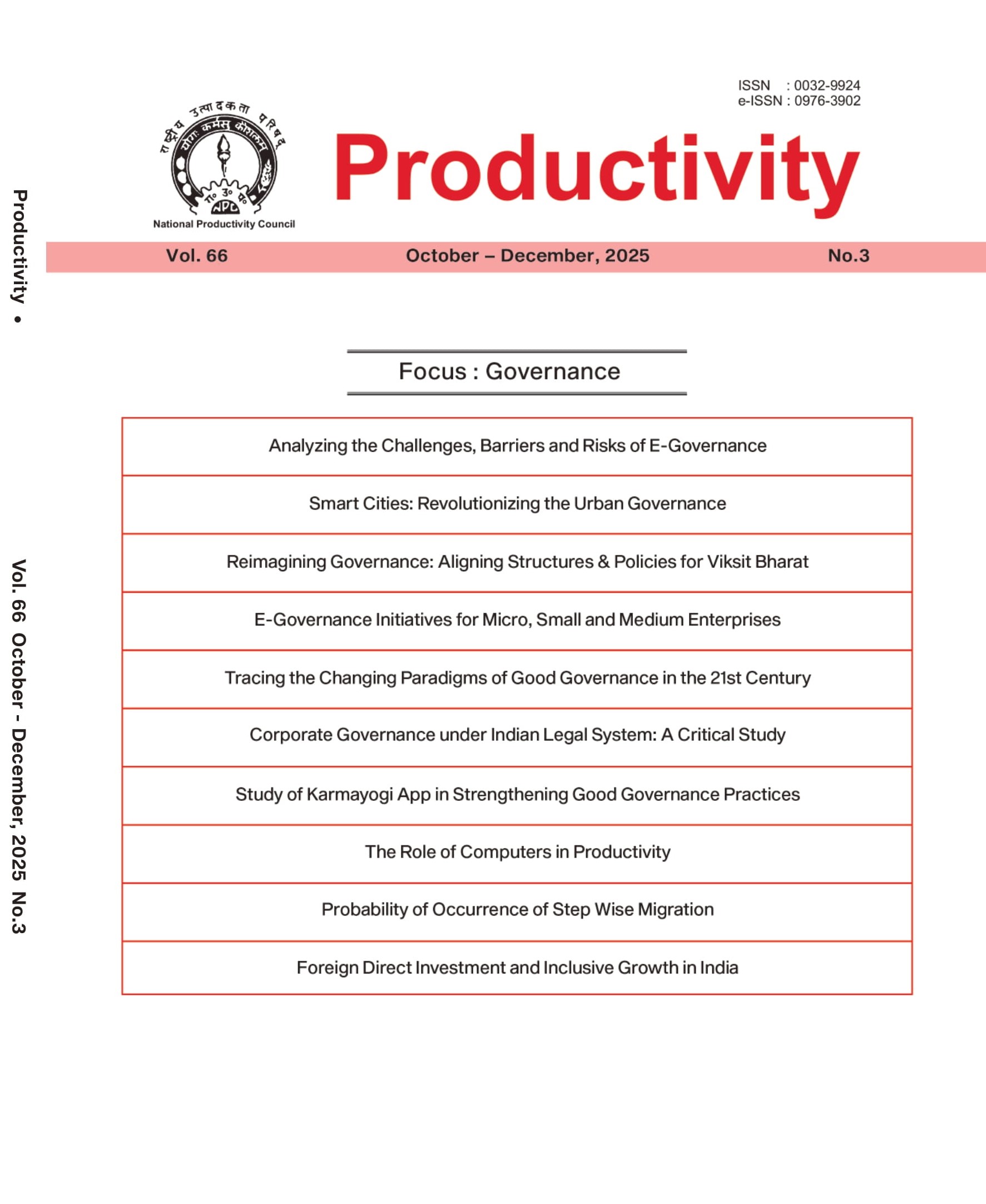

Productivity : A Quarterly Journal of The National Productivity Council
Published in Association with National Productivity Council
Current Volume: 66 (2025-2026 )
ISSN: 0032-9924
e-ISSN: 0976-3902
Periodicity: Quarterly
Month(s) of Publication: June, September, December & March
Subject: Economics
DOI: 10.32381/PROD
Unravelling the Determinants of Domestic Savings in India: An ARDL Approach
By : Suresh Kumar Patra , Rajiv Kant Yadav , Saurabh Kumar
Page No: 118-132
Abstract
The Indian economy has undergone substantial changes in the post-reform era, marked by a shift towards greater market orientation in policy and notable macroeconomic progress, including the development of a diverse financial market and increased global integration. Recognizing the pivotal role of domestic savings in fostering capital accumulation and supporting sustained economic growth, there is a pertinent need to reassess the factors influencing savings behaviour within this altered economic landscape. Against this backdrop, this study empirically examines the determinants of domestic savings in India using the latest available data. Employing the ARDL approach, which is well-suited for modeling equations involving both stationary and nonstationary variables of order I(1) and addressing potential endogeneity issues, the findings indicate that GDP, financial development, age dependency, inflation, fiscal deficit, real interest rate, and net barter terms of trade exert statistically significant influences on domestic savings in both the short and long term. In terms of policy implications, maintaining price stability and ensuring continuity in the growth trajectory are recommended strategies for bolstering savings and perpetuating the symbiotic relationship between savings and economic expansion in India. Further, through increasing economic development and income levels, policies like export diversification, trade barrier reduction, and competitiveness enhancement that aim to improve the net barter terms of trade can have a favorable effect on domestic savings.
Authors :
Suresh Kumar Patra : Assistant Professor, Department of Economics, Central University of Rajasthan, Ajmer, India.
Rajiv Kant Yadav : Department of Economics, School of Social Sciences, Central University of Rajasthan, Kishangarh, Ajmer, Rajasthan, India.
Saurabh Kumar : Assistant Professor, Department of Statistics, Central University of Rajasthan, Kishangarh, Ajmer, Rajasthan, India.
DOI: https://doi.org/10.32381/PROD.2024.65.02.2