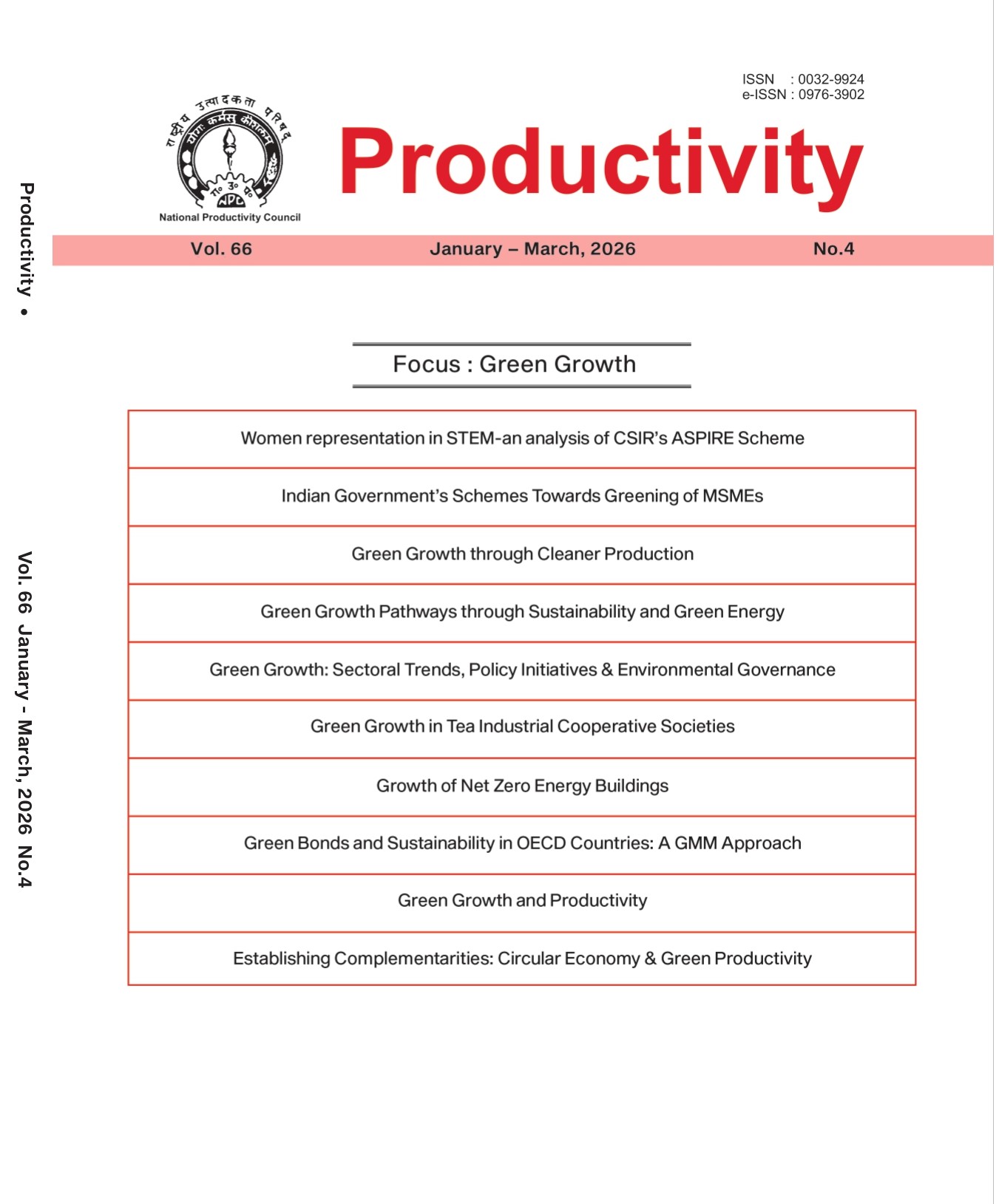



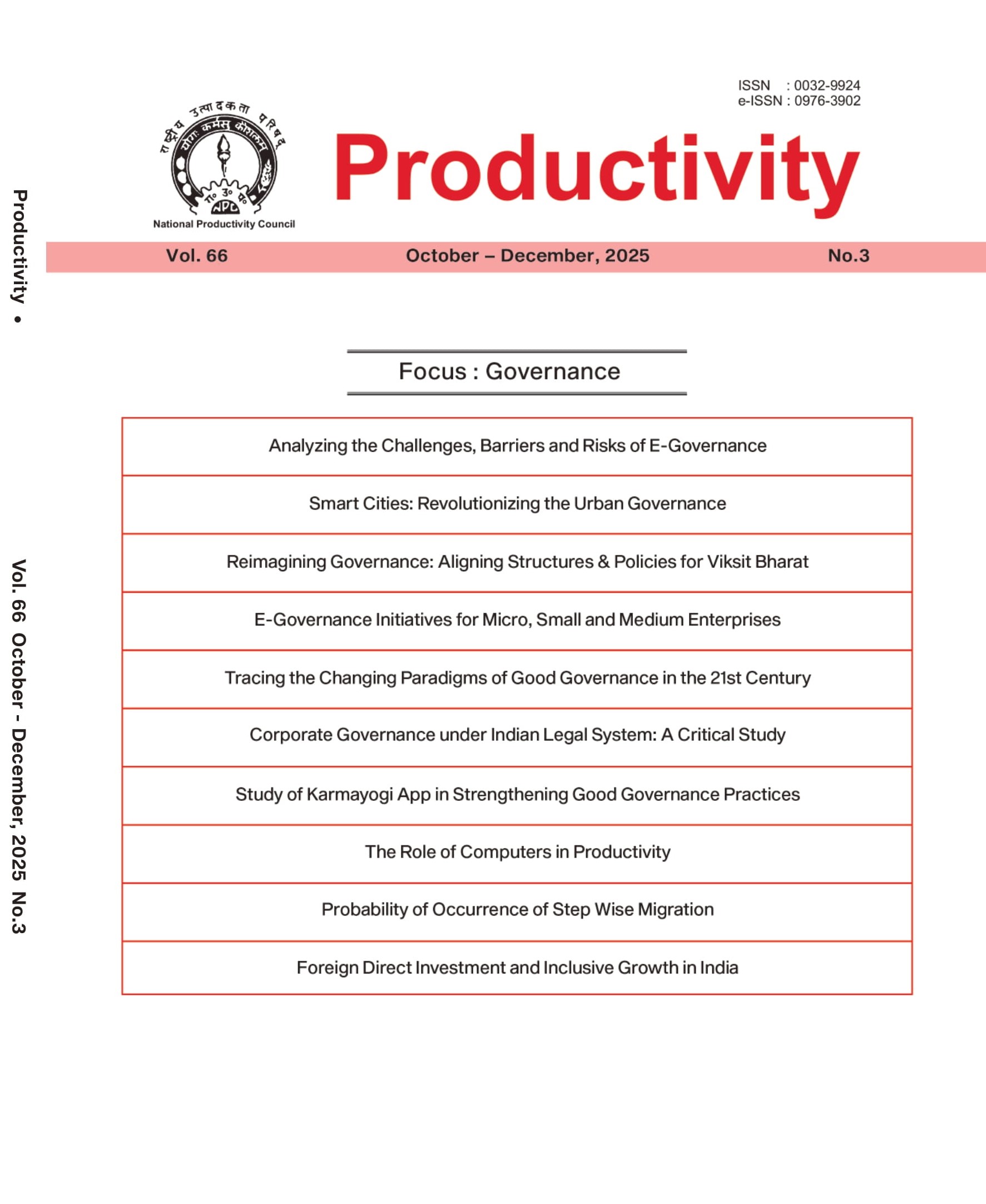

Productivity : A Quarterly Journal of The National Productivity Council
Published in Association with National Productivity Council
Current Volume: 66 (2025-2026 )
ISSN: 0032-9924
e-ISSN: 0976-3902
Periodicity: Quarterly
Month(s) of Publication: June, September, December & March
Subject: Economics
DOI: 10.32381/PROD
Reusing Fractions of Legacy Municipal Solid Wastes in India: A Circular Economy Approach
By : Richa Singh , Bakul Rao , Krishnanand Maillacheruvu , Shyam R. Asolekar
Page No: 227-238
Abstract
Management of the so-called legacy wastes (i.e. aged wastes) is one of the challenging tasks faced by developing nations including India. Such sites are often those locations where fresh wastes are not brought because the sites are fully packed and inoperable. The un-scientific operations at those abandoned dumpsites have led to various long term challenges such as ground and surface water pollution, air pollution, dumpsite fires, and on-site scavenging - which have been periodically creating massive threats to public health. This paper focuses on management of legacy wastes by adopting feasible, affordable, and environmentally sound technological options aimed at recovery of the maximum possible resources and also generate energy from the combustible waste fractions obtained from mining of these dump sites. The study envisages the need of integrating the circular economy approach with sustainable waste management in India by utilizing waste fractions for gainful applications and ensuring that negligible amount of waste is ending-up into the dumpsites or landfills. It is hoped that this study will serve two purposes, i.e., energy and land recovery by scientific and systematic management of the combustible and inert fraction of the legacy wastes and conversion of reclaimed land to scientific landfills by installing composite liner system for a sustainable landfilling practice. As an add-on, the reclaimed land can also be sold or used for any other purposes after satisfying the adequate fit-for-use criteria for the specific application.
Authors :
Richa Singh : Environmental Science & Engineering Department, Indian Institute of Technology, Bombay, Mumbai
Bakul Rao : Centre for Technology Alternatives for Rural Areas, Indian Institute of Technology Bombay
Krishnanand Maillacheruvu : Civil Engineering and Construction, Bradley University, Peoria, USA
Shyam R. Asolekar : Environmental Science & Engineering Department, Indian Institute of Technology, Bombay, Mumbai
DOI: https://doi.org/10.32381/PROD.2019.60.03.1