




National Security
Published in Association with Vivekananda International Foundation
Current Volume: 9 (2026 )
e-ISSN: 2581-9658
Periodicity: Quarterly
Month(s) of Publication: Mar, Jun, Sep & Dec
Subject: Political Science & International Affairs
DOI: 10.32381/NS
Online access is free for the Research Faculty of VIF
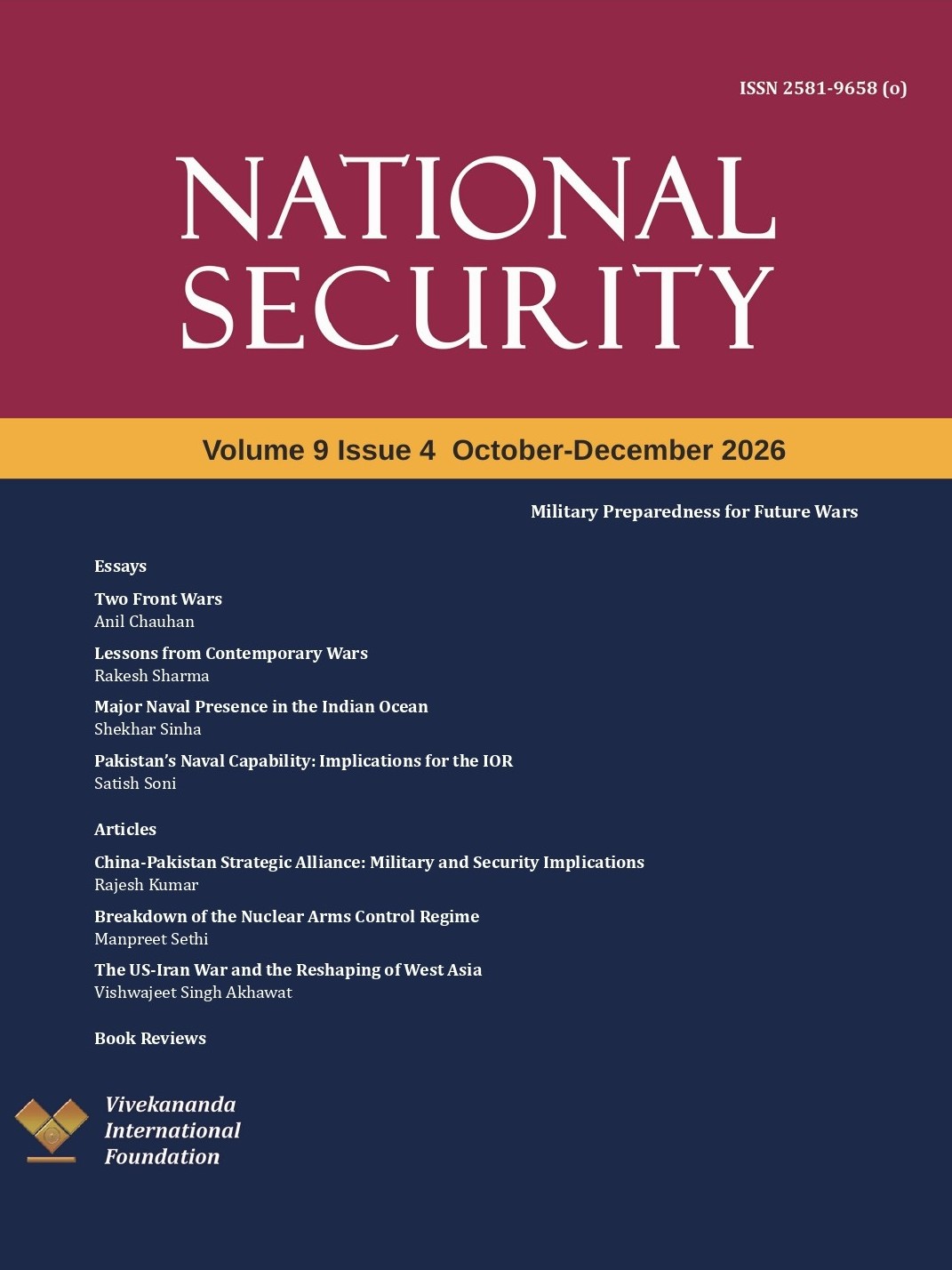
Pakistan’s Naval Capability Build-up and its Strategic Implications for the Indian Ocean Region
By : Satish Soni
Page No: 544-556
Abstract
South Asia’s maritime domain has emerged as a theatre of heightened strategic interest in the twenty-first century, shaped by increasing economic interdependence, critical energy security imperatives and geopolitical contestation within the Indian Ocean Region (IOR). Against this evolving backdrop, the Pakistan Navy has, over the past decade, pursued a sustained and calibrated modernisation programme aimed at enhancing its maritime deterrence posture. This force development trajectory encompasses the induction of advanced submarines, frigates, corvettes, long-range maritime surveillance platforms and precision-guided missile systems, enabled by a deepening strategic cooperation with China’s People’s Liberation Army (Navy) and Turkey. The underlying objectives of this naval expansion are to secure vital sea lines of communication, protect maritime approaches linked to the strategically significant Gwadar Port and position Pakistan as an increasingly relevant stakeholder in the evolving geopolitical and security architecture of the Indian Ocean. This essay examines the principal dimensions of Pakistan’s naval modernisation effort and assesses its wider strategic implications for regional maritime stability, deterrence dynamics and the balance of power in the Indian Ocean littoral.
Author
Vice Admiral Satish Soni (Retd.) is a former Deputy Chief of Naval Staff and has served as the Chief of Staff, Eastern Naval Command, Flag Officer Commanding-in-Chief of Eastern as well as Southern Naval Commands, among other senior appointments in the Indian Navy.
DOI: http://doi.org/10.32381/NS.2026.09.04.4